A Conversation with pastel artist and muralist, Deborah Shea
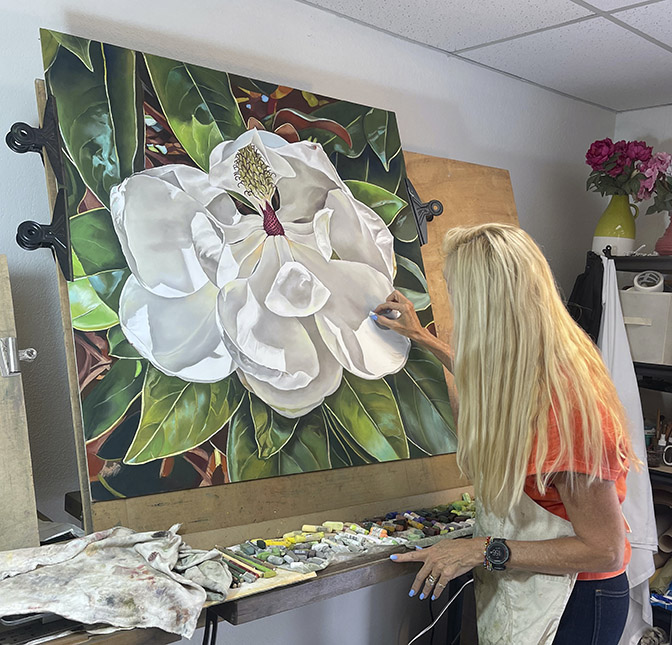
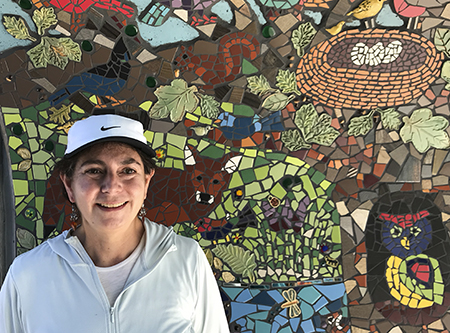
Deb Shea is a visual artist of floral wonder. Shea, a colorist currently working primarily with pastels, studied art and design at UC Davis where she began a career as a graphic designer. Shea worked in design and branding for many years before focusing her attention on her own art practice, which includes pastels, fiber arts, and public art murals. We conversed, with intermittent laughter, in her studio at Art Bias and then visited her solo exhibition, From Bud to Bloom, in the Art Bias Gallery.
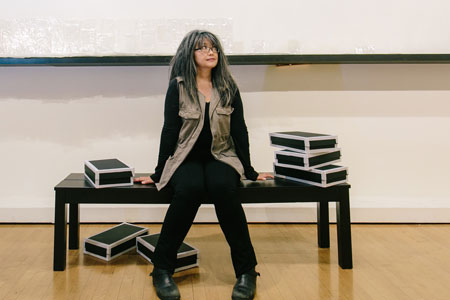
Deb Shea at work in her studio at Art Bias in San Carlos, California.
Nanette: Tell me about your background.
Deb: I studied studio art with Wayne Thiebaud and Roland Peterson. They were great. Thiebaud was an especially wonderful professor, and a very wonderful painter and colorist. I really enjoyed that quite a bit.
I had to work while in school to support myself. I had a scholarship and worked as a graphic designer to pay for my education. I did graphic design for several different agencies in the college: the newspaper, posters for Arts and Lectures, all that kind of stuff. I took that up as my career after I finished school. I was hoping to go to San Francisco Art Institute for graduate school, but I never had enough money. I was paying off my student debt for quite a while. So, I became a designer! I worked for a while in Sacramento, then I moved to San Francisco. I continued to be a designer, then an art director, and then a creative director.
I moved from San Francisco to the peninsula about 30 years ago. I worked for two or three software companies as a creative director. One was based in Oslo, so I was traveling to Norway quite a bit, and two other software companies. I had my own marketing business for about ten years. I was doing artwork as well but primarily designing, illustrating and branding—a lot of branding and identity work, for many kinds of companies.
Then the recession hit in 2008. So, my business really suffered after that. Marketing budgets kind of go by the wayside when you have a real economic crisis.
I started to work full time for a client for about five years. Being a creative director and doing all the illustration and design work for all their packaging.
Nanette: Was that Pamela’s?
Deb: That was Pamela’s. I worked for Pamela for about 25 years altogether. I first started freelancing for her when my daughter was born, and then slowly but surely, her company grew and grew. When I first met her, it was just her and her warehouse manager. So, we went through a lot together! After some years, I had enough of working for a small company and a lot of deadline pressure that was very stressful.
Then I had a bit of a health scare. I got over that but decided it was finally time to dedicate myself to my art full time.
Nanette: Were you engaged in your own personal artwork while you were having a design career?
Deb: I was.
Nanette: Has it always been pastels?
Deb: No. Previously I did a lot of acrylic work and collage work. I did take some courses at the Art Institute in San Francisco. It was wonderful. I did a lot of very large oil paintings and acrylic paintings in those classes.
Nanette: But now you work primarily in pastels?
Deb: Yes primarily. It’s a medium that I started working with for my illustration work, because a client was looking for an artisan feel to the packaging design. So, I started to do pastel drawings. My employer was paying for all my supplies. They said, “Buy anything you want.” That was great, because I got to use really nice stuff. Then I had deadlines, of course. So, I learned to really dive into the medium. I was enjoying it very much, too. That was fun.
Nanette: What is it about pastels that engages you?
Deb: I got some pastels from my grandfather went I was very young. I’ve always been very comfortable in drawing. I really, really enjoy the emotional quality of drawing. I think that was one of the reasons why I kept up with my artwork while I was a designer. There was such a great emotional attachment to touching things rather than working on a computer. I also love to do things in textiles, like knitting, and crocheting, and felting, and that kind of stuff, working with the paper flowers. . . I love making things. So, pastels, I’ve always loved their quality, the velvetiness of them, and the super beautiful colors.
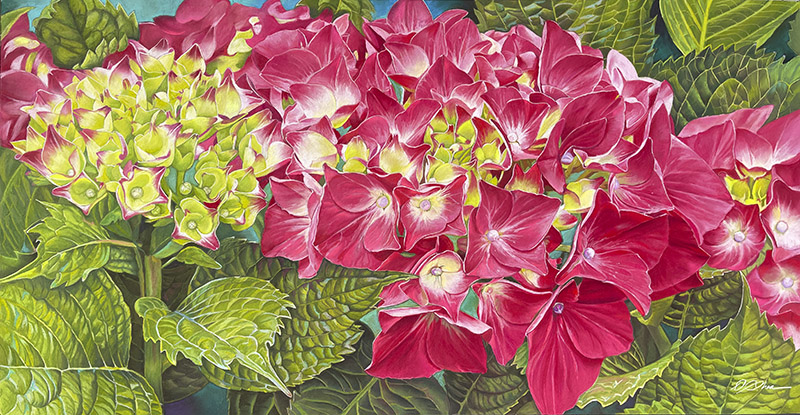
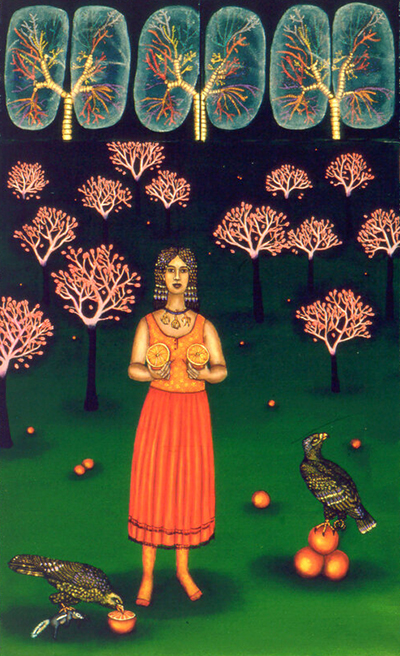
Love at First Sight, pastel on board, 28″ x 54″ by Deb Shea, 2026
Nanette: The tactile thing—do you feel like you can get your hands into the pastels more than you can with paint?
A Conversation with Katherine Bazak by Sharmon Hilfinger
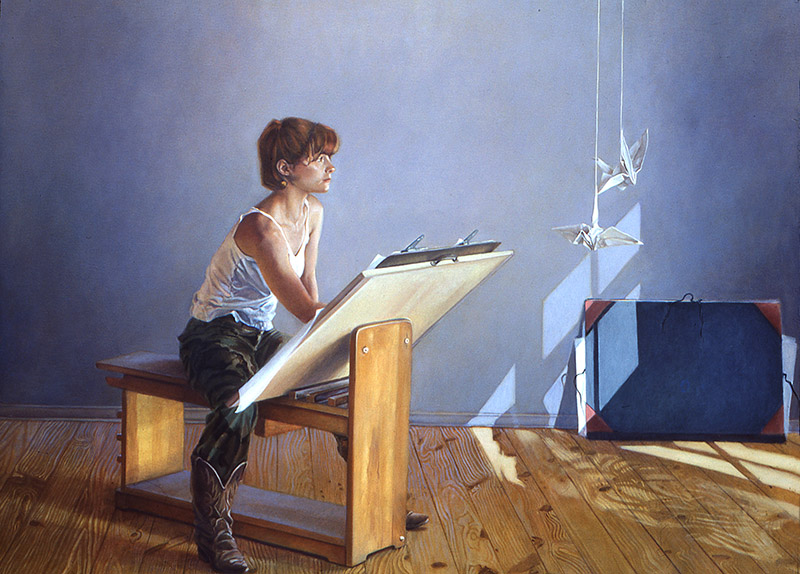
Katherine and I were introduced to each other by a mutual friend over 30 years ago, when we were both establishing our creative careers while starting our families. Kindred spirits working in different métiers, we have shared our experiences as creative artists ever since. Her exquisite painting of Lucy Drawing graces our dining room and never fails to draw comments from people who see it for the first time.
Sitting down now, so many years later, to talk to Katherine about her career as a figurative painter and teacher has been a fantastic lesson in how to look at art. Talking with Katherine is like going on a tour of the painter’s process, exposing how the materials, color and composition reveal the artistic intent. She reminds us that great artwork is not accidental; it is deeply understood and performed by its creator. Katherine is exceptionally articulate with her paintbrush as well as with her ruminations on art and how it works.
Lucy Drawing, Oil on canvas, 52″ x 72″ by Katherine Bazak, 1984–85
Sharmon: You and I grew up in the 1960’s and 70’s when the art trends were Conceptual Art, Minimalism, Pop Art, Psychedelic Art. But you have always been a figurative painter—a very fine one, I might add—so I am curious to know what influences and training led you to your personal style of painting.
Katherine: My visual education started at an early age. On Sundays, my father would leave my brother and me on the steps of the National Gallery in Washington DC at 9:45 a.m. before he would go to the golf course about 15 minutes away. We sat on the steps until the Gallery opened—nobody was worried about us, there were guards who knew us. This started when I was 10 years old. I wandered around the museum while my brother sat in rooms that had paintings of boats and read a book.
One of the first paintings I loved was by Mary Cassatt, a girl with a braid in a white outfit, and another Cassatt of a little girl in a blue chair. Another favorite was by John Singer Sargent called Repose. I spent a lot of time in the room with the Vermeer’s. I remember the painting of a woman with a beautiful jewel-like red hat.
I loved the Titian room! The Portrait of Farnese with the pink vest, Venus Holding an Apple, Venus and Adonis, the Portrait of the Doge—those paintings have been with me my whole life. There is something going on in those paintings—something behind the eyes of the people he painted. I could just look at those and know that the painting of Titian’s Doge was better than the other Doges in the room.
At that age I had no idea who these painters were! But by the time I left high school I had walked through every room at the National Gallery. For a visual person this was heaven.
Every once in a while, we would go to the Phillips Gallery that has a big pre-and-post Impressionist collection. That’s where I saw Renoir’s Boating Party. Some hear the name Renoir and think of peachy-pink people. I mean old ladies love Renoir. In the Boating Party—they’ll say, “he painted the light” which is a cheesy thing to say, but he did! When you see the Boating Party you can feel the wind, you can feel the sunlight. It’s a very evocative painting. It took me a long time to understand and respect this aspect of representational painting.
There are paintings that I just want to stand in front of and spend time looking at or revisit. Why do certain paintings interest me? I’ve thought about that a lot and now looking back, I realize that I have always been a ruminator. I love the way some paintings offer me a way to ruminate. All my paintings have something to do with that.
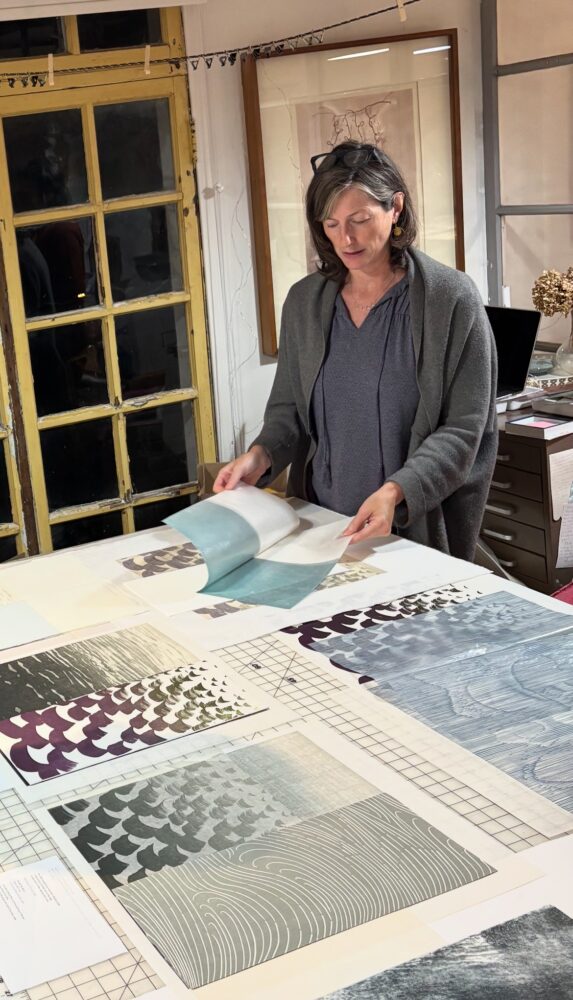
Macy Chadwick is the founder and director of In Cahoots Residency in Petaluma, California. Macy is remarkable as a creative residency host in part because she is exceptionally personable with a wonderful gift of giving a story, often with unpredictable humor and resulting laughter. Her own work as a printmaker and book artist is visually poetic and imbued with a sensitive essence of personal reflection. We talked about her work and the running of In Cahoots while sitting under a large oak tree on the residency grounds.
Macy Chadwick in the studio. Photo: Edie Overturf
Nanette: How did you come to art?
Macy: When I was little, I loved all kinds of art, and my mom really encouraged it. I took some after school art classes starting in third grade and continued with that until high school. In order to take the advanced art classes in high school, I had to commit to being an art major in college because the goal of the advanced art classes was to help you prepare a portfolio to apply to college. So I said, yeah, I’ll be an art major in college. Then I decided I really did want to do that. I pursued my BFA, but I was never one of the artsy kids. I didn’t have purple hair or tattoos, still don’t. But I was definitely one of the creative kids, and art has always been a big part of my life.
Nanette: How did you get into printmaking and book arts?
Macy: In undergrad, I was an Illustration major and I never really loved it. I had loved drawing in high school, because that was just what we were offered. In college, I started taking printmaking classes to do my illustrations and then I realized I was actually more interested in making prints about my own ideas and concepts than I was in illustrating other people’s ideas. So, I ended up being a double major in Illustration and Printmaking.
This was at Washington University in St. Louis. I was very interested in putting my prints into a sequence. At the time, they didn’t have book arts there, so I went to the library and checked out the Japanese Stab Binding book—the one with the green cover. I don’t know why, but that’s the only book on book arts techniques that every library seems to have. So, I learned stab binding, and I taught myself a couple of other bindings in undergrad.
Between undergrad and grad school, I took Book Arts classes at Oregon College of Art and Craft with Barb Tetenbaum. It was from Barb that I learned the foundation of everything I know about book arts and letterpress printing. I’ve learned more over the years, but Barb taught me so much. As happens with your first teacher—you still reference what they taught you, and who they admired. Barb admired Tim Barrett, Hedi Kyle, Patty Scobey, Julie Chen, and Gary Frost. So, I still admire all those people, and others, too. I continued to study Book Arts and Printmaking in grad school and then I learned more when I moved to Berkeley to work for Julie Chen.
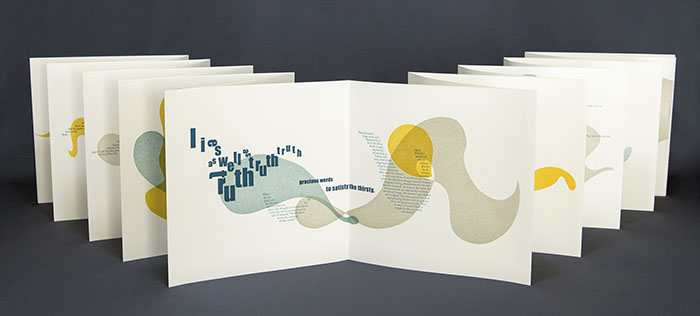
Meanwhile by Macy Chadwick, Limited edition artist book: Letterpress, relief printing; accordion structure in half-clamshell box. Edition of 40, 2017. Photo: Bernhard Uhl
Nanette: When was that?
Macy: I moved to Berkeley in 2003. I had graduated from Wash U in 1994. The rest of the nineties I lived in Portland, Oregon. I studied with Barb at the Oregon College of Art and Craft, which has since closed. Then I went to grad school at the University of the Arts in Philadelphia, from 2001 to 2003. UArts closed recently as well.
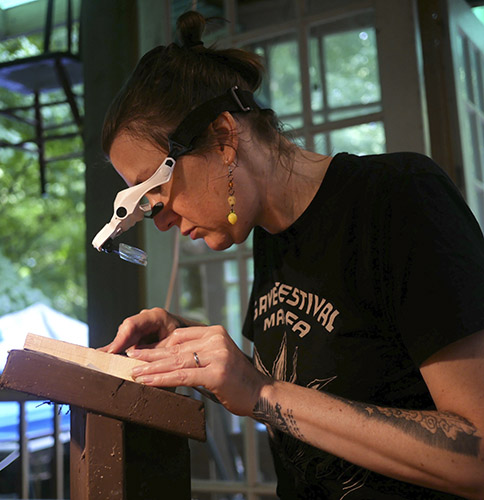
Rebecca engraving at Jim Horton’s studio in Ann Arbor, Michigan. Horton gave Rebecca her very first lessons in wood engraving in 2013. Photo: Tony Drehfal, another master wood engraver.
Rebecca Gilbert is a printmaker’s printmaker—impressively knowledgeable about printmaking history, and historical and contemporary print processes. Rebecca astounds with her joyful commitment to a seven year long project based on Hans Holbein’s Dance of Death. Rebecca’s own dance demonstrates an insightful perception of humanity delivered with generosity, depth, and a fresh lightness of the creative spirit.
This conversation took place under a large oak tree during a summer printmaking residency at In Cahoots Residency in Petaluma, California.
Nanette: How did you come to art?
Rebecca: I pretty much always wanted to be an artist. Since elementary school at least. And I was actually just thinking about this the other day. I met my best friend in elementary school, Bobby Riefsnyder, on the first day of kindergarten. We would play together every day after school. I would pretend that I was an art teacher and he would pretend to be a music teacher. We probably played that every day for a couple of years, and it never got old, so I feel like I always knew I wanted to be an artist and I always knew I wanted also to be an educator. Even then, I thought of those as two different things that you could merge into one, and they are two totally different sets of skills. When I went to college, I started as an art education major, because that seemed like the most obvious way to pursue both. I don’t know what art education programs are like now, but at that time, I found that learning about art and making art weren’t very important in that major. All of the focus was on teaching, and art barely even felt secondary, so I changed my major to printmaking.
Nanette: As an undergrad?
Rebecca: As an undergrad, yes.
Nanette: And why printmaking? They actually had a printmaking major?
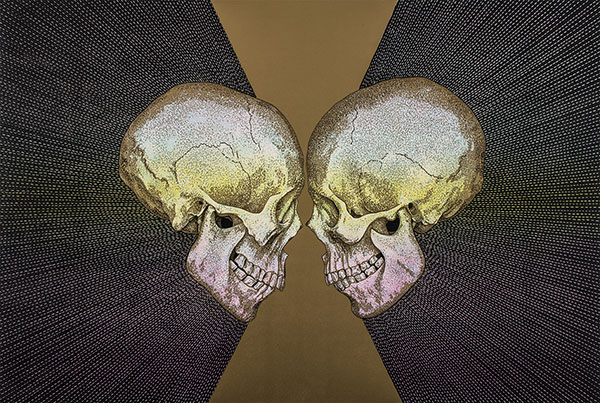
Memento Mori (Skulls) by Rebecca Gilbert, Reduction and multiple block color woodcut, 26.25″ x 37.5″, 2019
Rebecca: Yes. I made my first print in high school. It was a monotype. I was thinking about this recently, too. I forgot that monotype is what made me fall in love with printmaking. I was hooked after the very first one, and I very rarely make monotypes these days. My high school had one little press that they would wheel out of the closet every now and then so we could make some prints, and I loved it.
In college, I had taken a bunch of printmaking classes, even as an education major. Besides the process involved in making a print, I just love all the tools and gadgets and presses, and all the printmakers seemed a little dangerous, edgy.
Nanette: More edgy than the other artists?
Rebecca: Yeah, yeah. [laughs]
That was part of what initially drew me to it. There’s such a long list of everything that I love about printmaking that keeps me drawn to it now.
Nanette: So, you were a printmaker right off the bat?
A Conversation with printmaker Christopher Hartshorne
During the summer of 2025 Christopher Hartshorne and I worked directly across from each other, at a printmaking residency at In Cahoots Residency in Petaluma, California. We were each at lovely large etching presses where daily I found myself appreciating the gift of being able to observe his process of pulling richly beautiful, futuristic moons—a memorable highlight of my own residency experience.
When we noticed the local blackberries were in and ripe, Chris picked a bunch to bake us a blackberry crumble. It was almost as delicious as Chris’ prints.
This conversation took place towards the end of our residency in the etching studio.
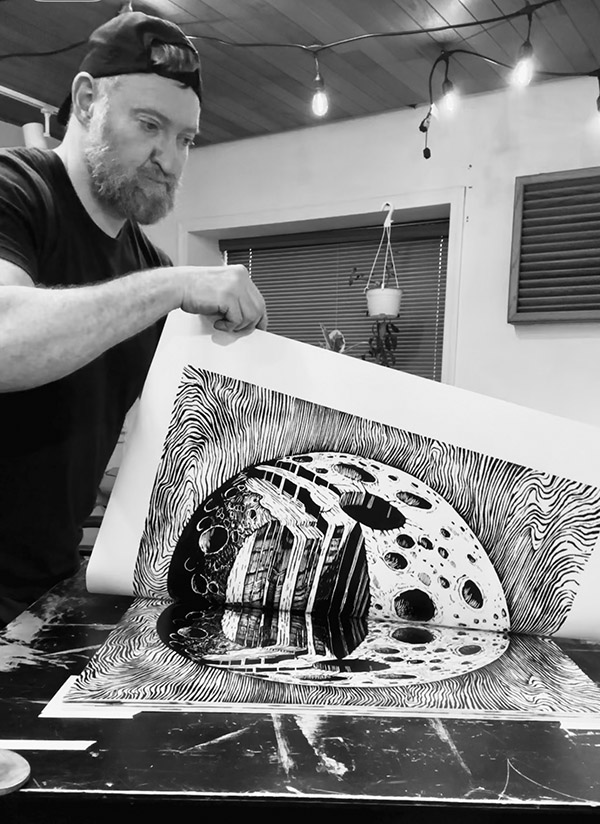
Christopher Hartshorne printing the Graphic Myths series
Nanette: How did you come to art?
Chris: I always made art as a kid. I was so shy, I didn’t try other things. Very introverted. It was like an escape, or something that I could do. And I got a lot of positive reinforcement as a kid. I was known as an artist as a kid. So I kind of stuck with it.
Nanette: Like drawing?
Chris: Yes, drawing. I’ve tried to do other things, but I always come back. I’m like, I’m an artist. I’ve got to keep making art.
Nanette: Why printmaking?
Chris: I was painting and I went to school for illustration, never did any printmaking in school, like in college, but when I discovered woodblock printmaking, I liked the process. It was a very definite process. You transfer an image, you carve the image, you print it, you kind of know what it’s going to look like, very graphic. A painting to me was too mysterious. Maybe I didn’t know how to paint. I was a painter, but I didn’t know when a painting was done. There was something really crisp and clear about printmaking and the way I was using it. I latched onto the process immediately. I loved how you could make an expressive, almost random mark on a piece of wood and it looked so defined and intentional when you printed it, because it’s so graphic and bold. That was really cool to me. The marks you can make and how bold they are compared to painting. But now I’m thinking of printmaking differently, actually. A print can be more mysterious, like a painting. So now my views are broadening. That’s how I latched onto printmaking, the process.
Nanette: How long have you been printing then?
Christopher Hartshorne: TempleGRAM, Multiple block woodcut installation, variable dimensions, 2019
Chris: Probably 20 to 25 years. I just started doing it on my own.
Nanette: After school?
Chris: Yes, I was hand pressing, with no community yet. I just started doing it and then kept doing it. I eventually went to grad school for printing, because that’s all I was doing.
Nanette: Many of the artists that I’ve met go in through painting, because painting is seductive and it’s elevated. It used to be, you were a painter or a sculptor. And that’s all there was for fine art. So I think it’s normal to go in through the magic of painting. What grad school did you go to?
Chris: I went to Tyler School of Art.
Nanette: How was your grad school experience?
Chris: It was good. I waited ten years in between BFA and MFA so I was older than everyone. I really wanted to immerse myself in printmaking and school for printmaking, but I actually did not really feel like going back to school. But it was good because they have a program in Rome, through the school, so the whole second year I was in Rome and it was more like a residency, which . . . why am I going to school if I’m just doing an artist residence? But it was really amazing. I would never have gone out of the country back then if it wasn’t for the program. It was my first time out and it was pretty cool. I had a small cohort of five other grad students from Tyler and a bunch of undergrads that were from a lot of different schools, just getting some international school experience. It was good.
I was scared to leave the country. I don’t know. I’m a homebody, but it was really, really amazing for me to leave, and see more than just the art experience.Just to see how other people live, non Americans, [laughs] was very good for me to see as an artist and a human, or an American, I guess, so that was pretty cool.
Sophie Loubere stands out as an artist invested in the conceptual nature of historical imagery while exploring materials and processes. She moves deftly through a range of studio practices — working with wood type on a Vandercook, hand working intaglio plates, exploring natural dyes, papermaking, creating multimedia installations, book arts, and writing. We met during a summertime printmaking residency at In Cahoots Residency in Petaluma, California. Our conversation took place in the etching studio towards the end of our residency.
Sophie Loubere giving a printmaking demonstration at the Bainbridge Island Museum of Art in Washington state. Photo by Laura Zander
Nanette: How did you come to art?
Sophie: I started in elementary school, and it was just something that I was good at. I started using chalk pastels, making pastel paintings, getting positive responses, and then I just kept on going. Eventually it was just one of those things where it just felt like it was what I needed to do, which I’m sure a lot of artists can relate to.
Nanette: Did you go to art school right after high school?
Sophie: I went to the University of Illinois at Urbana Champaign, and I was an art major. But while I was there, I was just feeling like the curriculum wasn’t really serving my needs, so I wound up transferring to Rhode Island School of Design in their illustration program.
I’ve always been interested in words and books and writing . So for a while, I thought that I would potentially become an illustrator. But then my interests just wound up being a little too noncommercial, a little too artsy fartsy, more interested in material, more interested in concept, and making artist books as opposed to illustrations for editorial and things like that.
When I went into the illustration program, I didn’t fully understand that the conventional commercial way of making money doing illustration would be to make illustrations for editorial magazines or for working in animation and designing characters for game studios and things like that.That just was not really where my interests lay. Then one winter session, I wound up taking a printmaking course, Painterly Prints, and I learned aquatint and monoprinting.
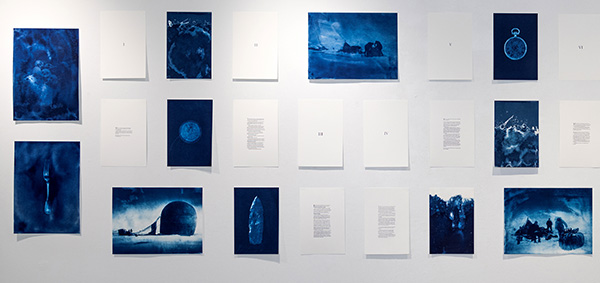
Sophie Loubere: Relics, Cyanotype, letterpress, archival imagery. Partial view of 20′ x 6′ installation of literary vignettes, cyanotypes, and audio and video based on historical research, 2022
After that I was really into etching. I spent my senior year mostly doing etching projects working on this extended sort of book project. After I graduated, I set up my own studio in Seattle. I was working as a graphic designer and publications manager at a nonprofit art school. I had a little studio and I wound up getting some grant money so I was able to get a little press. Then I basically just explored varieties of ways of doing printmaking. I was feeling a little bit frustrated because I didn’t have a conventional printmaking background because I hadn’t majored in it when I was an undergrad. I was trying to learn from books, YouTube videos. I taught myself how to mezzotint, and eventually I just felt like I needed some more specific background. I applied for grad school. I got into a grad school that had a pretty in-depth printmaking program and that’s where I honed both my practice as well as my printmaking skills.
Nanette: So you’re primarily a printmaker?
Sophie Loubere: Relics, detail
Sophie: At this point, yes. I’m open to making in pretty much any particular way. I have worked with fabrics before. I’ve done installation. I’ve done audio and video work to go along with the prints. But I think that primarily when I’m thinking conceptually, the majority of the time it winds up being a print in some way or other, and print doesn’t necessarily mean something that is like a letterpress print. I also have done things working with cyanotypes and alternative photography. I view those things as prints as well.
In my view, there’s a lot of different meshing that goes on between all these different artistic media. I would say that printmaking falls into a lot of different categories.
Elizabeth Gómez is a Redwood City based artist and children’s book illustrator. Part of Gómez’s practice involves designing and managing community participatory murals in both paint and mosaic.
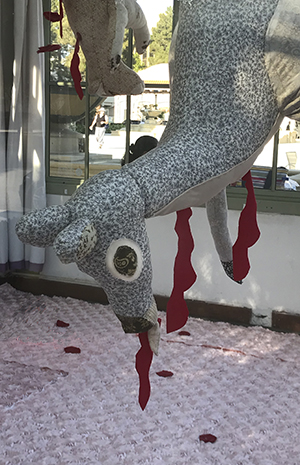
I first met Elizabeth during her July 2021 Redwood City Art Kiosk exhibition. Her installation, Naturaleza Muerta, was striking in the manner it pulled the audience in and then held their attention with an edgy softness: A lifesize deer and mountain lion hang upside down in the center of the kiosk. They are accompanied by a squirrel and a crow. These hand sewn creatures are made from pale, low contrast fabrics. Scatterings of thin red cloth trail from each body. The kiosk floor is covered with pink quilting and a spare grid of deep red, fabric roses. There is a feeling of being in a child’s bedroom. These layers of symbolism reveal a multi-dimensional philosophy about the relationship of humans to other animals, to profound effect. In this work Gómez brings together a blend of Louise Bourgeois construction with Sue Coe content to make her own statement about real life events involving wild animals in our suburban neighborhoods.
Gómez has an MFA in Pictorial Art from San Jose State University. She has shown at the deYoung Museum in San Francisco; the Oakland Museum of California; MACLA in San Jose, California; and at the Mohr Gallery in Mountain View, California.
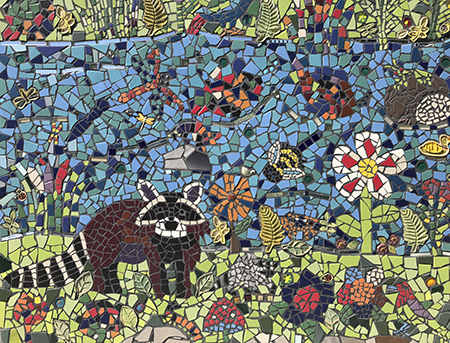
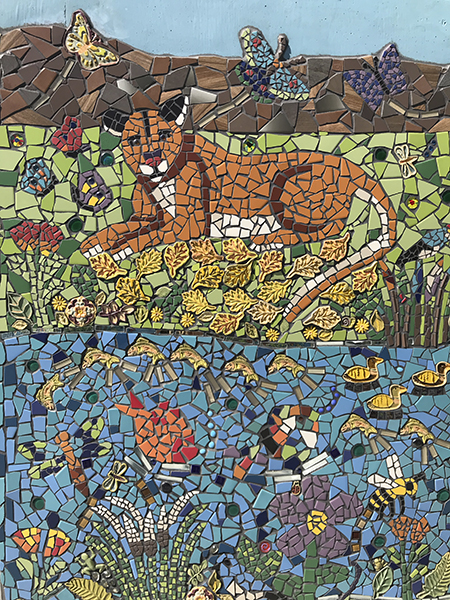
This week Gómez’s most recent mural, created with the help of many from our community, will be unveiled at the Magical Bridge Playground in Redwood City. We spoke during the last weeks of mosaic tile making under the redwoods and oaks on the back patio at Red Morton Park, the mural’s home.
Magical Bridge Playground mural, 2021
Whirligig: Let’s talk about your background. You went to San José State?
Elizabeth: I did most of my college in Mexico City where I am from. I did three years at the San Francisco Art Institute and then I did my masters in painting at San Jose State. I had great professors like Erin Goodwin-Guerrero and Rupert Garcia. It was an excellent program, lots of support, really nice.
Whirligig: How long have you been working in mosaic?
Elizabeth: I have been doing small things here and there but I am really a painter. I have been working with Redwood City for many years. I have done murals in the schools and parks. The city knows me as an artist that can create and facilitate public works with volunteers, with the help of the community. That is why they asked me to do this mosaic mural. I have learned a lot doing this.
Whirligig: What are the dimensions?
Elizabeth: It is gigantic. It has more than 700 square feet of tile.
Whirligig: You did the design?
Elizabeth: I did the design and many workshops. For example, here in Red Morton Park during the pandemic we were outdoors and indoors and outdoors again and then we couldn’t do it at all. Then, I had to transport boxes of materials to the volunteers, house to house, I would bring a new box and take competed work away. I did that for many months. It was a lot of work. Then we were allowed to work here outside again, almost a year and a half after we started. The hardest thing about this project has been the management. We have had more than 750 volunteers on this mural. Everybody is welcome. I have taught the class on how to make mosaic shapes hundreds of times now. I will be happy to see it on the wall.
Whirligig: You plan to install next week. . .
Elizabeth: We have two walls and a tunnel. We are hiring professional tile installers because it is so big and heavy. I will be there as support. I don’t know what problems we will encounter, but we will have problems. We already fixed a few things–the walls were uneven and there was an anti-grafitti sealant on one wall that would not allow the tiles to adhere, so we had to remove that.
Orange Halves
Whirligig: Tell me about your painting work.
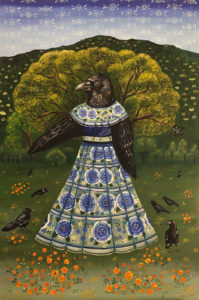
Elizabeth: My work belongs to the Mexican tradition. I like surrealism. I like animals and nature. I like a lot of handmade patterns and decoration. I have been working on a collection called Madre Tierra (Mother Earth). They are women with the face of an animal. Very surreal. They represent the need to care for the environment. The most recent is Mother Earth Crow. She is signaling with her wings the end of the wilderness, saying “From here to here is wilderness, so you don’t build. And from here to here is for humans, so stay on the human side.” They almost look religious. They are big animals with dresses, in nature. One is Vindictive Mother Earth. She has humans in a cage. Bird Mother Earth is teaching little birds how to protect themselves against us. But all very beautiful and colorful, filled with flowers. Mother Earth Wolf is planting flowers on the pavement in Mexico City. She is taking care of them with a watering can, a nurturing Mother Earth.
Whirligig: Those are in acrylic, oil?
Elizabeth: I love to paint old style, oil on wood, because with painting in glazes it becomes very jewel like and medieval. You can touch the colors.
I’ve also illustrated many children’s books. I just finished a book on El Salvador, ABC El Salvador.
Crow Mother Earth at the Edge of the Wilderness
Whirligig: Are there specific artists you are inspired by or look too?
Elizabeth: Sometimes I am a bit sad that the person most known here is Frida Kahlo. When you see Frida’s work it’s not only Frida’s style, but it is Frida’s style on top of the Mexican tradition. Her work makes a lot of sense within Mexican art. When she was painting there were a lot of women painting. For example Leonora Carrington and Remedios Varo. There was a magical group of women painters that had this surreal, folksy, decorated, colorful work. I really like their work. Because I grew up in Mexico City it was normal for me to visit Frida’s house or see a show of Remedios Varo and other artists from that time. I don’t try to do what they do, but I like the visual language they were using. My own work is always about nature and the environment.
Whirligig: Would you say that you are mostly inspired by female artists?
Elizabeth: I would say that I really like their quality. I don’t want to generalize, but with Mexican women artists there is something that is, to use a trite word, feminine–care taking, nurturing and smaller–that I like. The famous male Mexican artists are very grandiose, “Industrialism came to save us! The workers will save us!” Full of big ideas, but with little heart. I like works with more heart. I am not saying that men cannot do this, just historically in Mexico it has been the case that women pay attention to heart.
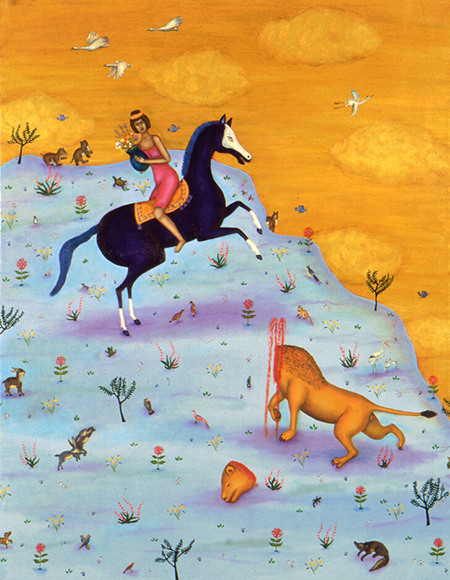
Lion Fountain
Whirligig: You exhibited sculpture in your Art Kiosk show.
Elizabeth: I do a little bit of everything. I have created three installations with ideas of nature and animals. At the Oakland museum for the Day of the Dead I showed dead animals. I made a coal circle . . . where it is clean the animals are alive and flying. Where it is dirty the animals are dead.Â
Whirligig: What is it about working with animal symbolism that you hope to communicate?
Elizabeth: I sometimes feel that we humans do not believe that animals have the same right as us to be here. That we are more than they are. That we own this place. After all of the facts telling us this is not the case, global warming. . . I want to be a voice for animals, even if it is a small one, saying “We are here. We belong. This is also our earth.”
Whirligig: So you grew up in Mexico City . . .
Elizabeth: Yes. I did most of my formative years in Mexico. I came here after I got married. I have been many years now here in California.
Whirligig: How is it to be an immigrant here in California?
Elizabeth: Sometimes it’s good, sometimes not so much. Especially if you are from Mexico. My husband is from Argentina and he does not cross too many people with stereotypes about what an Argentinian is. Maybe they know about the tango. . . But if you are from Mexico the stereotypes are very, very, very strong. Sometimes when I encounter someone who knows only that I am from Mexico and nothing else about me, I feel discriminated against. For example, people who don’t know me immediately assume that I am not educated. They talk to me as if I didn’t know things. This actually happens a lot. I am not saying that everybody needs to be educated, but oh my gosh, they speak to me in such a way that I want to say, You know I have a graduate degree you don’t have to talk to me as if I don’t understand things.
Whirligig: Because of your accent?
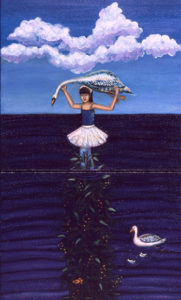
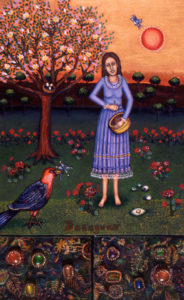
Kelp BallerinaDesayuno
Elizabeth: My accent for sure, and then they ask me, Where are you from? And I say, Mexico. In my life in California I have been hired at least three times as a babysitter. I would be with my children and they [some stranger in public] would assume I was a nanny. It was hard for me to convince these moms that I was also a mom and not the nanny. They would ask questions like, “The children speak Spanish to you?” And I would say, Yes. Then they would say, “That’s wonderful. Other nannies I know speak Spanish to the children but the children do not speak Spanish back. Do you have a driver’s license? How much do you charge?” They would be so surprised to find out I was the mother and not the nanny. Some assumptions are stronger than you think. In daily life doors can close easily because people have very strong stereotypes about what a Mexican is. I moved to a new neighborhood and the next door neighbor told me, “I don’t want to be discouraging but Mexicans are moving here. . .” Things like that happen here and there and everywhere. It always surprises me because most people are nice and good. But those who are rude and not nice. . . they don’t know me, I don’t know them. . .
Whirligig: Part of it is being a woman. . .
Elizabeth: Yes. But why don’t they just ask me what I think rather than thinking I don’t know anything? Sometimes people start sentences like, “Here in California, we. . . ” immediately making me the other. I’ve been here 30 years. I can say, We in California. . .
I like so many things about Northern California, but when I face those discriminating people I don’t like it.
Whirligig: I’m sorry that is here.
Naturaleza Muerta, at the Redwood City Art Kiosk
Elizabeth: People don’t know that if you have an accent you are asked a lot, Where are you from? How long are you staying? If it were a neutral question . . . but when you are asked that on a weekly basis it makes you feel as if you don’t belong, you don’t belong, you don’t belong. It makes you feel there is a wall around you everywhere you go. Now when they ask me, I ask them, And where are you from? Tell me about. . . We all are from somewhere, even if we didn’t cross a border. I try to be light about it but I wish it wasn’t the case.
Whirligig: You’ve been working on a two plus year project. What will you do after?
Elizabeth: The park has asked me to make some individual animals. It will be only me in my studio. I will have control of everything. I am looking forward to that. Then I will paint. I have loved doing this, but it was a lot of heavy lifting.
Whirligig: It’s an important project.
Elizabeth: I love that we have so many community members taking part, and also, if someone came to a workshop and made a piece of the mural, it is included. I didn’t get rid of anything the volunteers created. I kept my promise, that “if you learn to do it, you are a part of the mural.”
Whirligig: Do you think there was anything in your upbringing that made you particularly tune into non-human animals?
Elizabeth: My grandfather was a farmer. He could barely sell his cows because he loved them. He named them and the chickens and the pigs. When buyers came to take them, he had so much trouble. They followed him like dogs. He was a bad farmer in that sense. I think growing up with him I fell in love with the animals just like he did. Growing up in Mexico City, nature was so devastated by pollution, 20 million people in one city.
One day, everywhere I went, there were dead birds. Something was happening in the air or poison. Walking to school that day was one of the most important days of my life. I realized it was not a normal day. This was human induced. I think I became an environmentalist that day. Later we heard it was a paper factory that did not have proper air filters. They polluted the air. The birds died. . . It really welded a before and after for me.
Whirligig: Do you have a spirit animal? Is there a particular animal you are closest to?
Elizabeth: Not really. I strongly believe the earth would be better off without us. We are the extra animal.
Whirligig: Agreed.
Magical Bridge Playground mural, 2021
Elizabeth: Even sharks and insects have a right to be here. I’m a little bit of Buddhist in that sense. Everything that is living has a right to be here.
What makes me really happy is that I have found many paths to follow and they have taken me to incredible places that I never thought I could go or do. My parents were very sad when I told them I wanted to be an artist. But I am so happy that I am. A perfect day for me has art and nature. I have lived my life like that. And Northern California is a beautiful place and people respect nature here. People are also more open. I know that the Bay Area is the right place for me. Here I can blend in. California has a very nice collection of Asian art and Latino art and Californian art and good food.
Whirligig: How are you feeling now that the mural is up and complete?
Elizabeth: It was a tremendous amount of work. I am exhausted. I am happy.
Whirligig Interview by Nanette Wylde. All images copyright and courtesy of Elizabeth Gómez. Elizabeth Gómez’s website.
A Conversation with Interdisciplinary artist Minoosh Zomorodinia
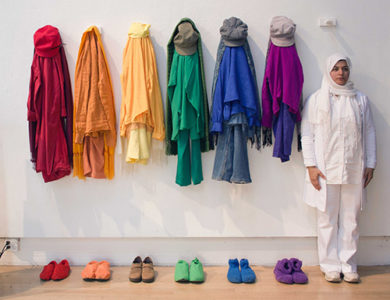
A Week Living Art, 2015
Minoosh Zomorodinia is an Iranian-born interdisciplinary artist and curator working in time, space and the natural world. Her current art practice involves nature walks which are documented via smart phone app. The resultant maps are then made tangible via a variety of both old and new technologies. There is an edgy, accessible humor in much of her work, this she calls “the abstract absurd.” actuality, Zomorodinia uses all aspects of her making to parse and comment on current critical issues including borders and territories, colonialism, immigration, culture and identity, stereotyping, relations of the self to the environment, the power of technology, and the art world itself. Her work is both layered and engaging—smart, funny, and often visually exquisite.
Zomorodinia earned an MFA in New Genres from the San Francisco Art Institute (SFAI). She has a Masters in Graphic Design and a BA in Photography from Azad University in Tehran. She is the recipient of a Southern Exposure’s Alternative Exposure Award, a California Arts Council grant, and a Kala Media Fellowship Award. She has received residencies at Headlands Center for the Arts, Ox-Bow School of Art and Artists’ Residency in Michigan, I-park Foundation in Connecticut, Local Language Residency in Oakland, Santa Fe Art Institute Residency, Djerassi Residency in Woodside, and Recology in South San Francisco. Zomorodinia has exhibited locally and internationally. She volunteers for Southern Exposure Gallery’s Curatorial Council and is a board member of Women Eco Artists Dialog. Zomorodinia currently lives and works in the Bay Area.
We spoke in the studio at Recology, where Minoosh is resuming an artist residency interrupted by the COVID-19 pandemic.
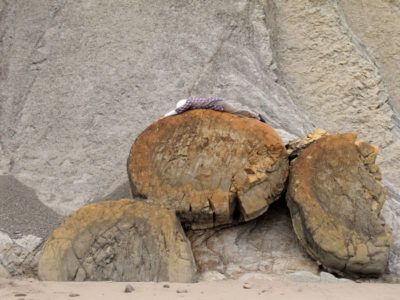
Integration with Nature, 2010
Nanette: A great deal of your work has a focus on the body in nature—often your own body which is shrouded, wrapped, blanketed, responding to external elements. Why the body? Why your own body?
Minoosh: There are different reasons to use the body in my work. First, I want to acknowledge that my friend, Tara Goudarzi, generously accepted to be a model for the Destruction of Nature, Destruction of The Human Being as we were traveling together.
One reason to use the body is expressing self. I spend a lot of time in nature, it’s an extraordinary experience and inspiration for my practice. My mind opens and I see things when I’m in nature. I search for spirituality in nature and some sort of psychology for finding positive energy. I have been wanting to illustrate this feeling in different ways.
Another reason is to dematerialize and use my body as a signifier to lived experience as well as illustrate identity. I believe using my body offers a variety of contexts and perceptions. Employing my body in my work somehow represents time and space, especially in my performance installations. I consider my body as a sculpture—I make myself vulnerable to challenge the perception of the female body, and represent culture and religion. I want to emphasize a political perception from a Muslim woman’s body and how it’s been interpreted in the world.
Nanette: Are you thinking of specific interpretations of a Muslim woman’s body? Can you explain?
A Conversation with printmaker and book artist Felicia Rice
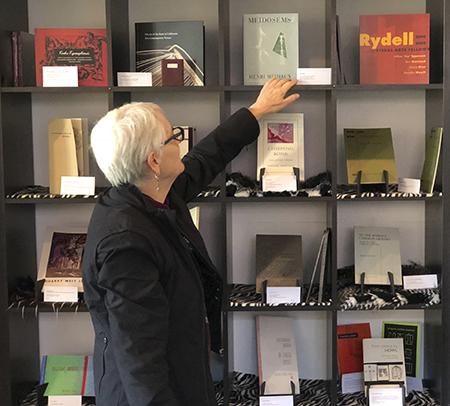
Felicia Rice, well known for her fine press work and collaborative books, celebrated 40 years of Moving Parts Press in December with a solo show at Felix Kulpa Gallery in Santa Cruz, California. Rice has worked with notable Californian artists and writers including: Francisco Alarcõn, Elba Rosaria Sánchez, Juan Felipe Herrera, Enrique Chagoya and Guillermo Gómez-Peña. As Moving Parts Press, Rice has received the Rydell Visual Arts Fellowship, Elliston Book Award, Stiftung Buchkunst Schänste Bücher aus aller Welt Ehrendiplom, and grants from the NEA, CAC and the French Ministry of Culture with Perseverance furthers: Moving Parts Press 1977–2017. Rice celebrates her history as printer, publisher, artist and collaborator. We visited the gallery to experience the work, talk about making books and working with other creatives.
Whirligig: You started Moving Parts Press in 1977 as a printshop in downtown Santa Cruz. How did you come to letterpress?
Felicia: When I was a kid a friend’s mother had a letterpress in the family room. It was a little table top pilot press. I can remember standing in the room and seeing it, and maybe touching it.
My folks were artists and teachers: my mother was a sculptor and kid’s art teacher. I grew up in her art classes and was exposed to all types of fine arts. My parents were founding members of the Mendocino Art Center. My father was a mosaic artist in the Art and Architecture movement in San Francisco working with Lawrence Halprin. He did pool bottoms and walls. Later he made independent fine art animated films.
The critical point came after I had left home. I was living in Berkeley around the corner from David Lance Goines’ studio and letterpress shop. My mom accidentally sent me one of those San Francisco Chronicle Weekend Edition articles on “Letterpress Printers of the Bay Area.” Adrian Wilson, Jack Stauffacher–there were about five of them. She accidentally sent it to me instead of my older sister. So I’m reading this thing and looking in the window at what’s going on around the corner. I started thinking this might be something I could get into. It didn’t necessarily mean I had to stay with it. I was 18 or 19 and thought maybe I could learn more. I went to Laney College which had a print and graphics program. The instructor said, “If you want to be a printer you need to get into computers.”
It was a time when there was a lot of support for crafts. A lot of my peers who grew up in California were carpenters or in the trades, which were highly respected. And the newspapers listed a lot of jobs for printers; so I thought I could be a printer. I could get work. At Laney there was some old letterpress stuff, but there was mostly this idea that one would go on to computers. It was interesting. I had also taken a printmaking class in Oregon around this time. I thought I could go to school for this but if it was just a fluke I could change my mind and do something else. I started looking around for print programs. There wasn’t really anything going on in the Bay Area. I came down to Santa Cruz with a friend to visit the school, and a friend of my friend said there was a press in the basement of Cowell College dining hall. So we went down there and there was this beautiful letterpress studio with a Vandercook, type and floor to ceiling windows with a gorgeous view of the bay. That’s how I got started. Jack Stauffacher was teaching.
Felicia with some of her books. Photo: Kent Manske
A Conversation with book artist and papermaker Michelle Wilson
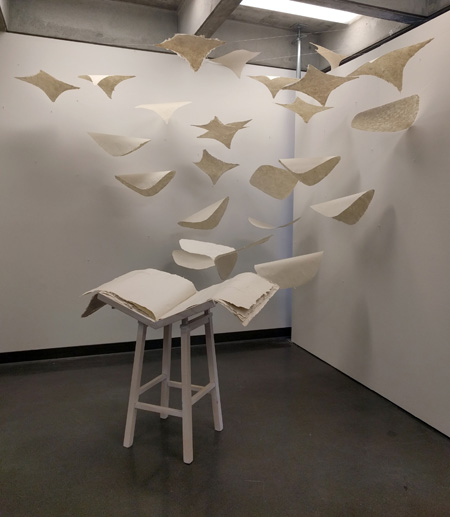
Michelle Wilson is a papermaker in an extremely complex sense. Her work with paper is both conceptual and concrete as it extends from the making of sheets for artist’s books and printmaking to social practice, sculpture and installation. As a somewhat recent transplant to the Bay Area, Wilson has quickly embedded herself and her work into the consciousness of the local art scene with a residency at the School of Visual Philosophy, a Small Plates commission from San Francisco Center for the Book, teaching at both San José State and Stanford, engagement with a handful of arts organizations, and many exhibitions.
This summer, Wilson’s collaboration with Anne Beck, The Rhinoceros Project, travels to the Salina Art Center (Salina, Kansas), Shotwell Paper Mill (San Francisco, California), the Healdsburg Center for the Arts (Healdsburg, California), and later this fall to the Janet Turner Print Museum in Chico, California. Her work is included in The Power of the Page: Artist Books as Agents for Change at the New Museum of Los Gatos (NUMU in Los Gatos, California), and Pulp as Portal, Socially Engaged Hand Papermaking at the Salina Art Center in Salina, KS. Wilson has a BFA from Moore College of Art and Design, and an MFA from the University of the Arts, both in Philadelphia.
We got together on a lovely spring afternoon towards the end of the semester to talk about art and teaching.
El Proceso at NUMU by Michelle Wilson. Photo: Robert Wuilfe
Nanette: I first became acquainted with your work in 2010 at an SGCI Conference in Philadelphia, occurring at the same time as Philagrafika, where I came upon a Book Bomb intervention in a public park. How did this collaboration with Mary Tasillo come about?
Michelle: Book Bombs began as a question I posed on Facebook. I was reading about yarn bombing, the tradition of knitting or crocheting something that is then bombed— left in a public space—a form of craft meets street art. I’m not a knitter or a crocheter; I’m a book artist, and so I posted a status update, “What would it mean to book bomb?” Mary took me seriously, and through our conversation, we discussed where people read in public space, who owns public space, and it led us to the idea of park benches. In Philly, every park bench has this center bar installed that is called the “arm rest,” but is designed to prevent a homeless person from sleeping comfortably on a bench. This seemed like an ideal place to install a book. Our project grew from this initial idea. And thus, Book Bombs was born.
Book Bombs by Michelle Wilson
Nanette: What were you envisioning regarding the scope and effects of Book Bombs?
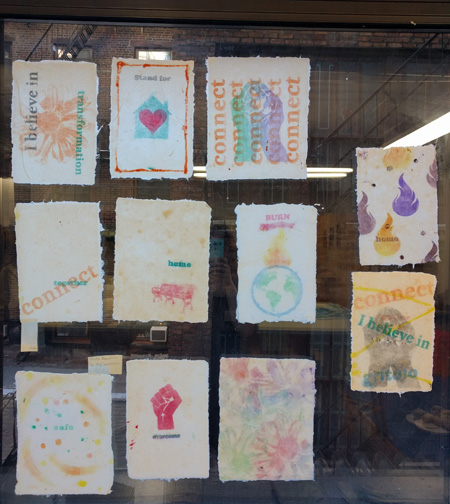
Michelle: We originally saw Book Bombs as just a project for Philagrafika 2010. However, we’ve had so much fun, we’ve continued. It’s been tricky to keep it up transcontinentally, but we manage. Most recently, we did a sort of intervention-workshop at the Center for Book Arts in New York called Keeping the Fire Alive. This was designed as a workshop for activists who were interested in using papermaking in their work, as well using it as a form of self-care against fatigue and for continued resistance. We’d originally proposed the workshop during the summer of 2016, before the election, thinking it would be a very different conversation.
A Conversation with conceptual artist C.K. Itamura
C.K.Itamura with Walk (2016) and 2016 thru 2064 (2016): Michelle Feileacan Photography
C.K. Itamura is an interdisciplinary artist, designer and producer. Her work responds to a wide range of personal and social content; and is realized as richly engaging, metaphorically layered, participatory, conceptual installations. C.K. is Director of Marketing and Events for San Francisco Center for the Book and a board member for Healdsburg Center for the Arts.
Her most recent work s+oryprobl=m is a three part series of exhibitions which may be experienced at: O’Hanlon Center for the Arts, Loft Gallery in Mill Valley (June– July 2017); The Spinster Sisters in Santa Rosa (April–June 2017), and City Hall Council Chambers also in Santa Rosa (thru May 4, 2017).
We chatted over an early evening cup of tea in mid April.
Nanette: You are making and exhibiting complex, multi-layered, series of works that are highly metaphorical and cross media distinctions. How would you advise new art audiences to approach and experience your work? What do you hope people will “get” from experiencing your art?
C.K.: I’ll use my piece Ladies (2015) to illustrate your point.
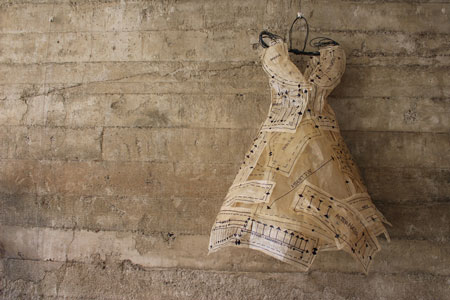
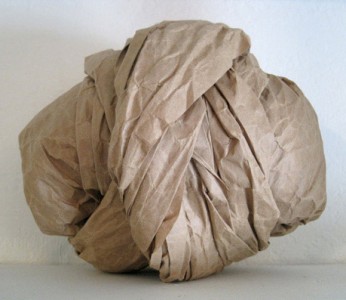
Ladies was inspired by a surreal hours-long conversation I had one afternoon in 2013, with two strangers in an art gallery. One woman was a retired physician with crutches, the other woman was an art patron that I’ve seen at artist receptions but had never spoken with before. Over the course of the afternoon, the retired physician revealed that she wanted to die because her crippled legs prevent her from doing all the things that hold joy for her, such as hiking, swimming and traveling. The art patron revealed that she had lost all of her money and was now living in a van that she had to park in a different place every night to prevent getting into trouble with the police. After the conversation concluded when the gallery closed for the day, I wrote down notes that would remind me of this curious encounter. Two years later, the notes evolved into Ladies, a wall mounted sculpture in the style of a mini-dress that Tina Turner wore on stage during a performance with Mick Jagger on the British stage of the Live Aid Concert in 1985.
Ladies is constructed of torn paper grocery bags; it is a bag dress that suggests the phrase “bag ladies,” term recalled from childhood that was used to describe seemingly homeless women who kept all their belonging in bags they carried with them, from place-to-place, at all times. Ladies is symbolic of contrasts: the facades of the retired physician and the art patron vs. a hidden desire to die and destitution; the opulence of Tina Turner’s memorable performance during a come back era of her career vs. the desperation of forgotten “bag ladies.” Excerpts from the notes I wrote after the curious conversation were written on the paper bag sections in pencil then selected words were traced over in permanent marker. In a final nod to another lady, my maternal grandmother, who hung laundry outside, rain or shine, the inside of the piece is filled with wooden clothes pins that are not plainly visible from the outside, as my grandmother was rarely seen away from her home.
A Conversation with Angelica Muro, integrated artist, curator, cultural critic, and art educator
Angelica Muro is an integrated artist, curator, and art educator with a strong interest in cultural criticism. Originally from the Central Valley agricultural community of Hopeton, California, Muro grew up on an apple orchard. As a child she became interested in photography, media imagery and popular culture. Muro served as Gallery Coordinator for WORKS/San José for five years, and as Educational Programmer for Movimiento de Arte y Cultura Latino Americana (MACLA, San José, California) for three years. She has a B.A. in photography from San José State University, and an MFA from Mills College in Oakland, California. She is currently Director and Chair of Visual and Public Art at California State University, Monterey where she teaches courses in photography, integrated media and media culture.
Her newest project, created with Juan Luna-Avin, Club Lido: Wild Eyes & Occasional Dreams opened February 12 at Empire Seven Studios in San José. We chatted over tea in early January, at Angelica’s Japantown (San José) bungalow. Reina Sofía, Angelica’s eight-year-old rescue pup, sat on her lap.
Nanette: How did you come to be an artist?
Angelica: I’ve been interested in art since I was a child, but I was never really good at making—I suppose my vision never matched my actual skill set, it still doesn’t. I remember always trying to make things such as sculptures and drawings, but never having the dexterity. Photography came into my life very early—my fourth grade teacher, Mrs. Dixon, had a pile of National Geographic magazines I was pointed to whenever I finished my assignment early—this was the first time I was truly able to look at images, photographs, people. Since then, it’s become my primary area of interest, socially and culturally.
Nanette: The first time you were able to look at images or that you became aware of the power of images?
Angelica: Aware of the power, of ways of seeing, of actually looking. We are so visually saturated, so much so that we are not actually seeing. I read recently that the brain is on a need-to-know basis. Our brains store the information in our environment and we don’t actually see it, even as we know it is there.
I very vividly remember looking through these National Geographics and seeing, seeing things that I had never seen before. It was new information. This is why travel is so exciting, it’s overwhelming new information for us that we are absorbing in a completely different way, and we take that absorption as being creative influences.
Nanette: Much of your work exploits and reveals the tensions between consumer celebrity culture and the realities of working class and immigrant lives in contemporary America, perhaps even specifically California. Who do you see as your audience for this work and what do you hope it achieves?
Angelica: I don’t often think about audience in the traditional sense; although as an educator, I often address ethical concerns involving audience with my students. I happen to live and work in California, so my work deals with the complexities of this eco-system—the spectrum of productivity, exploitation, and the distribution of wealth—and often explores issues of gender, race, and class. I’m interested in social issues, and I find that visual tension inspires me to create.
I think there’s several ways to think about audience—I remember being in graduate school, a time that allowed me to experiment with ideas with a critical, yet limited audience. Suddenly, I had a body of work about being Latina, being a woman, being the daughter of a farmworker, and navigating social constructs. And then my audience became people who where interested in issues of identity. However, my work deals with larger social issues of equalization, socialization, conditioning, and the various codes of gender identification. It’s a dialogue with my community, my artist cohort, scholars, thinkers, curators, and activists who are interested in issues of positionality and privilege. I suppose that in the simplest and most complicated sense, my audience is one interested in issues of difference, otherness, and diasporic culture. I question ideological frameworks of meritocracy, social mobility, and distribution of wealth, because I want to, in small part, be in dialogue with someone, anyone, interested in discourse about the complicated social structure we live in.
Agricultural Workers series (Cali-for-nia), pigment print, by Angelica Muro, 2012
A Conversation with MicroClimate Collective, Glenna Cole Allee and Victoria Mara Heilweil, artists and curators
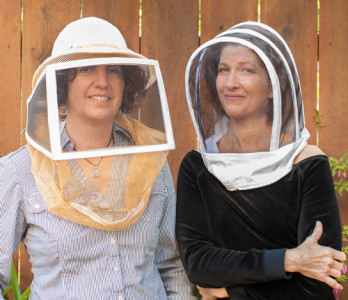
Glenna Cole Allee (right) and Victoria Mara Heilweil (left) make up the collaborative curatorial project known as MicroClimate Collective. The exhibitions they produce are thematic (Hypnagogia, Wabi Sabi, Night Light, Chance Operations, Unseen Unsaid, Everything Must Go!, Eidolon, Perfect Place/No Place, X Libris, A.D.D.) with strong considerations for the nuances of layered meanings within the language of the title, and appear to seek unexpected, if not surprising, interpretations across creative genres.
MicroClimate has a focus of interdisciplinary visual and performing arts programming which provides a context for cross-pollination between diverse circles of Bay Area artists. Their mission is to foster experimentation, collaboration, and risk-taking in an atmosphere free of commercial pressures.
Within this entity they have curated eleven multi-disciplinary exhibitions during the last seven years. They are currently preparing their twelfth, Obsidere which opens at Alter Space Gallery (San Francisco) on May 9.
Glenna and Victoria are both exhibiting visual artists, often working with photography. We chatted in late January in Victoria’s Mission District flat.
Nanette: Individually, how did you come to be an artist?
Victoria: I started off doing film and video work while I was in high school and majored in that in college. While in college I also took quite a few photography classes, which is where I discovered that I loved all media that utilized a frame. I made an experimental film in college, and also did some less than traditional photography. I think I knew then that I wanted to be an artist, but feared that I wouldn’t be able to support myself and so didn’t immediately call myself that, or move in that direction. Out of college I worked first in the feature film industry in editing, and then in the commercial photo industry as a photo assistant and studio manager. While working I was still doing my own personal photography work, and it became apparent that I wasn’t cut out to be a commercial photographer. At that point I committed to getting my MFA and being an artist. I would say that it’s only been the last ten years that I have been really actively showing my work and moving my art career forward.
Glenna: I certainly tried not to. This fact of who we are, as artists, seems to be a wider circle that persistently swallows whatever other circles we draw. I tried to do other things and deny it but it wouldn’t leave, this predicament, “artist.” I have become better at putting parentheses around the resistance and the doubt. Recently I’ve been inhabiting a certain excitement and deep joy in working consistently, as well as a daily sense of appreciation for being able to make, and give time to, my work.
Nanette: How did you come to be MicroClimate Collective and how do you think of yourselves inside of this entity?
Victoria: I had a friend who was the Artistic Director for the Climate Theater on 9th and Folsom Street. It was a small theater that had been around a while, but when she took it over she had a vision of it having other programming than just theater. She invited me in to check out a space she thought could work for visual art and asked me to tell her what could be done there. I gave her some suggestions and then she asked if I would run it. I had been doing some curating as part of my teaching at City College of San Francisco, but was definitely interested in doing more curating outside of that arena so I said yes. Very quickly I realized I needed help with this and invited Glenna and another artist to join me.
Dee Dee Kramer spoken word performance in Biblio Babel by Glenna Cole Allee and Yulia Pinksuvich from X Libris. Photo: Victoria Mara Heilweil
I knew Glenna from showing her work in the student gallery at City College. There was also a music series and a film series at the theater. The three of us joined forces with the three film series curators to put on one night shows that took over the whole floor. We showed all different media including music, performance and spoken word. It was exciting, but very tiring and eventually the other curators left to go on to other pursuits leaving just Glenna and I. We had decided after a few years that we wanted to start looking for other spaces to curate our thematic shows, and to have them last more than one night. Right about that time the Climate Theater lost their lease and closed, which forced us to move on.
I think of myself as one of the co-founders and primary co-curators of MicroClimate Collective. Glenna and I each have different strengths and wear different hats, although we can switch off if needed.
Glenna: I was just finished with an MFA and there was Victoria, beckoning. The MFA experience I’d just finished had been transformative–the constant company and critique of others who understood art as the main focus, having everything needed right there. I wanted to actively sustain dialogue and community, and this curatorial project seemed like a possible way. It was very interesting, to create a project together to try to foster creative community–the multi-genre shows might become a conversation between artists. That was one main motivation that drew me–the notion that MicroClimate might initiate work, and even collaboration between artists. It’s been a very satisfying thing, that we have inspired others in this way a little bit.
How I think of myself within MicroClimate: as an artist, with all my personal aesthetics and sensibilities, working intentionally to be a creative collaborator. Which entails seeking to meet halfway, and to be receptive/inviting to the third thing in the room, to what would not be created alone.
I often am in the role of filtering our ideas into language, of pushing to articulate our themes, and sometimes raveling them into little knots and back out again. I find this interesting; actually enjoy it.
A Conversation with photographer and book artist Diane Cassidy
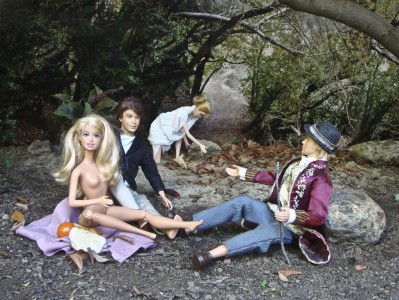
After Manet’s dejeuner sur L’herbe by Diane Cassidy.
Bay Area photographer and artist Diane Cassidy celebrates her 82nd birthday this month with the showing of a new series of photographs at the annual San Francisco Altered Barbie show, and the launch of her first website. Cassidy studied photography at San Jose State University in the late 1980’s, and continues to take classes with respected photographers through various peninsula venues. A monograph of Cassidy’s work is scheduled for publication by Hunger Button Books in 2013.
Nanette: How did you come to be an artist?
Diane: For me, becoming an artist was an indulgence. Throughout my formative years I was equally interested in making art and natural science. An unfortunate marriage ending in divorce left me, at a very early age, completely responsible for myself and my two children.
My first plan in preparing myself for a well-paying job was to get a degree in Art Education. Being young and impatient, I just couldn’t tolerate the necessary Mickey Mouse curricula; those how to educate courses were so so boring. I had trouble staying awake. One day while conversing with fellow classmates I learned that with a degree in a related science I could qualify for an internship in Medical Technology. I made the switch. How I relished those difficult chemistry and physics classes. A welcome relief.
During my 20 year stint as a Medical Technologist I was always taking art classes and workshops. Art was my hobby. Then one day in the 70’s while on vacation I stopped at the Script’s Institute. I noticed some images of shore life displayed on their walls that I really liked. Upon asking I learned that they were hi-contrast photographs. Thus began my foray into photography.
One day I attended a photo workshop in portraiture with Margo Davis at the Palo Alto Cultural Center. While she went over her bio she mentioned that though she had a BA in French from San Jose State, she returned to get a MA in photography. I had gotten a BA in Biology from San Jose State years ago; maybe I could return to get a MA in photography. Which I did. I retired as early as I could from Valley Medical Center and concentrated on photography in earnest.
A Conversation with visual artist, Lisa Hochstein by Kent Manske
Wrap 2 by Lisa Hochstein
Lisa Hochstein is a Santa Cruz, California-based artist who works in collage, painting and fiber arts.
She recently curated the exhibition Earth • Science • Art for the R. Blitzer Gallery in Santa Cruz. The exhibition paired 16 scientists from the USGS Pacific Coastal & Marine Science Center with 16 Bay Area and Santa Cruz artists.
Hochstein has a BFA in painting from the University of Massachusetts, Amherst.
Whirligig: What is art?
Lisa: My answer to that depends on whether I am in the role of artist or of audience. As someone who creates objects, art making is a response I have to the world’s bumping up against my awareness. Making art feels very instinctual though I can’t completely explain why I feel drawn to this particular activity. It has always seemed a little strange to me—that awareness leads to a desire to make something. When I am in my studio, my frame of mind is one of openness and curiosity and a certain amount of discontent or unease. Each piece grows from a combination of feelings, ideas, memories, associations and formal considerations, plus elements of chance and luck that I always hope to be awake to. I regain some kind of equilibrium through my work, but it’s not just about that. I also want to be surprised by what I’m doing.
Origins by Lisa Hochstein
When I’m in the role of audience, I take in someone else’s work and want it to transfer some of that initial response/art-making impulse from its maker to me. As a viewer I also look for something I recognize as much as I look to be surprised. Elegance, honesty, technical skill, originality, narrative truth and aesthetic truth are some of the touchstones for deciding whether I regard something as art or creative output, which strike me as different from each other. There is a lot of creative work that may be artistic but not what I would call art. For me, something that is awkward and raw can be art while something beautiful and harmonious can easily fall into a creative-but-not-art category. Art needs to sing.
Bay Area artist Valerie Raps recently completed a public art commission for the Alum Rock History Corridor Project.
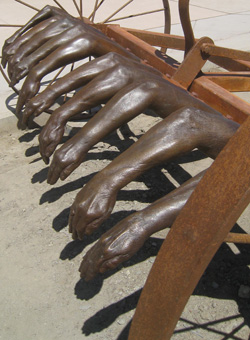
Cultivating Community is a life-size, stylized spring tooth harrow created from fabricated steel and cast bronze. The tines of the harrow are made from casting the arms of ten San Jose community members. The sculpture is located at Tropicana Shopping Center in East San Jose.
Raps has a MFA from San Jose State University and a MA in Holistic Counseling from JFK University. She is also the Resident Curator of Art Ark Gallery in San Jose.
Nanette: You recently completed a commission for a sculpture for the Tropicana Shopping Center. Tell us about this project.
Valerie: The project was commissioned by the City of San Jose Office of Cultural Affairs in collaboration with Don Imwalle, who is the property owner of the northeast corner of Tropicana Shopping Center on King and Story Roads in San Jose.
About three years ago the city put out a call for participation for submissions to be part of an artists catalogue. They selected 30 out of 300 applicants for this catalogue which was then made available to developers who build commercial and residential spaces. I was one of three artists to present proposals for a public art project for the Tropicana Shopping Center. The site is part of a larger project called the Alum Rock Cultural History Corridor, an area in East San Jose which has pinpointed several locations for public funds to commenorate the rich and diverse history of the area.
A Conversation with textile and book artist Jody Alexander
The artist in her studio
Santa Cruz based artist Jody Alexander is known for creating complex characters whose narratives are revealed through an array of artifacts which almost always include handmade books and are often exhibited as interactive art installations.
Her work celebrates collecting, storytelling, and odd characters.
Alexander has just completed two solo exhibitions: Jody Alexander: Sedimentals at Mohr Gallery in Mountain View, California; and The Odd Volumes of Ruby B.: An Installation at Saffron and Genevieve in Santa Cruz, California.
In the first half of 2011 Alexander’s work was included in: The Art of the Book at Donna Seager Gallery in San Rafael, California; The Book: A Contemporary View at Delaware Center for the Contemporary Arts; Reconstructions at Conrad Wilde Gallery in Tucson, Arizona; Encaustic with a Textile Sensibility at Kimball Art Center in Park City, Utah; and Masters: Book Art published by Lark Books.
Alexander has a BA in Art History from UCLA and a MS in Library Science from Simmons College in Boston.
Nanette: How did you come to be interested in the book as an art object?
Jody: While working on my Master’s degree in Library Science in Boston, Massachusetts. One of my professors took our class to Harvard’s Houghton Library. He began by showing us medieval manuscripts: Book of Hours, Gutenburg Bible, Nuremburg Chronicles amongst others. Obviously, this was very exciting to examine these treasures up close, but then he started taking out artists’ books. I don’t think I had ever seen an artists’ book before, and if I had, I wasn’t really aware of them as a genre of art. I think that I couldn’t breathe for a little while. I had one of those moments when everything suddenly made sense and it was clear that this is what I wanted to do. I proceeded to do every remaining project in Library School on artists’ books: their history, collecting them, storage and preservation of artists’ books, etc. As soon as I graduated I started to make them.
Nanette: Tell us about the first book you made.
Jody: When I was about eight or nine I know I made some small books. I used to draw a hillbilly family and type out their story on my green portable Sears typewriter. These eventually became little books. I’m not sure how I bound them. They were just little pamphlet books. They no longer exist.
Photographer Marion Patterson has several new bodies of work coming out based on recent travels to Antarctica and the Galapagos. Patterson was mentored by Ansel Adams who became a lifelong friend. She also studied with Dorthea Lange, Pirkle Jones, Jerry Uelsmann, and Minor White. She studied philosophy at Stanford and received her Masters in Interdisciplinary Creative Arts from San Francisco State University. Patterson was faculty at DeAnza and Foothill College for 28 years. She currently makes her home in Anchor Bay, California.
Nanette: How did you come to paint on your photographs.
Marion: I was a painter first. A watercolor painter. But from an early age it was always photography, and then I fell into the Ansel Adams circle.
When did I start painting again? Maybe when I saw Holly Roberts’ work. She paints thickly and saves only little bits of the photograph. Instead of that approach I wanted part of the photograph to be painted on. I love paint. When I got my Masters at San Francisco State I took a course in animation in which I had to draw on cels. It’s an incredibly complicated thing. I made a camel walking across the screen and all this stuff. It was two or three minutes of film. My instructor said, “Did it come out the way you wanted it to?” and I said, “Yes, and that’s the problem.” It didn’t give me any surprises. The thing with paint is that there is always a surprise. Even with drawing there is a little surprise depending on how you hold the pencil. That’s what I love about paint. It leads you. The camera leads you. The darkroom leads you.
Nanette: When you are isolating a particular element in an image what are you thinking about?
Antarctica Warming by Marion Patterson
Marion: It is a matter of how do we see? How do we perceive as we do? Why do we perceive what we do?
A conversation with conceptual photographer Julia Bradshaw
Photographer and video performance artist Julia Bradshaw is exhibiting seven different series of work in her first one person show at Fresno City College this month. Her work often comments on language and the mixed messages of cross-cultural exchanges.
Bradshaw was born in Manchester, England. She spent nine years working and living in Munich, Germany where she studied with Michael Jochum before coming to California in 1995. She received her MFA from San José State University in 2007. Bradshaw is Assistant Professor of Photography at California State University, Fresno.
Nanette: At Fresno City College you are exhibiting seven different series of photo-based works: Cut Pieces (2010), Case X (2010), Nocturnal (2010), On Photographing Breasts (2009), Tissue Blowing Project (2007), Constraints (2003), and Companions of my Imagination (1994). What is the thread between these bodies of work?
Julia: I am interested in the photographic series as a means to problem solve or comment on everyday life. Apart from the Nocturnal series, all of these projects have something to do with our culture and society. Cut Pieces, On Photographing Breasts and Case X are all linked in that they have to do with my investigations into libraries and books. They consider book content, the public’s misuse of books and a library’s policy on “protecting” books. The Constraints Series has to do with the various societal dictums that potentially have something inherently good and bad associated with them. For example, I have an image and text combination I call “polite conversation.” In this image I am trying to say that “polite conversation” is positive in that it ensures a civil society, however it also has a negative aspect in that polite conversation also can prevent people engaging at a deeper level. Likewise in the Tissue Blowing Project I am also thinking about language. In this project I visually represent miscommunication, disputes, failed advances, diametric viewpoints and avoidance and absence in relationships.
Bay area painter José Arenas recently completed a mural commission in his hometown neighborhood of downtown San Jose, now the up and coming art district of the United States’ 10th largest city. Arenas is art faculty at Foothill College in Los Altos Hills, California; a graduate of the San Francisco Art Institute and UC Davis, where he completed his MFA in 2000. He is currently represented by Hang Gallery in San Francisco. This interview was conducted at the completion of the San Jose mural, and will be included in a monograph of Arenas’ work to be published in early 2010 by Hunger Button Books.
José Arenas Mural on First Street, San Jose, California, 2009
Nanette: You’ve just completed a mural in downtown San Jose that is 16 feet high by 108 feet long. How does that feel?
José: It feels pretty good especially now that it’s done. I now have time to look back and reflect on what happened in the last two months. I was really excited to work with other people. I usually don’t get that when working in the studio, in there it’s mostly alone time. So I got to work with a great team for about six weeks and at the end of the project we held an unveiling party. It was a really good way to give thanks to all of them for being involved in such a big project.
Nanette: Talk about your process in both developing the imagery and in painting the mural.
José: The call for entries involved submitting a packet that included one’s work, a resume, statement, and letter of intent. The statement and letter were instrumental in articulating my own history and connection to San Jose. After I was accepted, there were two designs that were expected of me within about three weeks. I wrote in the statement that I was pretty much of a downtown (San Jose) kid for most of my childhood years. So I went back to that statement and remembered what drew me to that area. I guess I was doing a bit of reminiscing because I was thinking back to when I was a kid.
When I started working on the design I used Photoshop, which for me was a relatively new way to put my ideas together. Typically the way I worked before was a collage cut and paste method where I had a blank sheet of paper and I would move images around to see how they formed relationships. What I ended up doing this time was cutting and pasting various elements from very specific sources. If I had an idea of a flower, I searched it out or I would scan it from a variety of book sources and then manipulate it in Photoshop so that it changed, and then I would incorporate it into the larger idea that I was working on. So it was a bit of a new way for me to work.
A Conversation with haiku scholar and poet Jane Reichhold
Jane Reichhold is an internationally recognized and award-winning artist and poet, prolific writer, editor, publisher, and scholar based in Gualala, California. Jane has written thousands of poems and published nearly 35 books on haiku, tanka, and renga, including Basho: The Complete Haiku (2008); Ten Years Haikujane (2008); and Writing and Enjoying Haiku: A Hands on Guide (2002). Jane is a co-editor of LYNX, the publisher of AHA Books, and editor of AHA! POETRY where she keeps the practice of writing successful haiku and other Japanese poetry forms alive and lively.
Haiku book River at Gualala Arts, 2009 by Jane Reichhold.
Nanette: You spent over twenty years working on Basho: The Complete Haiku. What compelled you to create this book? Can you talk about your motivations and processes?
Jane: I felt that if I could really see how Basho wrote his hokku, by seeing each word he used and not some translator’s idea of what a haiku could be in English, I could figure out how to write a better haiku. I started first by collecting every translation of each of his poems and comparing them. Then I asked Japanese friends to give me a word-for-word translation. I began to study Japanese but still depended on Japanese translators. My only contribution was to understand how Japanese poetry works and to make the translations fit or follow these precepts.
Nanette: That’s a very humble response for twenty years of work which resulted in invaluable insights for both Basho and haiku scholars and enthusiasts.
Jane: Truth, like haiku, is so simple.
Nanette: What initially drew you to haiku?
Jane: On the sale table at City Lights Books Store in San Francisco, in 1968, I found a Peter Pauper book of translations for a quarter. Though I had been writing poetry since college, I felt that here in the Japanese poems was a new way of expressing poetry. Soon afterwards I was making a vessel on a potter’s wheel and just as I pulled the clay upward a bird sang out. I had the feeling that it was the bird’s voice that caused the clay to rise. I realized that in this coincidence what I felt was the same kind of inspiration Japanese poets valued.
Kent Manske is a visual artist working in traditional and hybrid forms of print media. He is a professor of art at Foothill College where he teaches graphic design, printmaking and books as art. His MFA is from The School of the Art Institute of Chicago. This interview was conducted upon the publication of a book on Kent’s work titled Re:ad.
Nutrients from the Queries series, Monoprint, collage, custom wood frame, nails by Kent Manske, 11.5″ x 9″ x 1.75″, 2005
Whirligig: Why do you make things?
Kent: To make sense of things I don’t understand, like my feelings about humanity. I’m compelled to process matters of our existence, like why we believe what we do. I make things to find my own peace, even though much of what I explore is not peaceful. Sixteen thousand people die per day of hunger related causes. The Arctic is melting and the oceans are rising. Exploring issues and concerns help me recontextualize my own reality and make sure I’m not living in a total state of deception. Art helps me to take responsibility for the privileges I’ve inherited.