A Conversation with Katherine Bazak by Sharmon Hilfinger
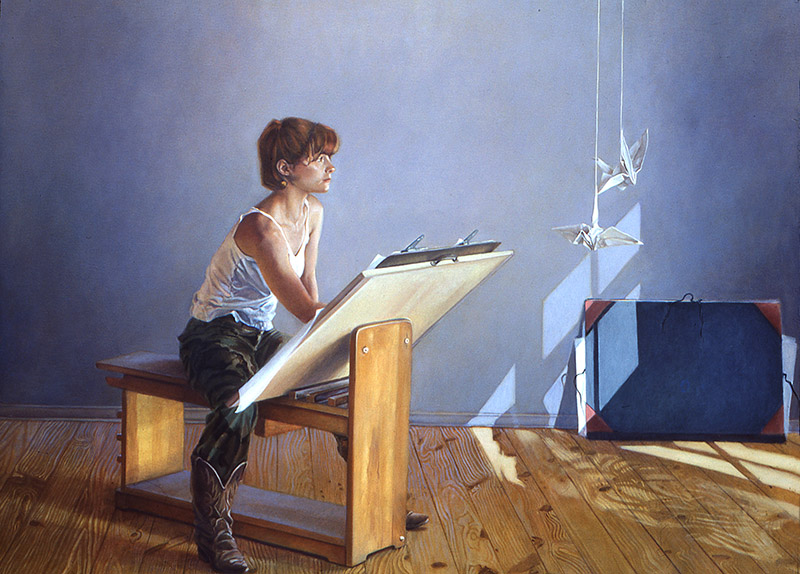
Katherine and I were introduced to each other by a mutual friend over 30 years ago, when we were both establishing our creative careers while starting our families. Kindred spirits working in different métiers, we have shared our experiences as creative artists ever since. Her exquisite painting of Lucy Drawing graces our dining room and never fails to draw comments from people who see it for the first time.
Sitting down now, so many years later, to talk to Katherine about her career as a figurative painter and teacher has been a fantastic lesson in how to look at art. Talking with Katherine is like going on a tour of the painter’s process, exposing how the materials, color and composition reveal the artistic intent. She reminds us that great artwork is not accidental; it is deeply understood and performed by its creator. Katherine is exceptionally articulate with her paintbrush as well as with her ruminations on art and how it works.
Sharmon: You and I grew up in the 1960’s and 70’s when the art trends were Conceptual Art, Minimalism, Pop Art, Psychedelic Art. But you have always been a figurative painter—a very fine one, I might add—so I am curious to know what influences and training led you to your personal style of painting.
Katherine: My visual education started at an early age. On Sundays, my father would leave my brother and me on the steps of the National Gallery in Washington DC at 9:45 a.m. before he would go to the golf course about 15 minutes away. We sat on the steps until the Gallery opened—nobody was worried about us, there were guards who knew us. This started when I was 10 years old. I wandered around the museum while my brother sat in rooms that had paintings of boats and read a book.
One of the first paintings I loved was by Mary Cassatt, a girl with a braid in a white outfit, and another Cassatt of a little girl in a blue chair. Another favorite was by John Singer Sargent called Repose. I spent a lot of time in the room with the Vermeer’s. I remember the painting of a woman with a beautiful jewel-like red hat.
I loved the Titian room! The Portrait of Farnese with the pink vest, Venus Holding an Apple, Venus and Adonis, the Portrait of the Doge—those paintings have been with me my whole life. There is something going on in those paintings—something behind the eyes of the people he painted. I could just look at those and know that the painting of Titian’s Doge was better than the other Doges in the room.
At that age I had no idea who these painters were! But by the time I left high school I had walked through every room at the National Gallery. For a visual person this was heaven.
Every once in a while, we would go to the Phillips Gallery that has a big pre-and-post Impressionist collection. That’s where I saw Renoir’s Boating Party. Some hear the name Renoir and think of peachy-pink people. I mean old ladies love Renoir. In the Boating Party—they’ll say, “he painted the light” which is a cheesy thing to say, but he did! When you see the Boating Party you can feel the wind, you can feel the sunlight. It’s a very evocative painting. It took me a long time to understand and respect this aspect of representational painting.
There are paintings that I just want to stand in front of and spend time looking at or revisit. Why do certain paintings interest me? I’ve thought about that a lot and now looking back, I realize that I have always been a ruminator. I love the way some paintings offer me a way to ruminate. All my paintings have something to do with that.