Macy Chadwick, In Cahoots Residency

A Conversation with Macy Chadwick

Macy Chadwick is the founder and director of In Cahoots Residency in Petaluma, California. Macy is remarkable as a creative residency host in part because she is exceptionally personable with a wonderful gift of giving a story, often with unpredictable humor and resulting laughter. Her own work as a printmaker and book artist is visually poetic and imbued with a sensitive essence of personal reflection. We talked about her work and the running of In Cahoots while sitting under a large oak tree on the residency grounds.

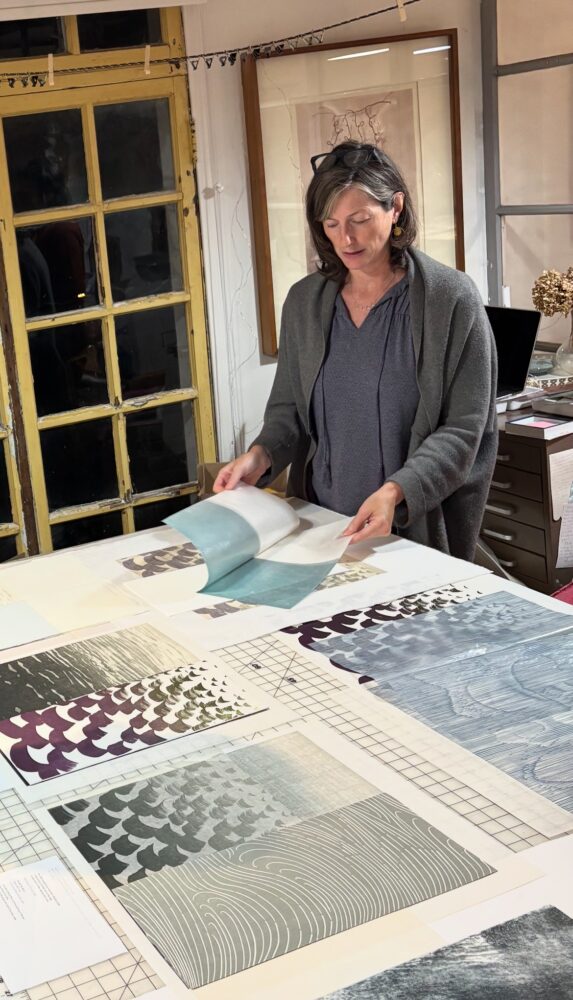
Macy Chadwick in the studio. Photo: Edie Overturf

Nanette: How did you come to art?

Macy: When I was little, I loved all kinds of art, and my mom really encouraged it. I took some after school art classes starting in third grade and continued with that until high school. In order to take the advanced art classes in high school, I had to commit to being an art major in college because the goal of the advanced art classes was to help you prepare a portfolio to apply to college. So I said, yeah, I’ll be an art major in college. Then I decided I really did want to do that. I pursued my BFA, but I was never one of the artsy kids. I didn’t have purple hair or tattoos, still don’t. But I was definitely one of the creative kids, and art has always been a big part of my life.

Nanette: How did you get into printmaking and book arts?

Macy: In undergrad, I was an Illustration major and I never really loved it. I had loved drawing in high school, because that was just what we were offered. In college, I started taking printmaking classes to do my illustrations and then I realized I was actually more interested in making prints about my own ideas and concepts than I was in illustrating other people’s ideas. So, I ended up being a double major in Illustration and Printmaking. 

This was at Washington University in St. Louis. I was very interested in putting my prints into a sequence. At the time, they didn’t have book arts there, so I went to the library and checked out the Japanese Stab Binding book—the one with the green cover. I don’t know why, but that’s the only book on book arts techniques that every library seems to have. So, I learned stab binding, and I taught myself a couple of other bindings in undergrad. 

Between undergrad and grad school, I took Book Arts classes at Oregon College of Art and Craft with Barb Tetenbaum. It was from Barb that I learned the foundation of everything I know about book arts and letterpress printing. I’ve learned more over the years, but Barb taught me so much. As happens with your first teacher—you still reference what they taught you, and who they admired. Barb admired Tim Barrett, Hedi Kyle, Patty Scobey, Julie Chen, and Gary Frost. So, I still admire all those people, and others, too. I continued to study Book Arts and Printmaking in grad school and then I learned more when I moved to Berkeley to work for Julie Chen.

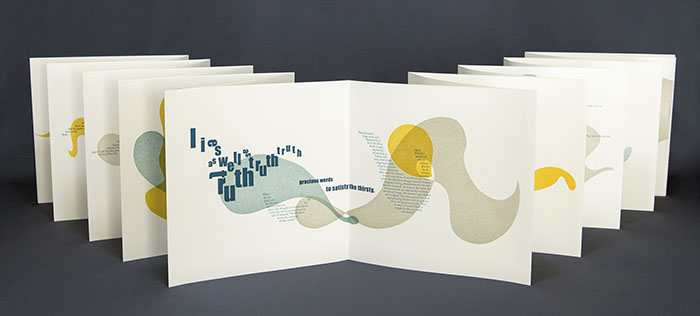
Meanwhile by Macy Chadwick, Limited edition artist book: Letterpress, relief printing; accordion structure in half-clamshell box. Edition of 40, 2017. Photo: Bernhard Uhl

Nanette: When was that?

Macy: I moved to Berkeley in 2003. I had graduated from Wash U in 1994. The rest of the nineties I lived in Portland, Oregon. I studied with Barb at the Oregon College of Art and Craft, which has since closed. Then I went to grad school at the University of the Arts in Philadelphia, from 2001 to 2003. UArts closed recently as well.

Read more

Rebecca Gilbert, printmaker

A Conversation with printmaker Rebecca Gilbert

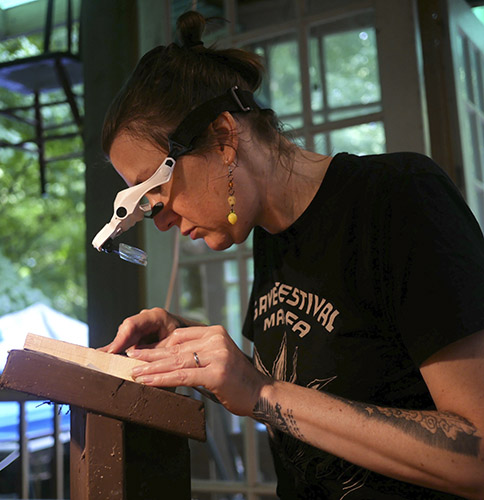
Rebecca engraving at Jim Horton’s studio in Ann Arbor, Michigan. Horton gave Rebecca her very first lessons in wood engraving in 2013. Photo: Tony Drehfal, another master wood engraver.

Rebecca Gilbert is a printmaker’s printmaker—impressively knowledgeable about printmaking history, and historical and contemporary print processes. Rebecca astounds with her joyful commitment to a seven year long project based on Hans Holbein’s Dance of Death. Rebecca’s own dance demonstrates an insightful perception of humanity delivered with generosity, depth, and a fresh lightness of the creative spirit.

This conversation took place under a large oak tree during a summer printmaking residency at In Cahoots Residency in Petaluma, California.

Nanette: How did you come to art?

Rebecca: I pretty much always wanted to be an artist. Since elementary school at least. And I was actually just thinking about this the other day. I met my best friend in elementary school, Bobby Riefsnyder, on the first day of kindergarten. We would play together every day after school. I would pretend that I was an art teacher and he would pretend to be a music teacher. We probably played that every day for a couple of years, and it never got old, so I feel like I always knew I wanted to be an artist and I always knew I wanted also to be an educator. Even then, I thought of those as two different things that you could merge into one, and they are two totally different sets of skills. When I went to college, I started as an art education major, because that seemed like the most obvious way to pursue both. I don’t know what art education programs are like now, but at that time, I found that learning about art and making art weren’t very important in that major. All of the focus was on teaching, and art barely even felt secondary, so I changed my major to printmaking.

Nanette: As an undergrad?

Rebecca: As an undergrad, yes.

Nanette: And why printmaking? They actually had a printmaking major?

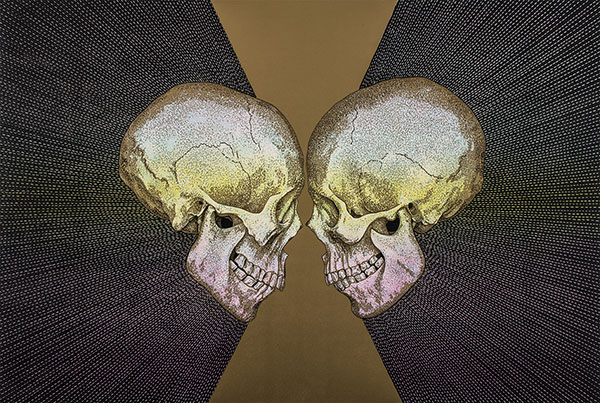
Memento Mori (Skulls) by Rebecca Gilbert, Reduction and multiple block color woodcut, 26.25″ x 37.5″, 2019

Rebecca: Yes. I made my first print in high school. It was a monotype. I was thinking about this recently, too. I forgot that monotype is what made me fall in love with printmaking. I was hooked after the very first one, and I very rarely make monotypes these days. My high school had one little press that they would wheel out of the closet every now and then so we could make some prints, and I loved it.

In college, I had taken a bunch of printmaking classes, even as an education major. Besides the process involved in making a print, I just love all the tools and gadgets and presses, and all the printmakers seemed a little dangerous, edgy.

Nanette: More edgy than the other artists?

Rebecca: Yeah, yeah. [laughs]

That was part of what initially drew me to it. There’s such a long list of everything that I love about printmaking that keeps me drawn to it now.

Nanette: So, you were a printmaker right off the bat?

Read more

Christopher Hartshorne, printmaker

A Conversation with printmaker Christopher Hartshorne

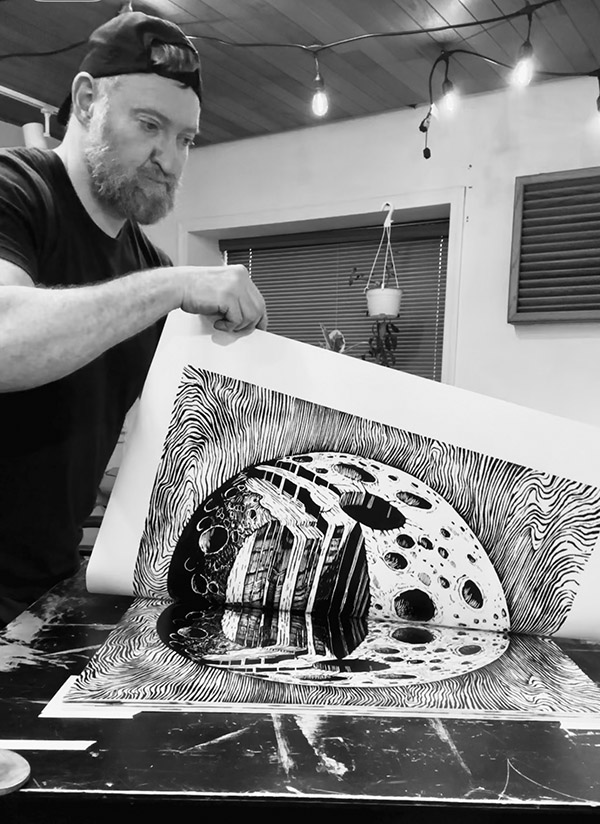
During the summer of 2025 Christopher Hartshorne and I worked directly across from each other, at a printmaking residency at In Cahoots Residency in Petaluma, California. We were each at lovely large etching presses where daily I found myself appreciating the gift of being able to observe his process of pulling richly beautiful, futuristic moons—a memorable highlight of my own residency experience.

When we noticed the local blackberries were in and ripe, Chris picked a bunch to bake us a blackberry crumble. It was almost as delicious as Chris’ prints.

This conversation took place towards the end of our residency in the etching studio.

Christopher Hartshorne printing the Graphic Myths series

Nanette: How did you come to art?

Chris: I always made art as a kid. I was so shy, I didn’t try other things. Very introverted. It was like an escape, or something that I could do. And I got a lot of positive reinforcement as a kid. I was known as an artist as a kid. So I kind of stuck with it.

Nanette: Like drawing?

Chris: Yes, drawing. I’ve tried to do other things, but I always come back. I’m like, I’m an artist. I’ve got to keep making art.

Nanette: Why printmaking?

Chris: I was painting and I went to school for illustration, never did any printmaking in school, like in college, but when I discovered woodblock printmaking, I liked the process. It was a very definite process. You transfer an image, you carve the image, you print it, you kind of know what it’s going to look like, very graphic. A painting to me was too mysterious. Maybe I didn’t know how to paint. I was a painter, but I didn’t know when a painting was done. There was something really crisp and clear about printmaking and the way I was using it. I latched onto the process immediately. I loved how you could make an expressive, almost random mark on a piece of wood and it looked so defined and intentional when you printed it, because it’s so graphic and bold. That was really cool to me. The marks you can make and how bold they are compared to painting. But now I’m thinking of printmaking differently, actually. A print can be more mysterious, like a painting. So now my views are broadening. That’s how I latched onto printmaking, the process.

Nanette: How long have you been printing then?

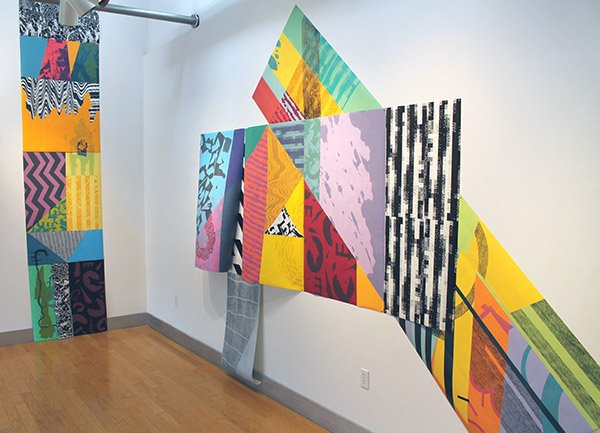
Christopher Hartshorne: TempleGRAM, Multiple block woodcut installation, variable dimensions, 2019

Chris: Probably 20 to 25 years. I just started doing it on my own.

Nanette: After school?

Chris: Yes, I was hand pressing, with no community yet. I just started doing it and then kept doing it. I eventually went to grad school for printing, because that’s all I was doing.

Nanette: Many of the artists that I’ve met go in through painting, because painting is seductive and it’s elevated. It used to be, you were a painter or a sculptor. And that’s all there was for fine art. So I think it’s normal to go in through the magic of painting. What grad school did you go to?

Chris: I went to Tyler School of Art.

Nanette: How was your grad school experience?

Chris: It was good. I waited ten years in between BFA and MFA so I was older than everyone. I really wanted to immerse myself in printmaking and school for printmaking, but I actually did not really feel like going back to school. But it was good because they have a program in Rome, through the school, so the whole second year I was in Rome and it was more like a residency, which . . . why am I going to school if I’m just doing an artist residence? But it was really amazing. I would never have gone out of the country back then if it wasn’t for the program. It was my first time out and it was pretty cool. I had a small cohort of five other grad students from Tyler and a bunch of undergrads that were from a lot of different schools, just getting some international school experience. It was good.

I was scared to leave the country. I don’t know. I’m a homebody, but it was really, really amazing for me to leave, and see more than just the art experience.Just to see how other people live, non Americans, [laughs] was very good for me to see as an artist and a human, or an American, I guess, so that was pretty cool.

Read more

Sophie Loubere, visual artist

A Conversation with printmaker Sophie Loubere

Sophie Loubere stands out as an artist invested in the conceptual nature of historical imagery while exploring materials and processes. She moves deftly through a range of studio practices — working with wood type on a Vandercook, hand working intaglio plates, exploring natural dyes, papermaking, creating multimedia installations, book arts, and writing. We met during a summertime printmaking residency at In Cahoots Residency in Petaluma, California. Our conversation took place in the etching studio towards the end of our residency.

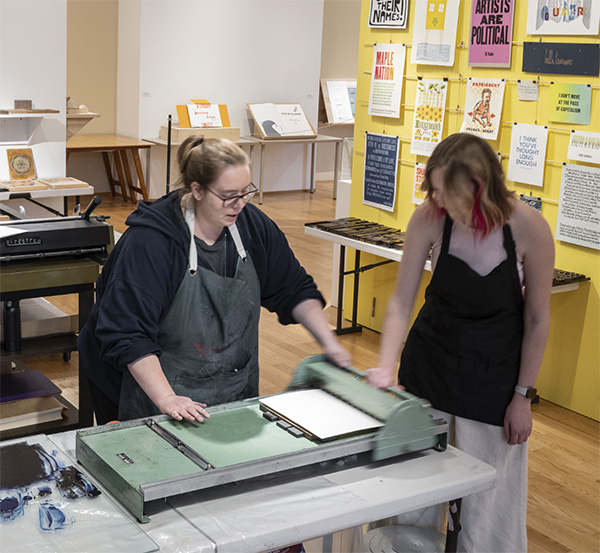
Sophie Loubere giving a printmaking demonstration at the Bainbridge Island Museum of Art in Washington state. Photo by Laura Zander

Nanette: How did you come to art?

Sophie: I started in elementary school, and it was just something that I was good at. I started using chalk pastels, making pastel paintings, getting positive responses, and then I just kept on going. Eventually it was just one of those things where it just felt like it was what I needed to do, which I’m sure a lot of artists can relate to.

Nanette: Did you go to art school right after high school?

Sophie: I went to the University of Illinois at Urbana Champaign, and I was an art major. But while I was there, I was just feeling like the curriculum wasn’t really serving my needs, so I wound up transferring to Rhode Island School of Design in their illustration program. 

I’ve always been interested in words and books and writing . So for a while, I thought that I would potentially become an illustrator. But then my interests just wound up being a little too noncommercial, a little too artsy fartsy, more interested in material, more interested in concept, and making artist books as opposed to illustrations for editorial and things like that. 

When I went into the illustration program, I didn’t fully understand that the conventional commercial way of making money doing illustration would be to make illustrations for editorial magazines or for working in animation and designing characters for game studios and things like that.That just was not really where my interests lay. Then one winter session, I wound up taking a printmaking course, Painterly Prints, and I learned aquatint and monoprinting. 

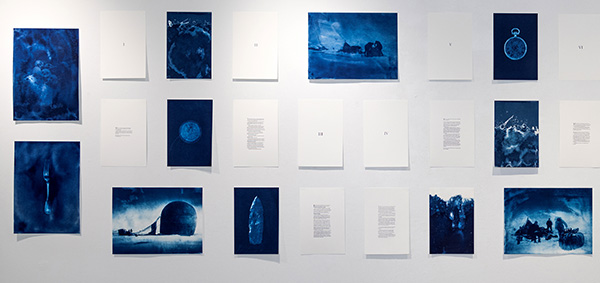
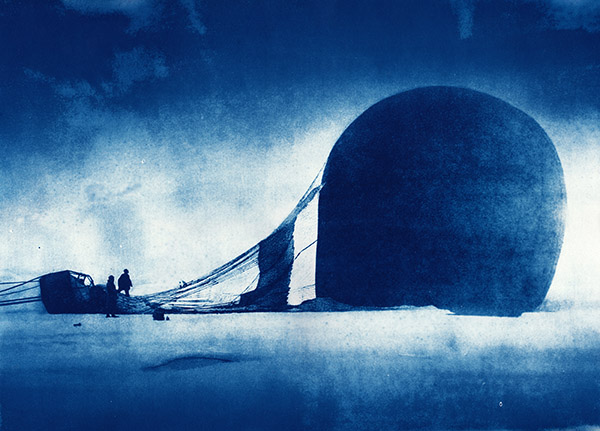
Sophie Loubere: Relics, Cyanotype, letterpress, archival imagery. Partial view of 20′ x 6′ installation of literary vignettes, cyanotypes, and audio and video based on historical research, 2022

After that I was really into etching. I spent my senior year mostly doing etching projects working on this extended sort of book project. After I graduated, I set up my own studio in Seattle. I was working as a graphic designer and publications manager at a nonprofit art school. I had a little studio and I wound up getting some grant money so I was able to get a little press. Then I basically just explored varieties of ways of doing printmaking. I was feeling a little bit frustrated because I didn’t have a conventional printmaking background because I hadn’t majored in it when I was an undergrad. I was trying to learn from books, YouTube videos. I taught myself how to mezzotint, and eventually I just felt like I needed some more specific background. I applied for grad school. I got into a grad school that had a pretty in-depth printmaking program and that’s where I honed both my practice as well as my printmaking skills.

Nanette: So you’re primarily a printmaker?

Sophie Loubere: Relics, detail

Sophie: At this point, yes. I’m open to making in pretty much any particular way. I have worked with fabrics before. I’ve done installation. I’ve done audio and video work to go along with the prints. But I think that primarily when I’m thinking conceptually, the majority of the time it winds up being a print in some way or other, and print doesn’t necessarily mean something that is like a letterpress print. I also have done things working with cyanotypes and alternative photography. I view those things as prints as well.

In my view, there’s a lot of different meshing that goes on between all these different artistic media. I would say that printmaking falls into a lot of different categories.

Nanette: Are you still making books?

Read more

Sinjin Jones, transmedia artist

A Conversation with Sinjin Jones, transmedia artist

Sinjin Jones is a transmedia artist, storyteller, and poet interested in the connections between diverse media forms which allow him to combine these in interesting ways. In 2019, shortly before the reality of a global pandemic, Jones became the Executive Artistic Director of The Pear Theatre in Mountain View, California.  

Sinjin Jones in 2024. Photo courtesy of The Pear Theatre.

Jones has a long history of engaging in live performance. From his student days until he moved to the Bay Area, Jones spent his summers working for A Theatre Group in Silverton, Colorado where he wrote, directed, and eventually became their Artistic Director and Vice President of their Board of Directors. He has founded a non-profit, multimedia artists’ collective called Otherworld Collective; and co-founded Perplexity Pictures, a film production company. He has a background in teaching performance arts at all levels, and is currently teaching for The Pear’s outreach programs. Jones has a Bachelor of Arts in Theatre, Film, and Video Production from the University of Colorado, Denver; and an MFA in Creative Writing from Regis University.

At The Pear, Jones is developing dynamic, engaging, and fresh programming that both surprises and challenges.
His leadership consistently demonstrates his rich intellect and deep investment in local communities. We spoke over tea at an outdoor cafe on a lovely spring afternoon.

Nanette: How did you come to theatre?

Sinjin: When I was a kid I would tell stories to myself. We were very poor and didn’t have access to theatre. We would go to the dollar store and I would get to pick out one thing. I would pick out a [cassette] tape because my mom had a radio that also had a tape recorder. I would go into my room at night and tell stories to myself, improvised stories. That turned into getting together with the neighbor kids to tell stories. I would write stories and we would perform them. This was second and third grade, and I didn’t really know what theatre was, only to some small extent. Then my elementary school turned into a school of the arts and I got to take some theatre classes. I think that’s the beginning. I consider myself to be a storytelling artist, but that live act of performing in front of people or seeing story come to life in person has always interested me. That’s really the start of it all.

More formally, I did theatre in high school. I was deciding between archaeology and theatre/film for college. The University of Denver had a program where you could do theatre and film at the same time, so I was sold. The idea of storytelling is really beautiful to me. I’ve practiced a lot of different forms of art, many are less collaborative than theatre is. I like the coalescence of different artists from different backgrounds and different skill sets coming together to create one unified portrait of something.

Nanette: Did you grow up in Colorado?

Sinjin: I did.

Nanette: Denver has a really good art scene.

Sinjin: They do. I am very lucky. Downtown Denver has a ton of public art. In college, one of the assignments for one of my theatre classes was, “Here’s a map of downtown Denver. Go see as many of the public art pieces as you possibly can.” That is very lucky. It’s nice to have a lot of public art to experience and just be around.

Nanette: You demonstrate an immense amount of theatrical knowledge, and it is apparent by your presentations that developing a contemporary and engaging season requires broad and deep research. What is your process from seed to completed season?

Read more

Cynthia Sears, Champion of the Arts

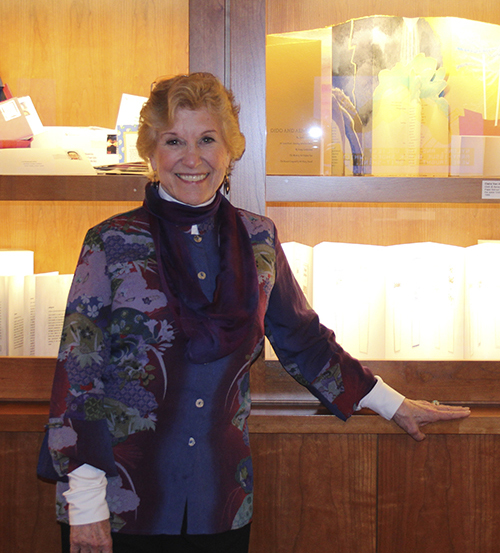
Cynthia Sears smiles as she stands in front of a well lit display case filled with handmade books.
Cynthia Sears in the Sherry Grover Gallery at BIMA.

Meet Cynthia Sears, Champion of the Arts

Cynthia Sears is a creativity explorer and the founder of the Bainbridge Island Museum of Art (BIMA) on Bainbridge Island in Washington State. She is known for her extensive support of artists, writers and cultural entities. Her collections include paintings and sculptures; antique and finely bound books; and some 1800 artist’s books, which comprise the Cynthia Sears Artist’s Books Collection at BIMA.

A pioneer in cultural support, Sears has collected and donated numerous works of regional artists to BIMA, creating a rich legacy of Pacific Northwest artistic production. Her wide ranging appreciation of the arts is demonstrated in BIMA’s community-centered mission and diverse programming which includes musical and theatrical performance; hands on educational activities; lectures, tours, and a wide array of community outreach events including an online series Artist’s Books Unshelved. This year BIMA is launching four generous biennial awards to support both regional artists and an artist making books. These BRAVA Awards (BIMA Recognizes Achievement in the Visual Arts) are in celebration of the tenth anniversary of BIMA in 2023, and a further expression of Sears’ belief in the value of the arts to human existence.

We conversed via zoom over a span of four months, discussing a range of subjects which touch on aspects of Cynthia’s life and thinking, including her work in radio and film, social and environmental issues, collecting and philanthropy, education, and the arts. 

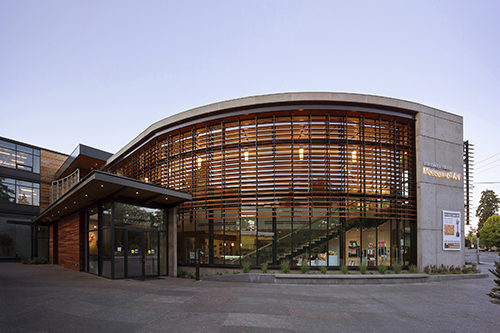
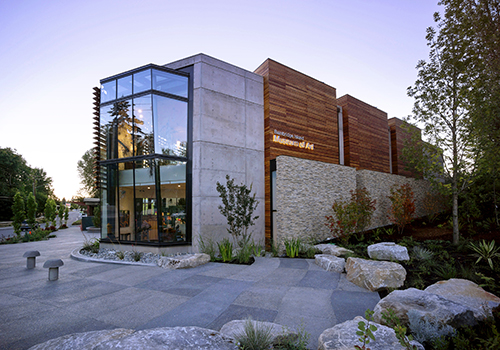
Bainbridge Island Museum of Art. Photo by Art Grice.

Nanette: What is your background: growing up, education, early careers? 

Cynthia: I spent my childhood in Beverly Hills. I went to public school through eighth grade and then to a girls’ boarding school in Virginia, Chatham Hall. I was actually relieved that I wasn’t going to Beverly High because the girls that I knew in 7th and 8th grade who were going there were so much more sophisticated than I was. They were very concerned with boyfriends and convertibles and cashmere sweaters. . . they were already like late teenagers. I wasn’t ready for any of that. The idea of going off to a place where you had lessons in the morning and then rode horses in the afternoon was heaven. My older sister went to Chatham first. I couldn’t wait to go because I met many of her friends, whom she would bring home during vacations. They were great, interesting girls, so I couldn’t wait to go. Going to that boarding school was one of the great experiences of my life. 

Then, I went to college at Bryn Mawr in Pennsylvania, also a small institution. The entire student body was only 750 girls. It was out in the country and beautiful. I just loved it. It looked like a medieval fortress—towering gray stone buildings which were built out of mica schist which catches the light so that it sparkles in the sun (I learned in my geography class). 

I studied English Literature and Latin. I was sure I was going to be a writer. Well, that didn’t happen, but I was convinced of it when I was in college. I had a wonderful experience with terrific people. 

Bainbridge Island Museum of Art. Photo by Art Grice.
Bainbridge Island Museum of Art. Photo: Art Grice.

Nanette: What happened after college? 

Cynthia: After college I got a wonderful job teaching in the Bronx. I was a teacher at the Hoffman School. It was a school for kids who didn’t exactly fit other places, either because the child was super intelligent and could get bored in a regular classroom, or kids who had physical or mental challenges. They were all mixed together in the classes and it really worked. It was extraordinary. 

I was hired as a Latin teacher. I taught Latin to second through sixth grades. We made Latin books and grammar books. They would say things like, “If the verb goes at the very end, how do you know who is doing what to whom? Maybe you make sounds so that you know this is the person who is doing the throwing and this is the thing being thrown.” They basically invented the accusative case. 

Read more

Judith Selby Lang, artist

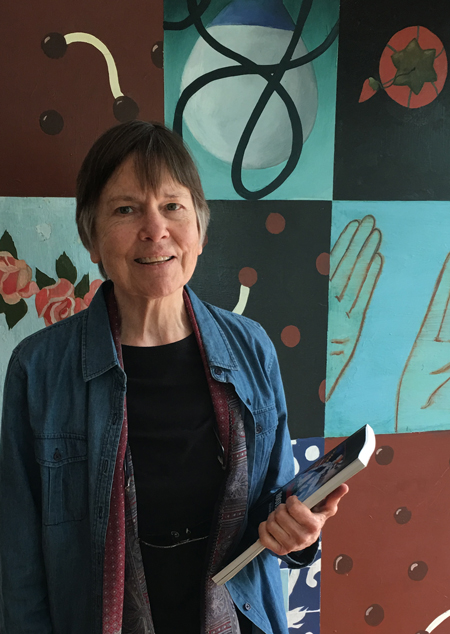
Judith Selby Lang

Judith Selby Lang’s website states that she “is an artist committed to the creation of positive symbols and life-affirming images to help energize the conversation about social, political and environmental issues.” This is a perfect description of the uplifting and transformative nature of her multi-dimensional art practice as well as a reflection of her demeanor and personality—creative, positive, life-affirming, energetic, and openly communicative about critical concerns that affect us all.

Lang’s work includes artist’s books, mixed media objects, and a wide range of projects using plastic debris collected from 1000 yards of one beach on the Northern California coast. Lang has an extensive exhibition history. She currently has a large scale beach plastic installation in The Secret Life of Earth: Alive! Awake! (And possibly really Angry!) at the American Visionary Art Museum in Baltimore, Maryland; and will be showing in The Great Wave: Contemporary Art about the Ocean at the Bedford Gallery in Walnut Creek, California in early 2020. Her current project is creating a wedding dress made from recovered plastic bags for exhibition in Castaways: Art from the Material World at The Bateman Foundation in Victoria, British Columbia, which opens in Spring of 2020.

Lang has a BA from Pitzer College and an MA in Interdisciplinary Studies in Creative Arts from San Francisco State University. She spent many years teaching art in a variety of North Bay (California) venues before turning her focus to the studio full time. With a barn full of beach plastic—washed, sorted and boxed—collected over the years, Lang has an immense body of work, both independent and collaborative, which reflects our times while engaging viewers from all walks of life in conversations regarding possibilities for improving our environment.

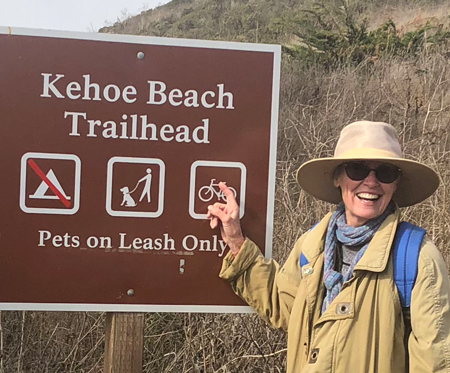
We visited on a bright fall afternoon in her rural Forest Knolls studio, just a short drive to Kehoe Beach.

Nanette: How did you come to art?

Judith: Defining myself as an artist was a long time in coming. I thought I would never have the patience to be an artist. People have this preconception that art is a wild and spontaneous activity but don’t know that after the flash of inspiration sometimes a long and tedious effort is required to realize the vision.

I grew up in a family that was art friendly. My dad and mom both painted. We went regularly to the art museum. In 1962 my parents took me to the Dallas Museum of Art where I saw Andrew Wyeth’s painting That Gentleman.

The painting drew many to the museum—there were long lines with stanchions and velvet ropes to control the crowds. Was it because curious onlookers wanted a glimpse of a painting of a black man? Mind you it was a simple scene of a black man seated, in dusky light, in a moment of repose. It’s of Wyeth’s neighbor Tom Clark. To me it seemed a radical move for the museum to exhibit a painting of a black man especially at a time when segregation still existed in the South. I remember water fountains with signs for whites only, for blacks only. This was 1962, years before the Voting Rights Act of 1965 and the Civil Rights Act of 1968. Perhaps it was the shock to the public that the museum had purchased the painting or maybe, it was, as I would like to think, that there was tremendous interest in seeing a masterwork by a great American artist. Either way there were people, lots of people waiting for their turn to view the painting.

The line moved slowly in a kind of reverential prayer and when it was my turn I stepped up in front of the painting to gaze with wonder not only at the power of the image but also the incredible finesse of the brush work. Something in my young heart was deeply moved. At that moment I made a commitment to art. I made my pledge to become an artist. That an image could have such an incredible impact on me and the people who had come to the museum was something that I too wanted to accomplish. On that day, at age twelve, I knew that I wanted to do something that would make a difference—to make art that would shine a light on injustice in the world.

Read more

Jan Rindfleisch, artist & curator

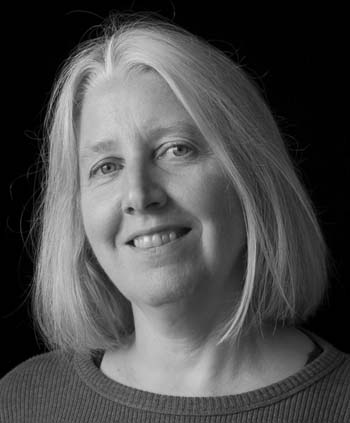
Jan Rindfleisch

Jan Rindfleisch is an artist, educator, writer, curator, and cultural worker. She was the executive director of the Euphrat Museum at De Anza College in Cupertino for 32 years. During that time, Rindfleisch laid the groundwork for an engaged and inclusive museum environment by continuously tapping the diverse local voices of Silicon Valley. Rindfleisch continues her work as a community builder with Roots and Offshoots: Silicon Valley’s Arts Community, a history of the art of the greater South Bay area from the post-Mission era artifacts of the Ohlone peoples to the artists and activists that have made the western/southern half of the Bay Area the rich and vibrant scene it is today.

Rindfleisch has a BA in Physics from Purdue University and an MFA from San José State University. Her awards include: Silicon Valley Business Journal Women of Influence (2014); San José City Hall Exhibits Committee (2006–2013); The ABBY Awards (2010); Silicon Valley Arts & Business Awards; Arts Leadership Award; Santa Clara County Woman of Achievement, (1989); Leadership Vision Award in the Arts, Sunnyvale Chamber of Commerce (1993); Civic Service Award, City of Cupertino, Cultural Arts, and the Asian Heritage Council Arts Award (1988).

Nanette: What was the impetus for you to write this book?

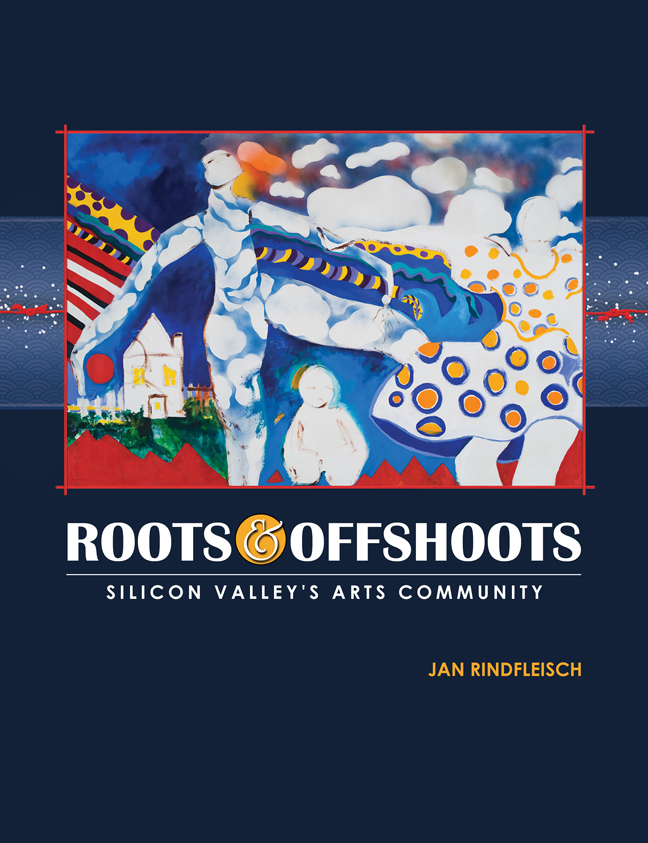
Roots and Offshoots cover image

Jan: I am one of those people that love to question boundaries. I started thinking: How did we get past the exclusion in the art world in the monochromatic 1970s, which didn’t reflect the breakthroughs of the 1960s, such as women’s rights and civil rights? How did we take that early cultural landscape, break new ground, and build new forms for the future? After decades as an arts museum director and a lifetime career as an artist, author, community advocate, and educator with an earlier background in the sciences, I decided to put some of the explorations and findings together.

My book and project Roots and Offshoots: Silicon Valley’s Arts Community begins with an essay entitled The Blossoming of Silicon Valley’s Arts Community and a profile of artist/activist Ruth Tunstall Grant. A Spiral Through Time follows threads between the ancestral Muwekma Ohlone, Juana Briones in the 1800s, Marjorie Eaton and her arts colony in the 1900s, and artist Consuelo Jimenez Underwood today. Over a period of years of research and writing, the book grew to about twenty profiles and two additional guest essays; one by Maribel Alvarez about MACLA, “Doing that Latino Art Thing,” and the other by Raj Jayadev about Silicon Valley De-Bug, “The Anatomy of an ‘Un-Organization’.”

There are people in Silicon Valley connected with incredible history, but their story isn’t being told. Their experiences tell a different story of who we are. Origins of organizations are often forgotten or rewritten, and the originators erased. How can one or a few names stand for an organization/period/idea and the rest be forgotten? How does this erasure affect our view of ourselves as creators and as being worthy of judging or promoting art, or taking a larger role in our community? I wanted to add some of these missing pieces that contribute to a richer story of Silicon Valley’s art scene. Frustration with systems can be a motivating force. Another big personal motivation was gratitude. This book is a way to thank so many people who paved the way and with whom I worked.

Nanette: The Bay Area is deeply rich in terms of cultural diversity and creative output. How did you determine which groups to represent, likely knowing that you could not include them all? Who was left out? Will there be a second volume?

Jan: The book is not a survey of the South Bay Area scene. I wanted to tell the story of the trailblazers who truly made a difference in Silicon Valley, and to provide broader historical context for their experience. A major/shared motivator was to share with the reader how the artists/activists in this book enrich us personally. The artists/activists open us to the art of daily life, and to the artist within each of us. They get us to examine ourselves, to question our lives, and to think freely. They inspire us to dream and imagine and effectuate change—to build connections (not walls!) and enliven our communities.

Read more

Alice Templeton, poet

Alice Templeton is winner of the New Women’s Voices Prize in Poetry (2008), which she received for Archaeology: Twenty-one Poems. Alice is a poet, musician, songwriter, educator, and scholar. In 2007 she received the distinction of honorable mention from the Robinson Jeffers Tor House Foundation for her poem Homing. Journals which have published her work include: Poetry, 88, Puerto del Sol, and Many Mountains Moving. She currently teaches creative writing and literature at the Art Institute of California in San Francisco.

alicetempleton_sm

Whirligig: When we first met you told me your poetry was about nature, but it actually encompasses so much more than what might typically be called nature poetry. I see yours as more like landscapes with an aftermath of human residue. What inspires you to write?

Alice: That’s a wonderful description of it. I think I am very place oriented, and that place is the way I measure what I feel and think. In the poetry I try to define, through concrete imagery and language, where I am so that I can know how far I’ve come—what my thoughts are now, what my feelings are now.

I often write about the places that have been meaningful to me, like my parents’ farm where I lived during high school and have continued to go back to throughout my adulthood. I think those images, those cycles of labor that we went through on the farm, were formative in my sense of who I am and what language is. I hear my parents’ voices and phrases a lot. I hear that connection between the language and the tools and the landscape. So landscape does shape my poetry, but I’m also interested in and driven by philosophical and cultural questions like: What is justice? and What is history?  Hopefully those human things inform my poetry as well.

Read more

Kent Manske, visual artist

A Conversation with Artist Kent Manske

Kent Manske is a visual artist working in traditional and hybrid forms of print media. He is a professor of art at Foothill College where he teaches graphic design, printmaking and books as art. His MFA is from The School of the Art Institute of Chicago. This interview was conducted upon the publication of a book on Kent’s work titled Re:ad.

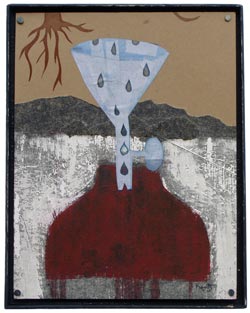
funnel

Whirligig: Why do you make things?

Kent: To make sense of things I don’t understand, like my feelings about humanity. I’m compelled to process matters of our existence, like why we believe what we do. I make things to find my own peace, even though much of what I explore is not peaceful. Sixteen thousand people die per day of hunger related causes. The Arctic is melting and the oceans are rising. Exploring issues and concerns help me recontextualize my own reality and make sure I’m not living in a total state of deception. Art helps me to take responsibility for the privileges I’ve inherited.

Read more