Deborah Shea, muralist & pastels

A Conversation with pastel artist and muralist, Deborah Shea

Deb Shea is a visual artist of floral wonder. Shea, a colorist currently working primarily with pastels, studied art and design at UC Davis where she began a career as a graphic designer. Shea worked in design and branding for many years before focusing her attention on her own art practice, which includes pastels, fiber arts, and public art murals. We conversed, with intermittent laughter, in her studio at Art Bias and then visited her solo exhibition, From Bud to Bloom, in the Art Bias Gallery.
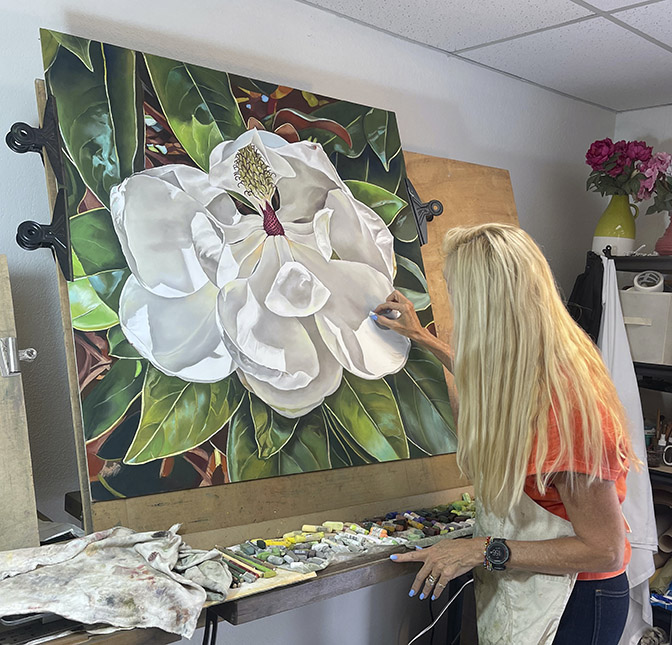
Deb Shea at work in her studio at Art Bias in San Carlos, California.

Nanette: Tell me about your background.

Deb: I studied studio art with Wayne Thiebaud and Roland Peterson. They were great. Thiebaud was an especially wonderful professor, and a very wonderful painter and colorist. I really enjoyed that quite a bit.

I had to work while in school to support myself. I had a scholarship and worked as a graphic designer to pay for my education. I did graphic design for several different agencies in the college: the newspaper, posters for Arts and Lectures, all that kind of stuff. I took that up as my career after I finished school. I was hoping to go to San Francisco Art Institute for graduate school, but I never had enough money. I was paying off my student debt for quite a while. So, I became a designer! I worked for a while in Sacramento, then I moved to San Francisco. I continued to be a designer, then an art director, and then a creative director.

I moved from San Francisco to the peninsula about 30 years ago. I worked for two or three software companies as a creative director. One was based in Oslo, so I was traveling to Norway quite a bit, and two other software companies. I had my own marketing business for about ten years. I was doing artwork as well but primarily designing, illustrating and branding—a lot of branding and identity work, for many kinds of companies.

Then the recession hit in 2008. So, my business really suffered after that. Marketing budgets kind of go by the wayside when you have a real economic crisis.

I started to work full time for a client for about five years. Being a creative director and doing all the illustration and design work for all their packaging.

Nanette: Was that Pamela’s?

Deb: That was Pamela’s. I worked for Pamela for about 25 years altogether. I first started freelancing for her when my daughter was born, and then slowly but surely, her company grew and grew. When I first met her, it was just her and her warehouse manager. So, we went through a lot together! After some years, I had enough of working for a small company and a lot of deadline pressure that was very stressful.

Then I had a bit of a health scare. I got over that but decided it was finally time to dedicate myself to my art full time.

Nanette: Were you engaged in your own personal artwork while you were having a design career?

Deb: I was.

Nanette: Has it always been pastels?

Deb: No. Previously I did a lot of acrylic work and collage work. I did take some courses at the Art Institute in San Francisco. It was wonderful. I did a lot of very large oil paintings and acrylic paintings in those classes.

Nanette: But now you work primarily in pastels?

Deb: Yes primarily. It’s a medium that I started working with for my illustration work, because a client was looking for an artisan feel to the packaging design. So, I started to do pastel drawings. My employer was paying for all my supplies. They said, “Buy anything you want.” That was great, because I got to use really nice stuff. Then I had deadlines, of course. So, I learned to really dive into the medium. I was enjoying it very much, too. That was fun.

Nanette: What is it about pastels that engages you?

Deb: I got some pastels from my grandfather went I was very young. I’ve always been very comfortable in drawing. I really, really enjoy the emotional quality of drawing. I think that was one of the reasons why I kept up with my artwork while I was a designer. There was such a great emotional attachment to touching things rather than working on a computer. I also love to do things in textiles, like knitting, and crocheting, and felting, and that kind of stuff, working with the paper flowers. . . I love making things. So, pastels, I’ve always loved their quality, the velvetiness of them, and the super beautiful colors.
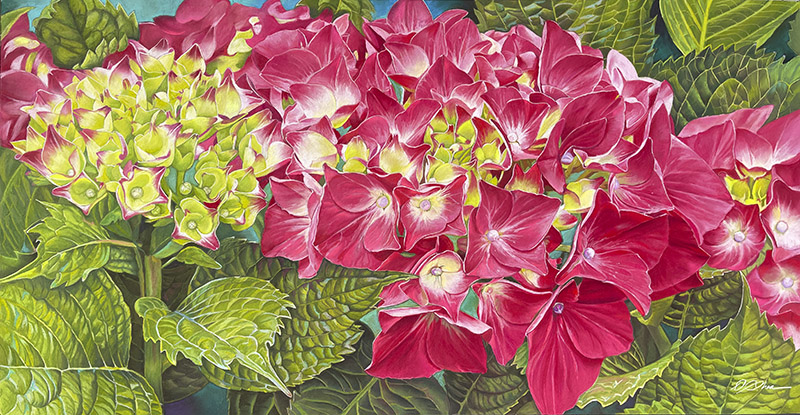
Love at First Sight, pastel on board 28" x 54" by Deb Shea, 2026
Love at First Sight, pastel on board, 28″ x 54″ by Deb Shea, 2026

Nanette: The tactile thing—do you feel like you can get your hands into the pastels more than you can with paint?
Read more

Katherine Bazak, painter

A Conversation with Katherine Bazak by Sharmon Hilfinger

Katherine and I were introduced to each other by a mutual friend over 30 years ago, when we were both establishing our creative careers while starting our families. Kindred spirits working in different métiers, we have shared our experiences as creative artists ever since. Her exquisite painting of Lucy Drawing graces our dining room and never fails to draw comments from people who see it for the first time.

Sitting down now, so many years later, to talk to Katherine about her career as a figurative painter and teacher has been a fantastic lesson in how to look at art. Talking with Katherine is like going on a tour of the painter’s process, exposing how the materials, color and composition reveal the artistic intent. She reminds us that great artwork is not accidental; it is deeply understood and performed by its creator.  Katherine is exceptionally articulate with her paintbrush as well as with her ruminations on art and how it works.

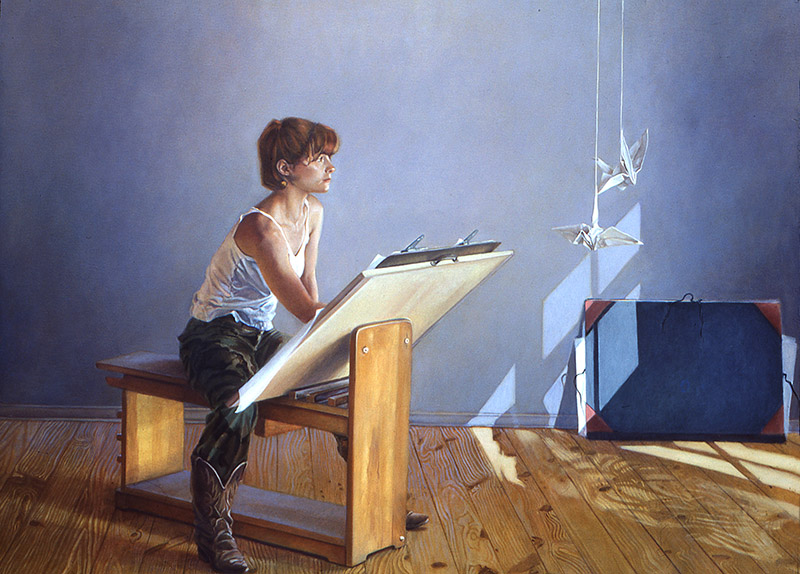
Lucy Drawing, Oil on canvas, 52" x 72" by Katherine Bazak, 1984–85
Lucy Drawing, Oil on canvas, 52″ x 72″ by Katherine Bazak, 1984–85

Sharmon: You and I grew up in the 1960’s and 70’s when the art trends were Conceptual Art, Minimalism, Pop Art, Psychedelic Art. But you have always been a figurative painter—a very fine one, I might add—so I am curious to know what influences and training led you to your personal style of painting.

Katherine: My visual education started at an early age. On Sundays, my father would leave my brother and me on the steps of the National Gallery in Washington DC at 9:45 a.m. before he would go to the golf course about 15 minutes away. We sat on the steps until the Gallery opened—nobody was worried about us, there were guards who knew us. This started when I was 10 years old. I wandered around the museum while my brother sat in rooms that had paintings of boats and read a book.  

One of the first paintings I loved was by Mary Cassatt, a girl with a braid in a white outfit, and another Cassatt of a little girl in a blue chair. Another favorite was by John Singer Sargent called Repose. I spent a lot of time in the room with the Vermeer’s. I remember the painting of a woman with a beautiful jewel-like red hat. 

I loved the Titian room! The Portrait of Farnese with the pink vest, Venus Holding an Apple, Venus and Adonis, the Portrait of the Doge—those paintings have been with me my whole life. There is something going on in those paintings—something behind the eyes of the people he painted.  I could just look at those and know that the painting of Titian’s Doge was better than the other Doges in the room.  

At that age I had no idea who these painters were! But by the time I left high school I had walked through every room at the National Gallery. For a visual person this was heaven.

Every once in a while, we would go to the Phillips Gallery that has a big pre-and-post Impressionist collection. That’s where I saw Renoir’s Boating Party. Some hear the name Renoir and think of peachy-pink people. I mean old ladies love Renoir. In the Boating Party—they’ll say, “he painted the light” which is a cheesy thing to say, but he did! When you see the Boating Party you can feel the wind, you can feel the sunlight. It’s a very evocative painting. It took me a long time to understand and respect this aspect of representational painting.  

There are paintings that I just want to stand in front of and spend time looking at or revisit. Why do certain paintings interest me?  I’ve thought about that a lot and now looking back, I realize that I have always been a ruminator. I love the way some paintings offer me a way to ruminate.  All my paintings have something to do with that. 

Read more

Christopher Hartshorne, printmaker

A Conversation with printmaker Christopher Hartshorne

During the summer of 2025 Christopher Hartshorne and I worked directly across from each other, at a printmaking residency at In Cahoots Residency in Petaluma, California. We were each at lovely large etching presses where daily I found myself appreciating the gift of being able to observe his process of pulling richly beautiful, futuristic moons—a memorable highlight of my own residency experience.

When we noticed the local blackberries were in and ripe, Chris picked a bunch to bake us a blackberry crumble. It was almost as delicious as Chris’ prints.

This conversation took place towards the end of our residency in the etching studio.

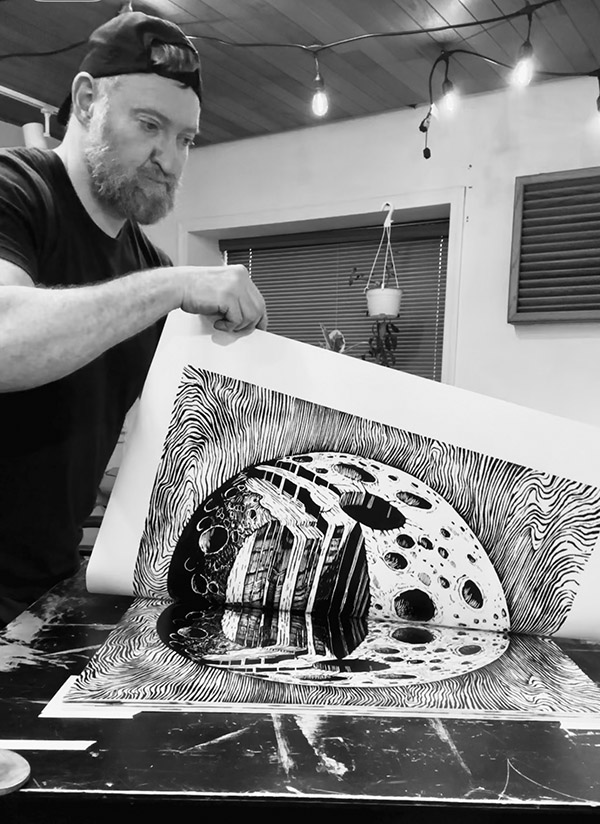
Christopher Hartshorne printing the Graphic Myths series

Nanette: How did you come to art?

Chris: I always made art as a kid. I was so shy, I didn’t try other things. Very introverted. It was like an escape, or something that I could do. And I got a lot of positive reinforcement as a kid. I was known as an artist as a kid. So I kind of stuck with it.

Nanette: Like drawing?

Chris: Yes, drawing. I’ve tried to do other things, but I always come back. I’m like, I’m an artist. I’ve got to keep making art.

Nanette: Why printmaking?

Chris: I was painting and I went to school for illustration, never did any printmaking in school, like in college, but when I discovered woodblock printmaking, I liked the process. It was a very definite process. You transfer an image, you carve the image, you print it, you kind of know what it’s going to look like, very graphic. A painting to me was too mysterious. Maybe I didn’t know how to paint. I was a painter, but I didn’t know when a painting was done. There was something really crisp and clear about printmaking and the way I was using it. I latched onto the process immediately. I loved how you could make an expressive, almost random mark on a piece of wood and it looked so defined and intentional when you printed it, because it’s so graphic and bold. That was really cool to me. The marks you can make and how bold they are compared to painting. But now I’m thinking of printmaking differently, actually. A print can be more mysterious, like a painting. So now my views are broadening. That’s how I latched onto printmaking, the process.

Nanette: How long have you been printing then?

Christopher Hartshorne: TempleGRAM, Multiple block woodcut installation, variable dimensions, 2019

Chris: Probably 20 to 25 years. I just started doing it on my own.

Nanette: After school?

Chris: Yes, I was hand pressing, with no community yet. I just started doing it and then kept doing it. I eventually went to grad school for printing, because that’s all I was doing.

Nanette: Many of the artists that I’ve met go in through painting, because painting is seductive and it’s elevated. It used to be, you were a painter or a sculptor. And that’s all there was for fine art. So I think it’s normal to go in through the magic of painting. What grad school did you go to?

Chris: I went to Tyler School of Art.

Nanette: How was your grad school experience?

Chris: It was good. I waited ten years in between BFA and MFA so I was older than everyone. I really wanted to immerse myself in printmaking and school for printmaking, but I actually did not really feel like going back to school. But it was good because they have a program in Rome, through the school, so the whole second year I was in Rome and it was more like a residency, which . . . why am I going to school if I’m just doing an artist residence? But it was really amazing. I would never have gone out of the country back then if it wasn’t for the program. It was my first time out and it was pretty cool. I had a small cohort of five other grad students from Tyler and a bunch of undergrads that were from a lot of different schools, just getting some international school experience. It was good.

I was scared to leave the country. I don’t know. I’m a homebody, but it was really, really amazing for me to leave, and see more than just the art experience.Just to see how other people live, non Americans, [laughs] was very good for me to see as an artist and a human, or an American, I guess, so that was pretty cool.

Read more

Michelle Wilson, papermaker & book artist

A Conversation with book artist and papermaker Michelle Wilson

Michelle Wilson is a papermaker in an extremely complex sense. Her work with paper is both conceptual and concrete as it extends from the making of sheets for artist’s books and printmaking to social practice, sculpture and installation. As a somewhat recent transplant to the Bay Area, Wilson has quickly embedded herself and her work into the consciousness of the local art scene with a residency at the School of Visual Philosophy, a Small Plates commission from San Francisco Center for the Book, teaching at both San José State and Stanford, engagement with a handful of arts organizations, and many exhibitions.

This summer, Wilson’s collaboration with Anne Beck, The Rhinoceros Project, travels to the Salina Art Center (Salina, Kansas), Shotwell Paper Mill (San Francisco, California), the Healdsburg Center for the Arts (Healdsburg, California), and later this fall to the Janet Turner Print Museum in Chico, California. Her work is included in The Power of the Page: Artist Books as Agents for Change at the New Museum of Los Gatos (NUMU in Los Gatos, California), and Pulp as Portal, Socially Engaged Hand Papermaking at the Salina Art Center in Salina, KS. Wilson has a BFA from Moore College of Art and Design, and an MFA from the University of the Arts, both in Philadelphia.

We got together on a lovely spring afternoon towards the end of the semester to talk about art and teaching.

El Proceso at NUMU by Michelle Wilson. Photo: Robert Wuilfe

Nanette: I first became acquainted with your work in 2010 at an SGCI Conference in Philadelphia, occurring at the same time as Philagrafika, where I came upon a Book Bomb intervention in a public park. How did this collaboration with Mary Tasillo come about?

Michelle: Book Bombs began as a question I posed on Facebook. I was reading about yarn bombing, the tradition of knitting or crocheting something that is then bombed— left in a public space—a form of craft meets street art. I’m not a knitter or a crocheter; I’m a book artist, and so I posted a status update, “What would it mean to book bomb?” Mary took me seriously, and through our conversation, we discussed where people read in public space, who owns public space, and it led us to the idea of park benches. In Philly, every park bench has this center bar installed that is called the “arm rest,” but is designed to prevent a homeless person from sleeping comfortably on a bench. This seemed like an ideal place to install a book. Our project grew from this initial idea. And thus, Book Bombs was born.

Book Bombs by Michelle Wilson

Nanette: What were you envisioning regarding the scope and effects of Book Bombs?

Michelle: We originally saw Book Bombs as just a project for Philagrafika 2010. However, we’ve had so much fun, we’ve continued. It’s been tricky to keep it up transcontinentally, but we manage. Most recently, we did a sort of intervention-workshop at the Center for Book Arts in New York called Keeping the Fire Alive. This was designed as a workshop for activists who were interested in using papermaking in their work, as well using it as a form of self-care against fatigue and for continued resistance. We’d originally proposed the workshop during the summer of 2016, before the election, thinking it would be a very different conversation.

Nanette: How is papermaking used for self-care?

Read more

Angelica Muro, integrated artist, curator, cultural critic, and art educator

A Conversation with Angelica Muro, integrated artist, curator, cultural critic, and art educator

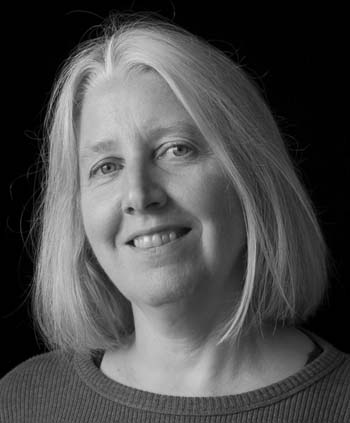
Angelica Muro

Angelica Muro is an integrated artist, curator, and art educator with a strong interest in cultural criticism. Originally from the Central Valley agricultural community of Hopeton, California, Muro grew up on an apple orchard. As a child she became interested in photography, media imagery and popular culture. Muro served as Gallery Coordinator for WORKS/San José for five years, and as Educational Programmer for Movimiento de Arte y Cultura Latino Americana (MACLA, San José, California) for three years. She has a B.A. in photography from San José State University, and an MFA from Mills College in Oakland, California. She is currently Director and Chair of Visual and Public Art at California State University, Monterey where she teaches courses in photography, integrated media and media culture.

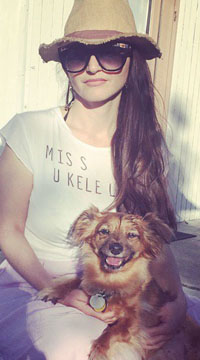
Her newest project, created with Juan Luna-Avin, Club Lido: Wild Eyes & Occasional Dreams opened February 12 at Empire Seven Studios in San José. We chatted over tea in early January, at Angelica’s Japantown (San José) bungalow. Reina Sofí­a, Angelica’s eight-year-old rescue pup, sat on her lap.

Nanette: How did you come to be an artist?

Angelica: I’ve been interested in art since I was a child, but I was never really good at making—I suppose my vision never matched my actual skill set, it still doesn’t. I remember always trying to make things such as sculptures and drawings, but never having the dexterity. Photography came into my life very early—my fourth grade teacher, Mrs. Dixon, had a pile of National Geographic magazines I was pointed to whenever I finished my assignment early—this was the first time I was truly able to look at images, photographs, people. Since then, it’s become my primary area of interest, socially and culturally.

Nanette: The first time you were able to look at images or that you became aware of the power of images?

Angelica: Aware of the power, of ways of seeing, of actually looking. We are so visually saturated, so much so that we are not actually seeing. I read recently that the brain is on a need-to-know basis. Our brains store the information in our environment and we don’t actually see it, even as we know it is there.

I very vividly remember looking through these National Geographics and seeing, seeing things that I had never seen before. It was new information. This is why travel is so exciting, it’s overwhelming new information for us that we are absorbing in a completely different way, and we take that absorption as being creative influences.

Nanette: Much of your work exploits and reveals the tensions between consumer celebrity culture and the realities of working class and immigrant lives in contemporary America, perhaps even specifically California. Who do you see as your audience for this work and what do you hope it achieves?

Angelica: I don’t often think about audience in the traditional sense; although as an educator, I often address ethical concerns involving audience with my students. I happen to live and work in California, so my work deals with the complexities of this eco-system—the spectrum of productivity, exploitation, and the distribution of wealth—and often explores issues of gender, race, and class. I’m interested in social issues, and I find that visual tension inspires me to create.

I think there’s several ways to think about audience—I remember being in graduate school, a time that allowed me to experiment with ideas with a critical, yet limited audience. Suddenly, I had a body of work about being Latina, being a woman, being the daughter of a farmworker, and navigating social constructs. And then my audience became people who where interested in issues of identity. However, my work deals with larger social issues of equalization, socialization, conditioning, and the various codes of gender identification. It’s a dialogue with my community, my artist cohort, scholars, thinkers, curators, and activists who are interested in issues of positionality and privilege. I suppose that in the simplest and most complicated sense, my audience is one interested in issues of difference, otherness, and diasporic culture. I question ideological frameworks of meritocracy, social mobility, and distribution of wealth, because I want to, in small part, be in dialogue with someone, anyone, interested in discourse about the complicated social structure we live in.

Angelica Muro
Agricultural Workers series (Cali-for-nia), pigment print, by Angelica Muro, 2012

Read more

Marion Patterson, photographer

A Conversation with photographer Marion Patterson

Antarctica by Marion Patterson

Photographer Marion Patterson has several new bodies of work coming out based on recent travels to Antarctica and the Galapagos. Patterson was mentored by Ansel Adams who became a lifelong friend. She also studied with Dorthea Lange, Pirkle Jones, Jerry Uelsmann, and Minor White. She studied philosophy at Stanford and received her Masters in Interdisciplinary Creative Arts from San Francisco State University. Patterson was faculty at DeAnza and Foothill College for 28 years. She currently makes her home in Anchor Bay, California.

Nanette: How did you come to paint on your photographs.

Marion: I was a painter first. A watercolor painter. But from an early age it was always photography, and then I fell into the Ansel Adams circle.

When did I start painting again? Maybe when I saw Holly Roberts’ work. She paints thickly and saves only little bits of the photograph. Instead of that approach I wanted part of the photograph to be painted on. I love paint. When I got my Masters at San Francisco State I took a course in animation in which I had to draw on cels. It’s an incredibly complicated thing. I made a camel walking across the screen and all this stuff. It was two or three minutes of film. My instructor said, “Did it come out the way you wanted it to?” and I said, “Yes, and that’s the problem.” It didn’t give me any surprises. The thing with paint is that there is always a surprise. Even with drawing there is a little surprise depending on how you hold the pencil. That’s what I love about paint. It leads you. The camera leads you. The darkroom leads you.

Nanette: When you are isolating a particular element in an image what are you thinking about?

Antarctica Warming by Marion Patterson

Marion: It is a matter of how do we see? How do we perceive as we do? Why do we perceive what we do?

Read more

Julia Bradshaw, photographer

A conversation with conceptual photographer Julia Bradshaw

Photographer and video performance artist Julia Bradshaw is exhibiting seven different series of work in her first one person show at Fresno City College this month. Her work often comments on language and the mixed messages of cross-cultural exchanges.

Bradshaw was born in Manchester, England. She spent nine years working and living in Munich, Germany where she studied with Michael Jochum before coming to California in 1995. She received her MFA from San José State University in 2007. Bradshaw is Assistant Professor of Photography at California State University, Fresno.

Nanette: At Fresno City College you are exhibiting seven different series of photo-based works: Cut Pieces (2010), Case X (2010), Nocturnal (2010), On Photographing Breasts (2009), Tissue Blowing Project (2007), Constraints (2003), and Companions of my Imagination (1994). What is the thread between these bodies of work?

Julia: I am interested in the photographic series as a means to problem solve or comment on everyday life. Apart from the Nocturnal series, all of these projects have something to do with our culture and society. Cut Pieces, On Photographing Breasts and Case X are all linked in that they have to do with my investigations into libraries and books. They consider book content, the public’s misuse of books and a library’s policy on “protecting” books. The Constraints Series has to do with the various societal dictums that potentially have something inherently good and bad associated with them. For example, I have an image and text combination I call “polite conversation.” In this image I am trying to say that “polite conversation” is positive in that it ensures a civil society, however it also has a negative aspect in that polite conversation also can prevent people engaging at a deeper level. Likewise in the Tissue Blowing Project I am also thinking about language. In this project I visually represent miscommunication, disputes, failed advances, diametric viewpoints and avoidance and absence in relationships.

Tissue Blowing Project by Julia Bradshaw

Read more

José Arenas, painter

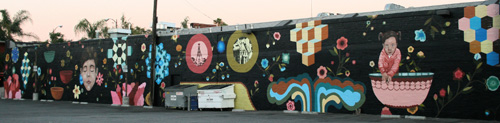
Bay area painter José Arenas recently completed a mural commission in his hometown neighborhood of downtown San Jose, now the up and coming art district of the United States’ 10th largest city. Arenas is art faculty at Foothill College in Los Altos Hills, California; a graduate of the San Francisco Art Institute and UC Davis, where he completed his MFA in 2000. He is currently represented by Hang Gallery in San Francisco. This interview was conducted at the completion of the San Jose mural, and will be included in a monograph of Arenas’ work to be published in early 2010 by Hunger Button Books.

mural_longestview2
José Arenas Mural on First Street, San Jose, California, 2009

Nanette: You’ve just completed a mural in downtown San Jose that is 16 feet high by 108 feet long. How does that feel?

José: It feels pretty good especially now that it’s done. I now have time to look back and reflect on what happened in the last two months. I was really excited to work with other people. I usually don’t get that when working in the studio, in there it’s mostly alone time. So I got to work with a great team for about six weeks and at the end of the project we held an unveiling party. It was a really good way to give thanks to all of them for being involved in such a big project.

Nanette: Talk about your process in both developing the imagery and in painting the mural.

José: The call for entries involved submitting a packet that included one’s work, a resume, statement, and letter of intent. The statement and letter were instrumental in articulating my own history and connection to San Jose. After I was accepted, there were two designs that were expected of me within about three weeks. I wrote in the statement that I was pretty much of a downtown (San Jose) kid for most of my childhood years. So I went back to that statement and remembered what drew me to that area. I guess I was doing a bit of reminiscing because I was thinking back to when I was a kid.

When I started working on the design I used Photoshop, which for me was a relatively new way to put my ideas together. Typically the way I worked before was a collage cut and paste method where I had a blank sheet of paper and I would move images around to see how they formed relationships. What I ended up doing this time was cutting and pasting various elements from very specific sources. If I had an idea of a flower, I searched it out or I would scan it from a variety of book sources and then manipulate it in Photoshop so that it changed, and then I would incorporate it into the larger idea that I was working on. So it was a bit of a new way for me to work.

Read more

Alice Templeton, poet

A Conversation with poet Alice Templeton

Alice Templeton is winner of the New Women’s Voices Prize in Poetry (2008), which she received for Archaeology: Twenty-one Poems. Alice is a poet, musician, songwriter, educator, and scholar. In 2007 she received the distinction of honorable mention from the Robinson Jeffers Tor House Foundation for her poem Homing. Journals which have published her work include: Poetry, 88, Puerto del Sol, and Many Mountains Moving. She currently teaches creative writing and literature at the Art Institute of California in San Francisco.

alicetempleton_sm

Whirligig: When we first met you told me your poetry was about nature, but it actually encompasses so much more than what might typically be called nature poetry. I see yours as more like landscapes with an aftermath of human residue. What inspires you to write?

Alice: That’s a wonderful description of it. I think I am very place oriented, and that place is the way I measure what I feel and think. In the poetry I try to define, through concrete imagery and language, where I am so that I can know how far I’ve come—what my thoughts are now, what my feelings are now.

I often write about the places that have been meaningful to me, like my parents’ farm where I lived during high school and have continued to go back to throughout my adulthood. I think those images, those cycles of labor that we went through on the farm, were formative in my sense of who I am and what language is. I hear my parents’ voices and phrases a lot. I hear that connection between the language and the tools and the landscape. So landscape does shape my poetry, but I’m also interested in and driven by philosophical and cultural questions like: What is justice? and What is history?  Hopefully those human things inform my poetry as well.

Read more

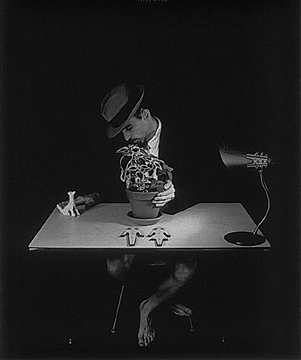
Jack Toolin, performance artist & photographer

A Conversation with performance artist & photographer Jack Toolin

Longtime San José art community member, Jack Toolin, has left the Bay Area for the vibrant stomping grounds of New York City. Jack —performance artist, photographer, founding member of the conceptual art collective C5 Corporation, and former board member of Works/San José—has work in the San José Museum of Art exhibition “Road Trip.” In this interview Jack talks about his history as a maker, what drives his practice, education, collaboration, and the search for the sublime.

toolinnature

Whirligig: You were born and raised in Pittsburgh. Can you tell me a bit about your upbringing and family life.

Jack: I grew up in a lower middle class neighborhood in the duplex that my mom grew up in. It was a racist neighborhood, very white, and conservative in lots of ways.

Whirligig: How did you come to be an artist?

Jack: My dad was into photography as a hobby, and he was very political and community-minded. He was responsible for getting various types of community programs in place like the community swimming pool, and music and art classes. So I ended up taking art and ceramic classes. Because of his interests in photography there was a darkroom in our basement, and I began to make photographs when I was 14.

Read more