Sophie Loubere, visual artist

A Conversation with printmaker Sophie Loubere

During the summer of 2025 I participated in a printmaking residency at In Cahoots in Petaluma, California. In residence with me were three other printmakers and a poet. We got to know each other a little over the two weeks that we shared space—in the studio, on outings, at meals. Sophie Loubere stood out as an artist deeply invested in the conceptual nature of historical imagery while exploring materials and processes. She moved from working with wood type on a Vandercook to chemical etching to handworking intaglio plates and back again. Always smiling, ready to share knowledge and information, while deeply focused on her tasks at hand. This conversation took place in the etching studio towards the end of our residency.
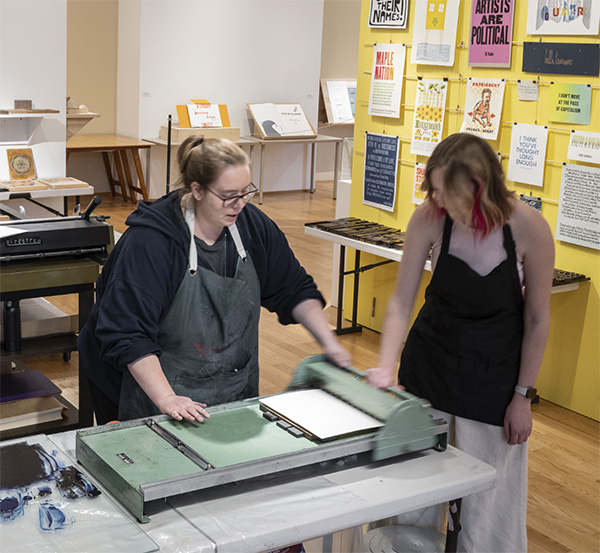
Sophie Loubere giving a printmaking demonstration at the Bainbridge Island Museum of Art in Washington state. Photo by Laura Zander

Nanette: How did you come to art?

Sophie: I started in elementary school, and it was just something that I was good at. I started using pastels, like chalk pastels, and I was making pastel paintings with those, and I was getting positive responses, and then I just kept on going, and eventually it was just one of those things where it just felt like it was what I needed to do, which I’m sure a lot of artists can relate to.

Nanette: Did you go to art school right after high school?

Sophie: I went to the University of Illinois at Urbana Champaign, and I was an art major. But while I was there, I was just feeling like the curriculum wasn’t really serving my needs, so I wound up transferring to Rhode Island School Design in their illustration program. I’ve always been interested in words and books and writing as well. So for a while, I thought that I would potentially become an illustrator. But then my interests just wound up being a little too noncommercial, a little too artsy fartsy, more interested in material, more interested in concept, and making artist books as opposed to illustrations for editorial and things like that. 

When I went into the illustration program, I didn’t fully understand that the conventional commercial way of making money doing illustration would be to make illustrations for editorial magazines or for working in animation and designing characters for game studios and things like that, and that just was not really where my interests lay. Then one winter session, I wound up taking a printmaking course, Painterly Prints, and I learned aquatint and monoprinting. 
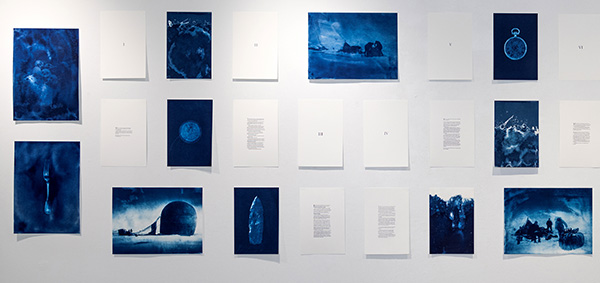
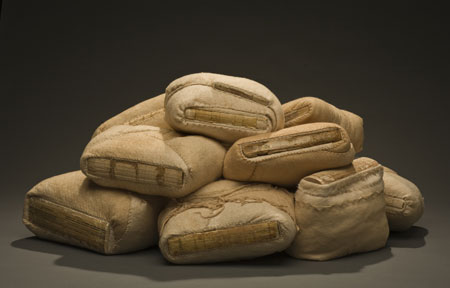
Sophie Loubere: Relics, Cyanotype, letterpress, archival imagery. Partial view of 20′ x 6′ installation of literary vignettes, cyanotypes, and audio and video based on historical research, 2022

After that I was really into etching. I spent my senior year mostly doing etching projects working on this extended sort of book project. After I graduated, I set up my own studio in Seattle. I was working as a graphic designer and publications manager at a nonprofit art school. I also had a little studio and I wound up getting some grant money so I was able to get a little press and then I basically just explored varieties of ways of doing printmaking. I was feeling a little bit frustrated because I didn’t have a conventional printmaking background because I hadn’t majored in it when I was an undergrad. I was trying to learn from books, YouTube videos. I taught myself how to mezzotint, and eventually I just felt like I needed some more specific background. I applied for grad school. I got into a grad school that had a pretty in-depth printmaking program and that’s where I honed both my practice as well as my printmaking skills.

Sophie Loubere: Relics, detail

Nanette: So you’re primarily a printmaker?
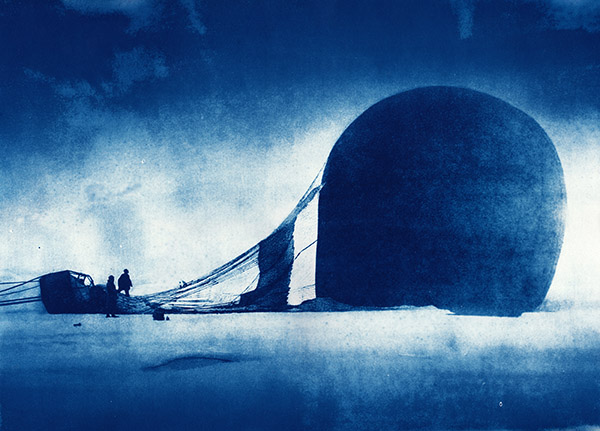
Sophie: At this point, yes. I’m open to making in pretty much any particular way. I have worked with fabrics before. I’ve done installation. I’ve done audio and video work to go along with the prints. But I think that primarily when I’m thinking conceptually, the majority of the time it winds up being a print in some way or other, and print doesn’t necessarily mean something that is like a letterpress print. I also have done things working with cyanotypes and alternative photography. I view those things as prints as well.

In my view, there’s a lot of different meshing that goes on between all these different artistic media. I would say that printmaking falls into a lot of different categories.

Read more

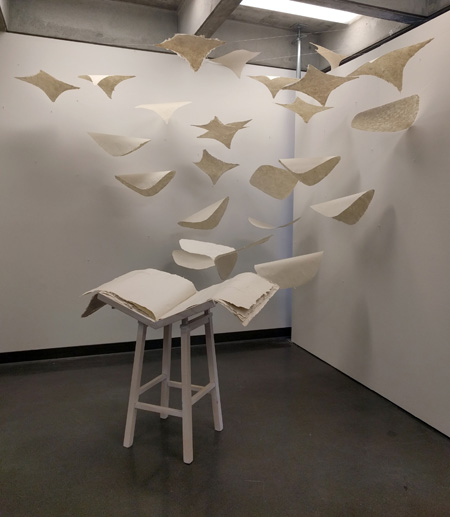
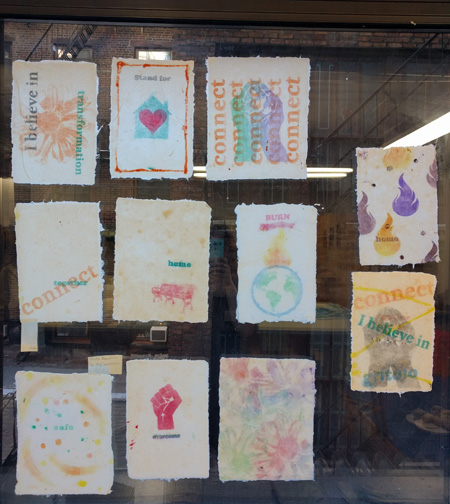
Michelle Wilson, papermaker & book artist

Michelle Wilson is a papermaker in an extremely complex sense. Her work with paper is both conceptual and concrete as it extends from the making of sheets for artist’s books and printmaking to social practice, sculpture and installation. As a somewhat recent transplant to the Bay Area, Wilson has quickly embedded herself and her work into the consciousness of the local art scene with a residency at the School of Visual Philosophy, a Small Plates commission from San Francisco Center for the Book, teaching at both San José State and Stanford, engagement with a handful of arts organizations, and many exhibitions.

This summer, Wilson’s collaboration with Anne Beck, The Rhinoceros Project, travels to the Salina Art Center (Salina, Kansas), Shotwell Paper Mill (San Francisco, California), the Healdsburg Center for the Arts (Healdsburg, California), and later this fall to the Janet Turner Print Museum in Chico, California. Her work is included in The Power of the Page: Artist Books as Agents for Change at the New Museum of Los Gatos (NUMU in Los Gatos, California), and Pulp as Portal, Socially Engaged Hand Papermaking at the Salina Art Center in Salina, KS. Wilson has a BFA from Moore College of Art and Design, and an MFA from the University of the Arts, both in Philadelphia.

We got together on a lovely spring afternoon towards the end of the semester to talk about art and teaching.

Nanette: I first became acquainted with your work in 2010 at an SGCI Conference in Philadelphia, occurring at the same time as Philagrafika, where I came upon a Book Bomb intervention in a public park. How did this collaboration with Mary Tasillo come about?

Michelle: Book Bombs began as a question I posed on Facebook. I was reading about yarn bombing, the tradition of knitting or crocheting something that is then bombed— left in a public space—a form of craft meets street art. I’m not a knitter or a crocheter; I’m a book artist, and so I posted a status update, “What would it mean to book bomb?” Mary took me seriously, and through our conversation, we discussed where people read in public space, who owns public space, and it led us to the idea of park benches. In Philly, every park bench has this center bar installed that is called the “arm rest,” but is designed to prevent a homeless person from sleeping comfortably on a bench. This seemed like an ideal place to install a book. Our project grew from this initial idea. And thus, Book Bombs was born.

Nanette: What were you envisioning regarding the scope and effects of Book Bombs?

Michelle: We originally saw Book Bombs as just a project for Philagrafika 2010. However, we’ve had so much fun, we’ve continued. It’s been tricky to keep it up transcontinentally, but we manage. Most recently, we did a sort of intervention-workshop at the Center for Book Arts in New York called Keeping the Fire Alive. This was designed as a workshop for activists who were interested in using papermaking in their work, as well using it as a form of self-care against fatigue and for continued resistance. We’d originally proposed the workshop during the summer of 2016, before the election, thinking it would be a very different conversation.

Nanette: How is papermaking used for self-care?

Read more

Angelica Muro

Angelica MuroAngelica Muro is an integrated artist, curator, and art educator with a strong interest in cultural criticism. Originally from the Central Valley agricultural community of Hopeton, California, Muro grew up on an apple orchard. As a child she became interested in photography, media imagery and popular culture. Muro served as Gallery Coordinator for WORKS/San José for five years, and as Educational Programmer for Movimiento de Arte y Cultura Latino Americana (MACLA, San José, California) for three years. She has a B.A. in photography from San José State University, and an MFA from Mills College in Oakland, California. She is currently Director and Chair of Visual and Public Art at California State University, Monterey where she teaches courses in photography, integrated media and media culture.

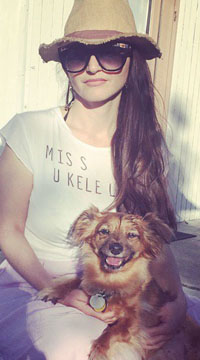
Her newest project, created with Juan Luna-Avin, Club Lido: Wild Eyes & Occasional Dreams opened February 12 at Empire Seven Studios in San José. We chatted over tea in early January, at Angelica’s Japantown (San José) bungalow. Reina Sofí­a, Angelica’s eight-year-old rescue pup, sat on her lap.

Whirligig: How did you come to be an artist?

Angelica: I’ve been interested in art since I was a child, but I was never really good at making—I suppose my vision never matched my actual skill set, it still doesn’t. I remember always trying to make things such as sculptures and drawings, but never having the dexterity. Photography came into my life very early—my fourth grade teacher, Mrs. Dixon, had a pile of National Geographic magazines I was pointed to whenever I finished my assignment early—this was the first time I was truly able to look at images, photographs, people. Since then, it’s become my primary area of interest, socially and culturally.

Whirligig: The first time you were able to look at images or that you became aware of the power of images?

Angelica: Aware of the power, of ways of seeing, of actually looking. We are so visually saturated, so much so that we are not actually seeing. I read recently that the brain is on a need-to-know basis. Our brains store the information in our environment and we don’t actually see it, even as we know it is there.

I very vividly remember looking through these National Geographics and seeing, seeing things that I had never seen before. It was new information. This is why travel is so exciting, it’s overwhelming new information for us that we are absorbing in a completely different way, and we take that absorption as being creative influences.

Whirligig: Much of your work exploits and reveals the tensions between consumer celebrity culture and the realities of working class and immigrant lives in contemporary America, perhaps even specifically California. Who do you see as your audience for this work and what do you hope it achieves?

Angelica: I don’t often think about audience in the traditional sense; although as an educator, I often address ethical concerns involving audience with my students. I happen to live and work in California, so my work deals with the complexities of this eco-system—the spectrum of productivity, exploitation, and the distribution of wealth—and often explores issues of gender, race, and class. I’m interested in social issues, and I find that visual tension inspires me to create.

I think there’s several ways to think about audience—I remember being in graduate school, a time that allowed me to experiment with ideas with a critical, yet limited audience. Suddenly, I had a body of work about being Latina, being a woman, being the daughter of a farmworker, and navigating social constructs. And then my audience became people who where interested in issues of identity. However, my work deals with larger social issues of equalization, socialization, conditioning, and the various codes of gender identification. It’s a dialogue with my community, my artist cohort, scholars, thinkers, curators, and activists who are interested in issues of positionality and privilege. I suppose that in the simplest and most complicated sense, my audience is one interested in issues of difference, otherness, and diasporic culture. I question ideological frameworks of meritocracy, social mobility, and distribution of wealth, because I want to, in small part, be in dialogue with someone, anyone, interested in discourse about the complicated social structure we live in.

Angelica Muro

Read more

Jody Alexander

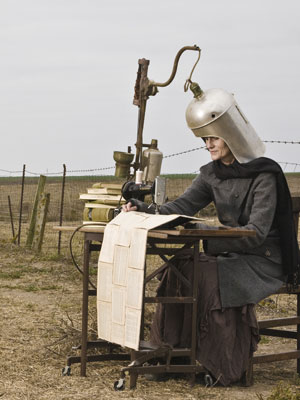
Jody Alexander The Artist in Her Studio

Santa Cruz based artist Jody Alexander is known for creating complex characters whose narratives are revealed through an array of artifacts which almost always include handmade books and are often exhibited as interactive art installations.

Her work celebrates collecting, storytelling, and odd characters.

Alexander has just completed two solo exhibitions: Jody Alexander: Sedimentals at Mohr Gallery in Mountain View, California; and The Odd Volumes of Ruby B.: An Installation at Saffron and Genevieve in Santa Cruz, California.

In the first half of 2011 Alexander’s work was included in: The Art of the Book at Donna Seager Gallery in San Rafael, California; The Book: A Contemporary View at Delaware Center for the Contemporary Arts; Reconstructions at Conrad Wilde Gallery in Tucson, Arizona; Encaustic with a Textile Sensibility at Kimball Art Center in Park City, Utah; and Masters: Book Art published by Lark Books.

Alexander has a BA in Art History from UCLA and a MS in Library Science from Simmons College in Boston.

Whirligig: How did you come to be interested in the book as an art object?

Jody: While working on my Master’s degree in Library Science in Boston, Massachusetts. One of my professors took our class to Harvard’s Houghton Library. He began by showing us medieval manuscripts: Book of Hours, Gutenburg Bible, Nuremburg Chronicles amongst others. Obviously, this was very exciting to examine these treasures up close, but then he started taking out artists’ books. I don’t think I had ever seen an artists’ book before, and if I had, I wasn’t really aware of them as a genre of art. I think that I couldn’t breathe for a little while. I had one of those moments when everything suddenly made sense and it was clear that this is what I wanted to do. I proceeded to do every remaining project in Library School on artists’ books: their history, collecting them, storage and preservation of artists’ books, etc. As soon as I graduated I started to make them.

Whirligig: Tell us about the first book you made.

Jody: When I was about eight or nine I know I made some small books. I used to draw a hillbilly family and type out their story on my green portable Sears typewriter. These eventually became little books. I’m not sure how I bound them. They were just little pamphlet books. They no longer exist.

Jody Alexander Eleven Exposed Spines

Read more

Jose Arenas

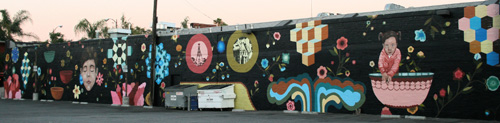
Bay area painter Jose Arenas recently completed a mural commission in his hometown neighborhood of downtown San Jose, now the up and coming art district of the United States’ 10th largest city. Arenas is art faculty at Foothill College in Los Altos Hills, California; a graduate of the San Francisco Art Institute and UC Davis, where he completed his MFA in 2000. He is currently represented by Hang Gallery in San Francisco. This interview was conducted at the completion of the San JJose mural, and will be included in a monograph of Arenas’ work to be published in early 2010 by Hunger Button Books.


mural_longestview2

Whirligig: You’ve just completed a mural in downtown San Jose that is 16 feet high by 108 feet long. How does that feel?

Jose: It feels pretty good especially now that it’s done. I now have time to look back and reflect on what happened in the last two months. I was really excited to work with other people. I usually don’t get that when working in the studio, in there it’s mostly alone time. So I got to work with a great team for about six weeks and at the end of the project we held an unveiling party. It was a really good way to give thanks to all of them for being involved in such a big project.

Read more

Kent Manske

Kent Manske is a visual artist working in traditional and hybrid forms of print media. He is a professor of art at Foothill College where he teaches graphic design, printmaking and books as art. His MFA is from The School of the Art Institute of Chicago. This interview was conducted upon the publication of a book on Kent’s work titled Re:ad.

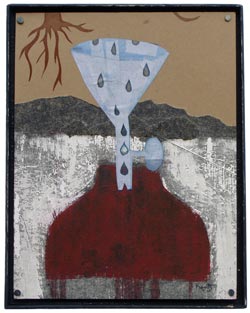
funnel

Whirligig: Why do you make things?

Kent: To make sense of things I don’t understand, like my feelings about humanity. I’m compelled to process matters of our existence, like why we believe what we do. I make things to find my own peace, even though much of what I explore is not peaceful. Sixteen thousand people die per day of hunger related causes. The Arctic is melting and the oceans are rising. Exploring issues and concerns help me recontextualize my own reality and make sure I’m not living in a total state of deception. Art helps me to take responsibility for the privileges I’ve inherited.

Read more