Macy Chadwick, In Cahoots Residency

A Conversation with Macy Chadwick

Macy Chadwick is the founder and director of In Cahoots Residency in Petaluma, California. Macy is remarkable as a creative residency host in part because she is exceptionally personable with a wonderful gift of giving a story, often with unpredictable humor and resulting laughter. Her own work as a printmaker and book artist is visually poetic and imbued with a sensitive essence of personal reflection. We talked about her work and the running of In Cahoots while sitting under a large oak tree on the residency grounds.
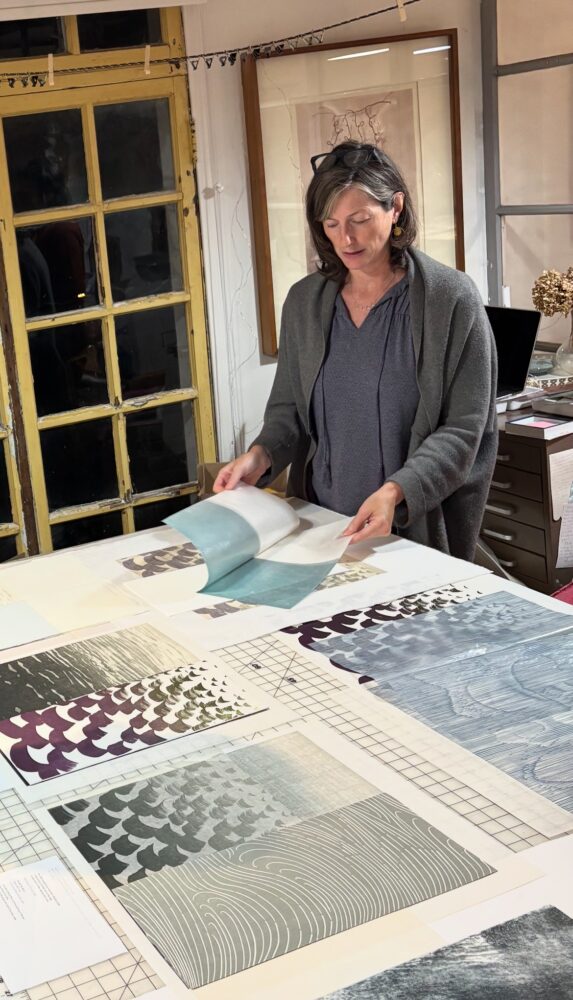
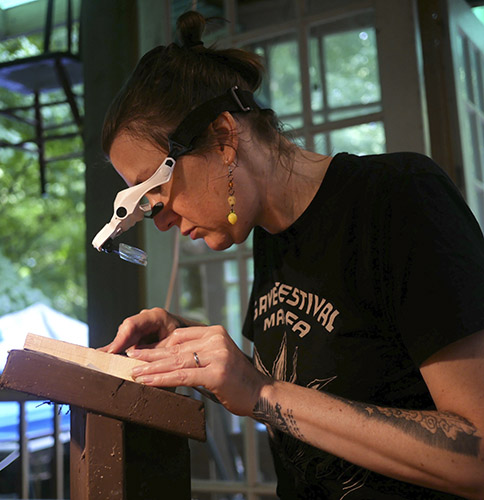
Macy Chadwick in the studio. Photo: Edie Overturf

Nanette: How did you come to art?

Macy: When I was little, I loved all kinds of art, and my mom really encouraged it. I took some after school art classes starting in third grade and continued with that until high school. In order to take the advanced art classes in high school, I had to commit to being an art major in college because the goal of the advanced art classes was to help you prepare a portfolio to apply to college. So I said, yeah, I’ll be an art major in college. Then I decided I really did want to do that. I pursued my BFA, but I was never one of the artsy kids. I didn’t have purple hair or tattoos, still don’t. But I was definitely one of the creative kids, and art has always been a big part of my life.

Nanette: How did you get into printmaking and book arts?

Macy: In undergrad, I was an Illustration major and I never really loved it. I had loved drawing in high school, because that was just what we were offered. In college, I started taking printmaking classes to do my illustrations and then I realized I was actually more interested in making prints about my own ideas and concepts than I was in illustrating other people’s ideas. So, I ended up being a double major in Illustration and Printmaking. 

This was at Washington University in St. Louis. I was very interested in putting my prints into a sequence. At the time, they didn’t have book arts there, so I went to the library and checked out the Japanese Stab Binding book—the one with the green cover. I don’t know why, but that’s the only book on book arts techniques that every library seems to have. So, I learned stab binding, and I taught myself a couple of other bindings in undergrad. 

Between undergrad and grad school, I took Book Arts classes at Oregon College of Art and Craft with Barb Tetenbaum. It was from Barb that I learned the foundation of everything I know about book arts and letterpress printing. I’ve learned more over the years, but Barb taught me so much. As happens with your first teacher—you still reference what they taught you, and who they admired. Barb admired Tim Barrett, Hedi Kyle, Patty Scobey, Julie Chen, and Gary Frost. So, I still admire all those people, and others, too. I continued to study Book Arts and Printmaking in grad school and then I learned more when I moved to Berkeley to work for Julie Chen.
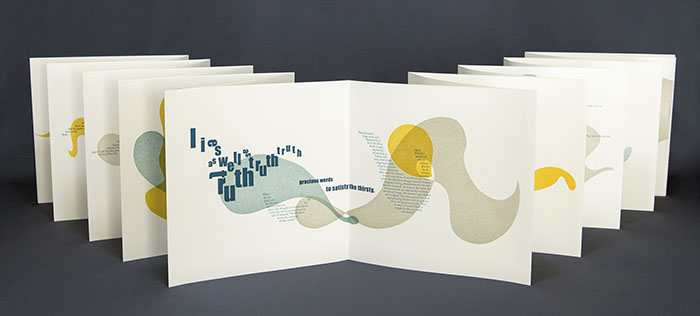
Meanwhile by Macy Chadwick, Limited edition artist book: Letterpress, relief printing; accordion structure in half-clamshell box. Edition of 40, 2017. Photo: Bernhard Uhl

Nanette: When was that?

Macy: I moved to Berkeley in 2003. I had graduated from Wash U in 1994. The rest of the nineties I lived in Portland, Oregon. I studied with Barb at the Oregon College of Art and Craft, which has since closed. Then I went to grad school at the University of the Arts in Philadelphia, from 2001 to 2003. UArts closed recently as well.
Read more

Rebecca Gilbert, printmaker

A Conversation with printmaker Rebecca Gilbert

Rebecca engraving at Jim Horton’s studio in Ann Arbor, Michigan. Horton gave Rebecca her very first lessons in wood engraving in 2013. Photo: Tony Drehfal, another master wood engraver.

Rebecca Gilbert is a printmaker’s printmaker—impressively knowledgeable about printmaking history, and historical and contemporary print processes. Rebecca astounds with her joyful commitment to a seven year long project based on Hans Holbein’s Dance of Death. Rebecca’s own dance demonstrates an insightful perception of humanity delivered with generosity, depth, and a fresh lightness of the creative spirit.

This conversation took place under a large oak tree during a summer printmaking residency at In Cahoots Residency in Petaluma, California.

Nanette: How did you come to art?

Rebecca: I pretty much always wanted to be an artist. Since elementary school at least. And I was actually just thinking about this the other day. I met my best friend in elementary school, Bobby Riefsnyder, on the first day of kindergarten. We would play together every day after school. I would pretend that I was an art teacher and he would pretend to be a music teacher. We probably played that every day for a couple of years, and it never got old, so I feel like I always knew I wanted to be an artist and I always knew I wanted also to be an educator. Even then, I thought of those as two different things that you could merge into one, and they are two totally different sets of skills. When I went to college, I started as an art education major, because that seemed like the most obvious way to pursue both. I don’t know what art education programs are like now, but at that time, I found that learning about art and making art weren’t very important in that major. All of the focus was on teaching, and art barely even felt secondary, so I changed my major to printmaking.

Nanette: As an undergrad?

Rebecca: As an undergrad, yes.

Nanette: And why printmaking? They actually had a printmaking major?

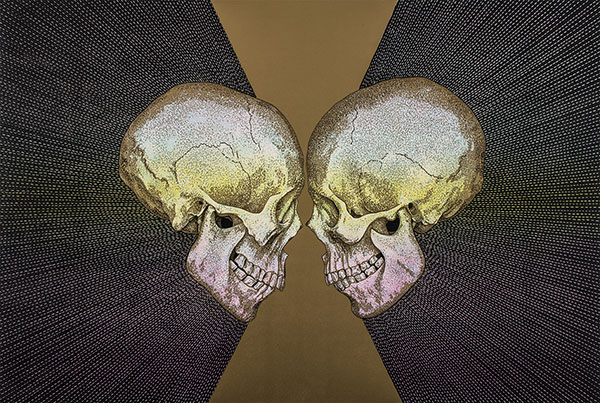
Memento Mori (Skulls) by Rebecca Gilbert, Reduction and multiple block color woodcut, 26.25″ x 37.5″, 2019

Rebecca: Yes. I made my first print in high school. It was a monotype. I was thinking about this recently, too. I forgot that monotype is what made me fall in love with printmaking. I was hooked after the very first one, and I very rarely make monotypes these days. My high school had one little press that they would wheel out of the closet every now and then so we could make some prints, and I loved it.

In college, I had taken a bunch of printmaking classes, even as an education major. Besides the process involved in making a print, I just love all the tools and gadgets and presses, and all the printmakers seemed a little dangerous, edgy.

Nanette: More edgy than the other artists?

Rebecca: Yeah, yeah. [laughs]

That was part of what initially drew me to it. There’s such a long list of everything that I love about printmaking that keeps me drawn to it now.

Nanette: So, you were a printmaker right off the bat?

Read more

Christopher Hartshorne, printmaker

A Conversation with printmaker Christopher Hartshorne

During the summer of 2025 Christopher Hartshorne and I worked directly across from each other, at a printmaking residency at In Cahoots Residency in Petaluma, California. We were each at lovely large etching presses where daily I found myself appreciating the gift of being able to observe his process of pulling richly beautiful, futuristic moons—a memorable highlight of my own residency experience.

When we noticed the local blackberries were in and ripe, Chris picked a bunch to bake us a blackberry crumble. It was almost as delicious as Chris’ prints.

This conversation took place towards the end of our residency in the etching studio.

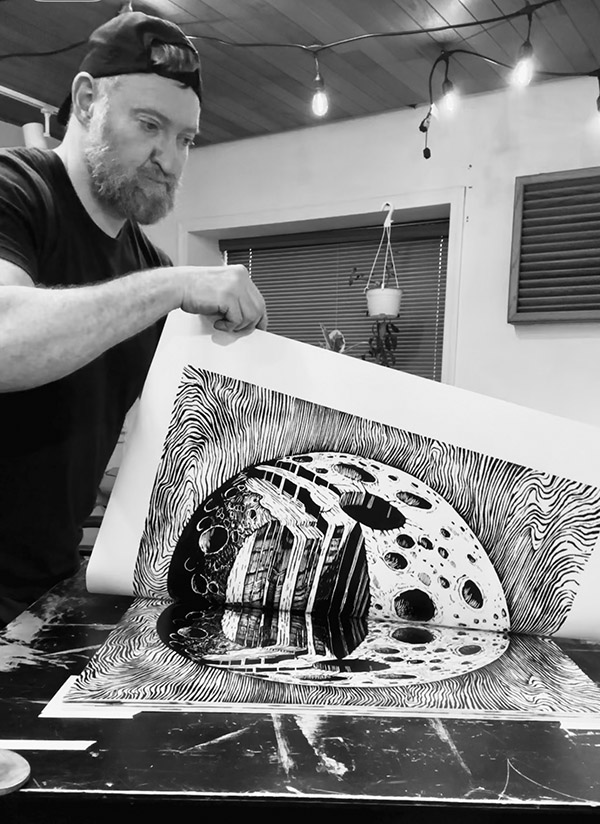
Christopher Hartshorne printing the Graphic Myths series

Nanette: How did you come to art?

Chris: I always made art as a kid. I was so shy, I didn’t try other things. Very introverted. It was like an escape, or something that I could do. And I got a lot of positive reinforcement as a kid. I was known as an artist as a kid. So I kind of stuck with it.

Nanette: Like drawing?

Chris: Yes, drawing. I’ve tried to do other things, but I always come back. I’m like, I’m an artist. I’ve got to keep making art.

Nanette: Why printmaking?

Chris: I was painting and I went to school for illustration, never did any printmaking in school, like in college, but when I discovered woodblock printmaking, I liked the process. It was a very definite process. You transfer an image, you carve the image, you print it, you kind of know what it’s going to look like, very graphic. A painting to me was too mysterious. Maybe I didn’t know how to paint. I was a painter, but I didn’t know when a painting was done. There was something really crisp and clear about printmaking and the way I was using it. I latched onto the process immediately. I loved how you could make an expressive, almost random mark on a piece of wood and it looked so defined and intentional when you printed it, because it’s so graphic and bold. That was really cool to me. The marks you can make and how bold they are compared to painting. But now I’m thinking of printmaking differently, actually. A print can be more mysterious, like a painting. So now my views are broadening. That’s how I latched onto printmaking, the process.

Nanette: How long have you been printing then?

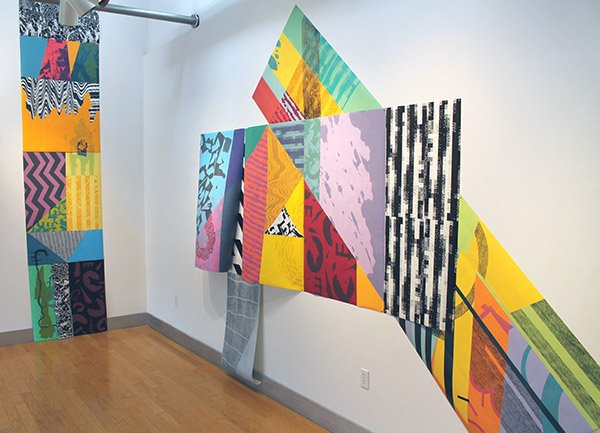
Christopher Hartshorne: TempleGRAM, Multiple block woodcut installation, variable dimensions, 2019

Chris: Probably 20 to 25 years. I just started doing it on my own.

Nanette: After school?

Chris: Yes, I was hand pressing, with no community yet. I just started doing it and then kept doing it. I eventually went to grad school for printing, because that’s all I was doing.

Nanette: Many of the artists that I’ve met go in through painting, because painting is seductive and it’s elevated. It used to be, you were a painter or a sculptor. And that’s all there was for fine art. So I think it’s normal to go in through the magic of painting. What grad school did you go to?

Chris: I went to Tyler School of Art.

Nanette: How was your grad school experience?

Chris: It was good. I waited ten years in between BFA and MFA so I was older than everyone. I really wanted to immerse myself in printmaking and school for printmaking, but I actually did not really feel like going back to school. But it was good because they have a program in Rome, through the school, so the whole second year I was in Rome and it was more like a residency, which . . . why am I going to school if I’m just doing an artist residence? But it was really amazing. I would never have gone out of the country back then if it wasn’t for the program. It was my first time out and it was pretty cool. I had a small cohort of five other grad students from Tyler and a bunch of undergrads that were from a lot of different schools, just getting some international school experience. It was good.

I was scared to leave the country. I don’t know. I’m a homebody, but it was really, really amazing for me to leave, and see more than just the art experience.Just to see how other people live, non Americans, [laughs] was very good for me to see as an artist and a human, or an American, I guess, so that was pretty cool.

Read more

Michelle Wilson, papermaker & book artist

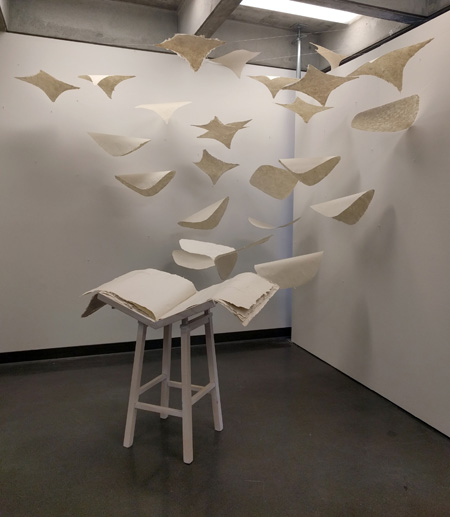
Michelle Wilson is a papermaker in an extremely complex sense. Her work with paper is both conceptual and concrete as it extends from the making of sheets for artist’s books and printmaking to social practice, sculpture and installation. As a somewhat recent transplant to the Bay Area, Wilson has quickly embedded herself and her work into the consciousness of the local art scene with a residency at the School of Visual Philosophy, a Small Plates commission from San Francisco Center for the Book, teaching at both San José State and Stanford, engagement with a handful of arts organizations, and many exhibitions.

This summer, Wilson’s collaboration with Anne Beck, The Rhinoceros Project, travels to the Salina Art Center (Salina, Kansas), Shotwell Paper Mill (San Francisco, California), the Healdsburg Center for the Arts (Healdsburg, California), and later this fall to the Janet Turner Print Museum in Chico, California. Her work is included in The Power of the Page: Artist Books as Agents for Change at the New Museum of Los Gatos (NUMU in Los Gatos, California), and Pulp as Portal, Socially Engaged Hand Papermaking at the Salina Art Center in Salina, KS. Wilson has a BFA from Moore College of Art and Design, and an MFA from the University of the Arts, both in Philadelphia.

We got together on a lovely spring afternoon towards the end of the semester to talk about art and teaching.

Nanette: I first became acquainted with your work in 2010 at an SGCI Conference in Philadelphia, occurring at the same time as Philagrafika, where I came upon a Book Bomb intervention in a public park. How did this collaboration with Mary Tasillo come about?

Michelle: Book Bombs began as a question I posed on Facebook. I was reading about yarn bombing, the tradition of knitting or crocheting something that is then bombed— left in a public space—a form of craft meets street art. I’m not a knitter or a crocheter; I’m a book artist, and so I posted a status update, “What would it mean to book bomb?” Mary took me seriously, and through our conversation, we discussed where people read in public space, who owns public space, and it led us to the idea of park benches. In Philly, every park bench has this center bar installed that is called the “arm rest,” but is designed to prevent a homeless person from sleeping comfortably on a bench. This seemed like an ideal place to install a book. Our project grew from this initial idea. And thus, Book Bombs was born.

Nanette: What were you envisioning regarding the scope and effects of Book Bombs?

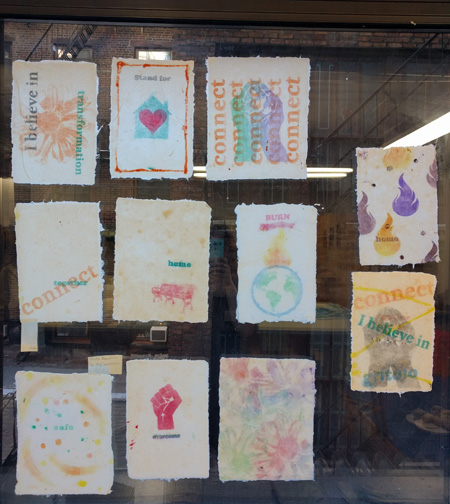
Michelle: We originally saw Book Bombs as just a project for Philagrafika 2010. However, we’ve had so much fun, we’ve continued. It’s been tricky to keep it up transcontinentally, but we manage. Most recently, we did a sort of intervention-workshop at the Center for Book Arts in New York called Keeping the Fire Alive. This was designed as a workshop for activists who were interested in using papermaking in their work, as well using it as a form of self-care against fatigue and for continued resistance. We’d originally proposed the workshop during the summer of 2016, before the election, thinking it would be a very different conversation.

Nanette: How is papermaking used for self-care?

Read more

Beau Beausoleil

Beau Beausoleil is a San Francisco-based poet and the proprietor of the Great Overland Book Company, which is located in San Francisco’s Inner Sunset neighborhood. Beausoleil has written more than ten books of poetry. His most recent collection, Ways to Reach the Open Boat, was published by Barley Books, UK in 2013.

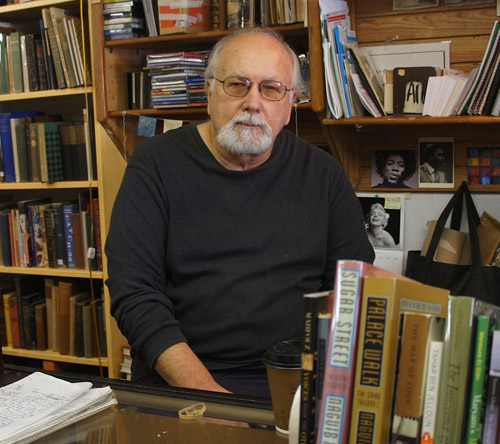
Beau Beausoleil at the Great Overland Book Company

In 2007 Beausoleil read an article in The New York Times about a car bombing on al-Mutanabbi Street, the historic bookseller’s street in Bagdad. This incident inspired the creation of the al-Mutanabbi Street Coalition, a project which currently has five distinct components: 130 letterpress printed broadsides; 260 artists’ books; a publication of poetry and prose titled Al-Mutanabbi Street Starts Here; the coordination of poetry readings around the world each year on the March 5th anniversary of the bombing; and most recently Absence and Presence, a call to 260 printmakers for the creation of fine art prints.

The project involves hundreds of artists who have created work specifically as a response to the 2007 bombing; and extensive local and international exhibition schedules, much of which Beausoleil coordinates himself. Complete editions of the visual art responses will ultimately be donated to the Iraqi National Library in Bagdad.

We met in early February over a cup of tea at Beau’s kitchen table.

Whirligig: What is poetry?

Beau: What is poetry? At one point in my life I stood on the corner of Powell and Geary, it was real close to Union Square not that far from Macy’s, and I had a little box next to me on the ground that had a sign that read “Support your local poet.” I would give out multiple copies of a poem that I had printed out to anyone who would take them. They didn’t know that they were poetry. My secret hope was that some patron would appear out of nowhere with a wallet, but of course that never happened.

I usually made enough to print out the next batch of poems. Some people would avoid me. They would go out into the street thinking that I was handing out a religious tract or a political tract of one kind or another. Some people would take them. I’d see them read them. I’d see them crumple them up after half a block and throw them away. But every now and then something would happen. I remember this one guy who took a poem. I watched him walk down Powell and I could see that he was reading the poem. He got about three quarters down the block. He turned around and walked back to me and said in this agitated voice, “I don’t know what this means, but this one line, that speaks to my life.” That’s poetry.

One time I was part of a group that was visiting Folsom Prison where there was a writer’s workshop. The visitors would read and then the prisoners would read. During the break this guy came up to me and said, “Are you Beau Beausoleil?” And I said, “Yes.” He said, “Did you have a poem in . . .” and he named this small magazine, and I said, “Yes.” He said. “Did it go like this. . .” and he recited my poem back to me. I was pretty stunned. He said, “I just wanted to tell you that that is the poem that started me writing.” That’s poetry.

Lorca, the Spanish poet, tells a story about duende. Duende is the inexpressible in art, in beauty. It’s there and you can feel it. Some people can recognize it. It’s an important part of the life of any artist who is really at that point. He tells a story to illustrate it.

There was a flamenco contest in this basement in Spain. All these young women are assembled. They are all in their 20s and beautiful. They are getting ready to go on the stage to perform before these three judges. Suddenly the door opens. A woman in her late 50s walks in, walks straight up to the stage, throws her arms in the air and the judges declare the contest over because they could see that she had duende. That’s poetry.

Poetry is something that gives you back part of your own life. It allows you to see your own life in another form, another way. That’s what poetry is.

Read more

Kent Manske, visual artist

A Conversation with Artist Kent Manske

Kent Manske is a visual artist working in traditional and hybrid forms of print media. He is a professor of art at Foothill College where he teaches graphic design, printmaking and books as art. His MFA is from The School of the Art Institute of Chicago. This interview was conducted upon the publication of a book on Kent’s work titled Re:ad.

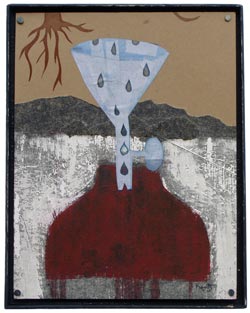
funnel

Whirligig: Why do you make things?

Kent: To make sense of things I don’t understand, like my feelings about humanity. I’m compelled to process matters of our existence, like why we believe what we do. I make things to find my own peace, even though much of what I explore is not peaceful. Sixteen thousand people die per day of hunger related causes. The Arctic is melting and the oceans are rising. Exploring issues and concerns help me recontextualize my own reality and make sure I’m not living in a total state of deception. Art helps me to take responsibility for the privileges I’ve inherited.

Read more