Macy Chadwick, In Cahoots Residency

A Conversation with Macy Chadwick

Macy Chadwick is the founder and director of In Cahoots Residency in Petaluma, California. Macy is remarkable as a creative residency host in part because she is exceptionally personable with a wonderful gift of giving a story, often with unpredictable humor and resulting laughter. Her own work as a printmaker and book artist is visually poetic and imbued with a sensitive essence of personal reflection. We talked about her work and the running of In Cahoots while sitting under a large oak tree on the residency grounds.
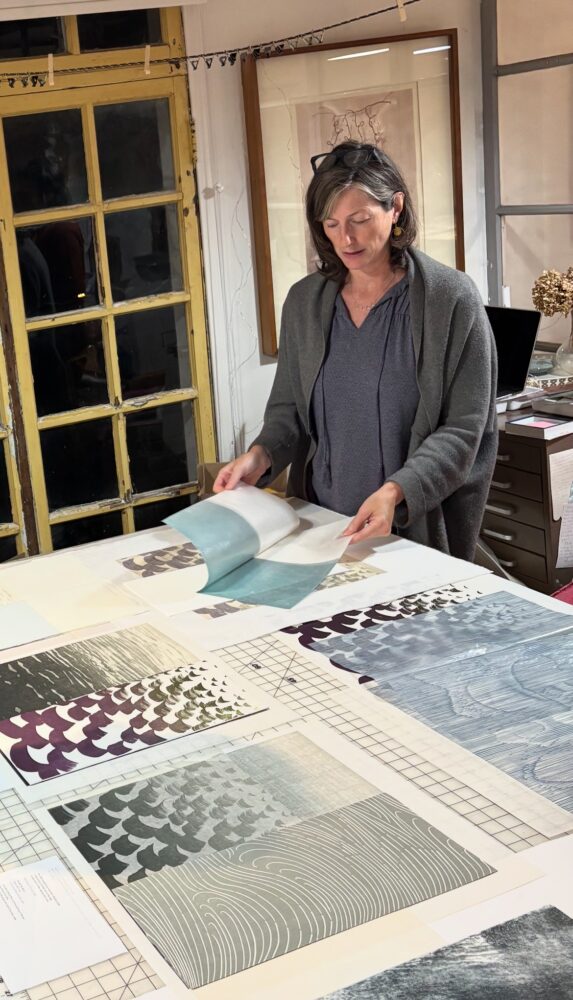
Macy Chadwick in the studio. Photo: Edie Overturf

Nanette: How did you come to art?

Macy: When I was little, I loved all kinds of art, and my mom really encouraged it. I took some after school art classes starting in third grade and continued with that until high school. In order to take the advanced art classes in high school, I had to commit to being an art major in college because the goal of the advanced art classes was to help you prepare a portfolio to apply to college. So I said, yeah, I’ll be an art major in college. Then I decided I really did want to do that. I pursued my BFA, but I was never one of the artsy kids. I didn’t have purple hair or tattoos, still don’t. But I was definitely one of the creative kids, and art has always been a big part of my life.

Nanette: How did you get into printmaking and book arts?

Macy: In undergrad, I was an Illustration major and I never really loved it. I had loved drawing in high school, because that was just what we were offered. In college, I started taking printmaking classes to do my illustrations and then I realized I was actually more interested in making prints about my own ideas and concepts than I was in illustrating other people’s ideas. So, I ended up being a double major in Illustration and Printmaking. 

This was at Washington University in St. Louis. I was very interested in putting my prints into a sequence. At the time, they didn’t have book arts there, so I went to the library and checked out the Japanese Stab Binding book—the one with the green cover. I don’t know why, but that’s the only book on book arts techniques that every library seems to have. So, I learned stab binding, and I taught myself a couple of other bindings in undergrad. 

Between undergrad and grad school, I took Book Arts classes at Oregon College of Art and Craft with Barb Tetenbaum. It was from Barb that I learned the foundation of everything I know about book arts and letterpress printing. I’ve learned more over the years, but Barb taught me so much. As happens with your first teacher—you still reference what they taught you, and who they admired. Barb admired Tim Barrett, Hedi Kyle, Patty Scobey, Julie Chen, and Gary Frost. So, I still admire all those people, and others, too. I continued to study Book Arts and Printmaking in grad school and then I learned more when I moved to Berkeley to work for Julie Chen.
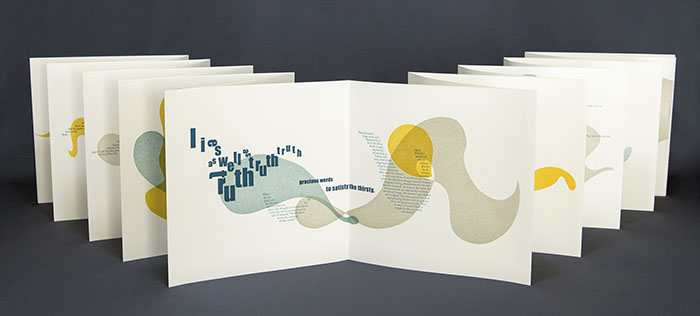
Meanwhile by Macy Chadwick, Limited edition artist book: Letterpress, relief printing; accordion structure in half-clamshell box. Edition of 40, 2017. Photo: Bernhard Uhl

Nanette: When was that?

Macy: I moved to Berkeley in 2003. I had graduated from Wash U in 1994. The rest of the nineties I lived in Portland, Oregon. I studied with Barb at the Oregon College of Art and Craft, which has since closed. Then I went to grad school at the University of the Arts in Philadelphia, from 2001 to 2003. UArts closed recently as well.
Read more

Sophie Loubere, visual artist

A Conversation with printmaker Sophie Loubere

Sophie Loubere stands out as an artist invested in the conceptual nature of historical imagery while exploring materials and processes. She moves deftly through a range of studio practices — working with wood type on a Vandercook, hand working intaglio plates, exploring natural dyes, papermaking, creating multimedia installations, book arts, and writing. We met during a summertime printmaking residency at In Cahoots Residency in Petaluma, California. Our conversation took place in the etching studio towards the end of our residency.

Sophie Loubere giving a printmaking demonstration at the Bainbridge Island Museum of Art in Washington state. Photo by Laura Zander

Nanette: How did you come to art?

Sophie: I started in elementary school, and it was just something that I was good at. I started using chalk pastels, making pastel paintings, getting positive responses, and then I just kept on going. Eventually it was just one of those things where it just felt like it was what I needed to do, which I’m sure a lot of artists can relate to.

Nanette: Did you go to art school right after high school?

Sophie: I went to the University of Illinois at Urbana Champaign, and I was an art major. But while I was there, I was just feeling like the curriculum wasn’t really serving my needs, so I wound up transferring to Rhode Island School of Design in their illustration program. 

I’ve always been interested in words and books and writing . So for a while, I thought that I would potentially become an illustrator. But then my interests just wound up being a little too noncommercial, a little too artsy fartsy, more interested in material, more interested in concept, and making artist books as opposed to illustrations for editorial and things like that. 

When I went into the illustration program, I didn’t fully understand that the conventional commercial way of making money doing illustration would be to make illustrations for editorial magazines or for working in animation and designing characters for game studios and things like that.That just was not really where my interests lay. Then one winter session, I wound up taking a printmaking course, Painterly Prints, and I learned aquatint and monoprinting. 

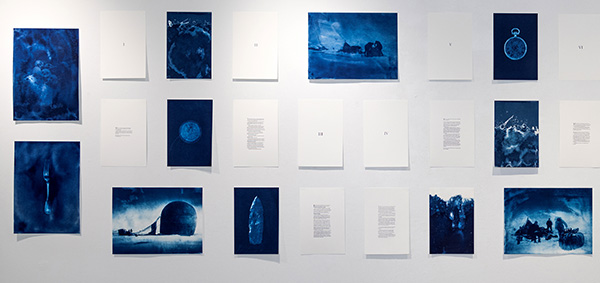
Sophie Loubere: Relics, Cyanotype, letterpress, archival imagery. Partial view of 20′ x 6′ installation of literary vignettes, cyanotypes, and audio and video based on historical research, 2022

After that I was really into etching. I spent my senior year mostly doing etching projects working on this extended sort of book project. After I graduated, I set up my own studio in Seattle. I was working as a graphic designer and publications manager at a nonprofit art school. I had a little studio and I wound up getting some grant money so I was able to get a little press. Then I basically just explored varieties of ways of doing printmaking. I was feeling a little bit frustrated because I didn’t have a conventional printmaking background because I hadn’t majored in it when I was an undergrad. I was trying to learn from books, YouTube videos. I taught myself how to mezzotint, and eventually I just felt like I needed some more specific background. I applied for grad school. I got into a grad school that had a pretty in-depth printmaking program and that’s where I honed both my practice as well as my printmaking skills.

Nanette: So you’re primarily a printmaker?

Sophie Loubere: Relics, detail

Sophie: At this point, yes. I’m open to making in pretty much any particular way. I have worked with fabrics before. I’ve done installation. I’ve done audio and video work to go along with the prints. But I think that primarily when I’m thinking conceptually, the majority of the time it winds up being a print in some way or other, and print doesn’t necessarily mean something that is like a letterpress print. I also have done things working with cyanotypes and alternative photography. I view those things as prints as well.

In my view, there’s a lot of different meshing that goes on between all these different artistic media. I would say that printmaking falls into a lot of different categories.

Nanette: Are you still making books?

Sophie: I am. The issue with making books is that they take a lot of time and materials. Since grad school, I haven’t had access to a papermaking studio, which is another aspect that I was exploring in school. So in lieu of that, I wound up deciding to experiment and figure out how to dye paper. I’ve gotten cotton papers and I’ve been dyeing them with natural dyes. There’s a lot of experimentation, a lot of failure that goes along with that. With that I have created a book, but it feels like more of a mock up at this point.

I think in order to make a full book I’m going to need access to papermaking resources, access to letterpress studios. 

Sophie Loubere: Wolves, Coptic stitch bound artist book, bleach linoleum block prints and plate lithographs on paper treated with madder, wattle, & iron. Exterior bookcloth dyed in madder and wattle and treated with iron and beeswax. 8.5″ x 7.5″ x .5″ closed, 8.5″ x 15″ x .5″ open, 2025

I have a couple of different books I want to make. They feel like projects that I’m always planning in my head. I have materials that I’ve collected. I’ve dyed book cloth using indigo, and it’s just kind of sitting there waiting for me to make a portfolio box with it. So, yes, I am still making books, and
I would say that even if the prints I’m making are not going into a traditional book form, I am always thinking of them in relationship to each other. When I put them together, I’m thinking of them as a narrative. They all explore some type of creation or visualization. 

I work a lot with archival imagery. I try to think of different ways of telling the same story, or thinking about different ways of viewing things through a certain perspective. For example, I might take an archival image that I found on the Internet that was taken by a photographer in the 1800s, and then do a reprint of that on expired photo paper. Then I will solarize it and do all sorts of things. Just the expired paper on its own will slightly abstract the image and shift how viewers see whatever that image is showing. Then I might take that image, scan it and then make a stone lithograph from it. Then I also might take the image that I’ve scanned and make a relief plate. I’ll make a print using a piece of paper that I’ve dyed using madder and iron—it’s really deep dark purple—but I put bleach on the plate. I then get a completely different image based on what is pulled out from the bleach versus what is on the stone, versus what is in the photograph, versus what is in the original slide.

Nanette: It sounds like you’re really interested in materials and processes.

Sophie: Yes.

Sophie Loubere: High Rocks Mining District, Dale Creek Canyon, Stone lithograph & bleach monoprint on paper treated with madder, wattle, & iron. Photograph by Andrew J. Russell, archived & scanned by the OCMA.10″ x 11″ varied edition of 8, 2025

Nanette: I’ve noticed, here, you’re working on three different projects during your residency?

Sophie: Mostly it’s two. I just wanted to finish one set of prints that I’m putting into a show. Partly what is informed by what I’m doing here is that I have this show coming up and I wasn’t quite able to finish that work before traveling here. I did a pop up studio at Bainbridge Island Museum of Art where I was working with wood type. I was really enjoying the immediacy of that. 

The work I do is planned and goes through a series of stages. I really put everything through the ringer. It has different times where it exists in certain ways. I think that development helps to add depth to the imagery and grows the imagery in particular ways, and also mimics time and the depth of the narratives I’m working with.

It’s fun to have these more immediate ways of working, using wood type. Somebody’s already created these. They have their own histories as well. Who knows how many different things these letters have said over the years. It’s rewarding to be able to take those pieces and put them together in particular ways and, after a day, have a brand new print. That is another really interesting way of working and it adds a certain spontaneity that I might not get in my other work.

Sophie Loubere: Salt Lake from Trestle Work, Stone lithograph & bleach monoprint on paper treated with madder, wattle, & iron. This is the front and back of the same print. Photograph by Andrew J. Russell, archived & scanned by the OCMA. 10″ x 12″ each, varied edition of 8, 2025

One of the things about my practice is that one of the reasons I do a bunch of different things is because I just get interested in a bunch of different stuff and I like to explore a bunch of different stuff. If I’m doing the same thing over and over and over again, I start to get a little stir crazy. Being able to add this variety to my practice, first of all, it potentially makes imagery that I can sell for a little bit more cheaply. I know that that’s not necessarily something everybody wants to hear from an artist, but the truth of the matter is that a lot of the stuff that I’m making, because it’s such a time intensive process, it’s hard to price at super cheap prices like $50 or whatever, but a letter press print, I could easily see selling for 30, 40, 50 bucks.

I am interested in expanding and growing my practice. I have experience as a graphic designer. I worked in house for awhile, and have also done freelance projects. So I really enjoy working with type. I also enjoy writing. It’s just another way of expanding on all of that.

Nanette: The Ultraviolet Evening print, is this a reference to Andy Warhol?

Sophie: Did he do something with that?

Nanette: I think Ultraviolet is associated with Warhol, or Lou Reed. That’s what my memory says. She was an actress or model.

Sophie: Oh, might be. Yeah, it sounds like something to do with Lou Reed.

Nanette: They were connected back in the beginning times.

Sophie Loubere: Ultraviolet Evening, Wood type letterpress print
15″ x 22″, varied edition of 12, 2025

Sophie: That is true. The beginning times. Actually, this is the third in a series, the three prints I’ve been making while I’ve been here, that all are 22 by 15. I was using these two type faces together. They can either exist on their own or they come together and create a poem. So this is the last one, and the poem moves through parts of the day. The first one is vibrating and green. The second one is sunset golds, golden hour. This last one I was thinking of that time of day when you go out and the sun has just set and the sky is that really vibrant, sort of periwinkle color, and also, ultraviolet. Part of me always thinks of ultra violent. There’s just something interesting to me about the way words can change. It’s also true that when I was in high school, I really, really liked the color purple, and my mother always went and did Friday Night protests on the street corner against the Iraq War. She had a poster board that she wrote that said, “Stop the cycle of violence.” And I thought it said, “Stop the cycle of violet.” I thought she was making fun of me because I had painted my entire room purple.

Nanette: That’s so funny.

Sophie: I guess I’m interested in words, and imagery with words, and illustrating things with words. Letterpress and wood type allow me to do that in a really spontaneous way that doesn’t come into the rest of my practice. This residency has allowed me the opportunity to play with that. Once I get home I might be able to explore more of this.

Nanette: I’ve noticed your etchings look very nature inspired. Do you want to tell me about that?

Sophie: Sure. I have an [intaglio] plate that is 9 by 12 that I made and I wanted to make a smaller, sister plate to that. One of the things I’m interested in is having something to respond to, to discuss the idea of nature in relationship to a lot of the other imagery I’m working with, because a lot of the imagery I’m working with right now and have been for the last few years, has been this specific set of glass plates [a photography process] taken by Andrew J. Russell in the 1870s. A lot of the photos he took were out in the American West before the railroads really started to bring a lot of the settler colonialism out. The imagery is a lot of big open spaces, and the humans are all these little tiny specks. You have these big open fields, big hills, giant rocks, and interesting landscape, and then these train tracks that are being built. He was part of the original geological team that went out and figured out whether or not Yellowstone was a place of interest. Because of that documentation, Yellowstone became the first national park.

Sophie Loubere: Tresspasses at Tandem Press, The Poisonous Calm, Found furniture and rocks, silverprint photographs, found audio. 54′ x 30′ installation, 2023

I’ve been using these glass plates, and there’s very specific imagery in them, and they’re also from one person’s perspective. However, there was also a painter, Thomas Moran, that went with them, and he made sketches. These sketches became monumental paintings when he returned home. The paintings of Yellowstone that he created were amalgamations of his sketches, and an artist idealized creation of real spaces. While they might be called Mammoth Hot Springs, the pieces painted are a collage of his sketches from a variety of areas. So they’re this really romanticized view of what was happening out there. 

I’m a little bit obsessed with grass, so the plates I’m working on now are these romantic ideals of closeups of grass, especially in relationship to the glass plates, which are really much more pulled out, panned out imagery, and they’re also created by the human hand.

Nanette: You’re getting to work with the original glass plates?

Sophie: No. They’ve all been scanned at a super high resolution by the Oakland Museum of California, and they’re all online. I was able to download and look through them. There’s over 600 of them. It’s pretty incredible. I have not actually seen the original glass plates.

Nanette: It seems like the content that you’re interested in is really about the relationships between history and the documentation of natural spaces or documentation of the land.

Sophie: That’s definitely part of it. There’s another part of the work where I go into archives. I do research and find stories. Then I take those stories and rewrite them. Obviously it’s all through my particular lens, but if I’m finding stories about specific people, I try to find the first person documentation of whatever that history is. Then I take those stories and I rewrite them into these 300 to 700 words little vignettes. These come together as literary essays.

Sophie Loubere: Trespasses Ultraviolet Evening, Found objects, five channel archival audio & video, video shot on site by artist, 54′ x 30′ installation, 2023. This photograph documents a video installation made up of archival footage and video recorded on site. I also placed 5 speakers throughout and created 5 channels of audio of archival audio, including a speaker in the belly of the clock that ticked constantly, then chimed midnight. The archival footage here is from the nuclear tests of Operation Upshot-Knothole in 1953. The audio is a sermon given in the 1970s by Kathryn Kuhlman, an early harbinger of the charismatic Christian movement.

For my thesis show, which was a big installation in a 34 by 50 foot warehouse, I had ten of these vignettes that I printed using photo litho plates on 18 by 24 inch handmade paper. The stories would range from the great fire of 1910, to an Apache horse heist in San Antonio in the 1700s, to the atomic bomb tests at Frenchman Flat in the mid 20th century, to the formation of the Permian basin in Texas 600 million years ago. It goes all over the place. That show was called Trespasses. It was really about human interaction with natural spaces.

I wound up collecting some rocks from the Great Salt Lake region that were 60 million years old. They were part of the installation.

Nanette: Was it legal to take them?  

Sophie: It wasn’t at a national park. I didn’t see any signs around saying I couldn’t do it. [laughs] It’s really about human interaction with natural spaces and nature and just thinking about how we have existed in all of these different time periods and the similarities between those things.

Nanette: We? Do you mean humans?

Sophie Loubere: Twelve House

Sophie: Humans and how we have existed and what ways in which we’ve existed. Thinking about how when we were settling/invading the West, the government just had people going out, and they were on their own. It was how America became America to a degree. The values behind it was part of what was going on with the research for that show, thinking about how and why we are the way we are. There’s still a lot of interesting things I want to look at in that research.

I’ve been doing a lot of research into Mormonism, thinking about cults and the way we worship celebrity.

Nanette: Did you read Under the Banner of Heaven?

Sophie: I watched the show, that was pretty dark.

Nanette: That’s just one little story, but it does tell the history of the Mormon religion.

Sophie: I’ve read some, and I actually listened to a lot of audio books. One of them was about the forming of Mormonism in Illinois and how they were basically run off of all of these different places. It’s really interesting and also just such a deeply American religion. They believe that they will become gods at some point.

Nanette: You have a show coming up. What’s the title of that?

Sophie Loubere: The Tall Grass, Madder and Wattle, Bleach monoprint & aquatint, soft ground, and hard ground etching on paper treated with madder, wattle, & iron. 11″ x 14″ each, 1–4 in a varied edition of 20, 2024

Sophie: It’s not a solo show. It’s part of a group exhibition of artists in Port Townsend. It’s called The Showcase.

The body of work I’m working on right now with dyed paper, I’m calling On the horizon, in the air, because I’m looking at a lot of far away horizons. I’m pulling clouds and highlights out using bleach. I have this interplay between the dyed paper, which is dyed using natural dyes like madder and wattle, and then the bleach, which is really caustic. If I let it sit in the paper enough, it will eat the paper.

Nanette: You’re using wattle and madder, and madder is red?

Sophie: Madder is red. Wattle is a tannin, which helps the dye adhere. There are many different types of tannins, but this one adds a beige pink tone that shifts the vibrancy of madder’s red.

First I take the paper and put it in aluminum acetate for a couple of days and then it goes into the madder and wattle. I have to put immersion heaters into the tray with the water. It gets up to 200, 250 degrees. It’s in there for an hour, hour and a half and then right after that is when I have to bleach it. If I let it sit, the bleach won’t be able to pull out the pigment anymore.

Sophie Loubere: Process of making On the Horizon, In the Air

Nanette: So you’re preparing for an exhibition now. What do you think is going to happen after that? What do you have in mind?

Sophie: I’ve done all these prints, I’d like to try to get a shop set up on my website and see what happens with that. I am not teaching at a university this year, so my time is a bit more open. I’m probably going to try to explore a little bit more of the business aspect of being an artist and see how that potentially works as well as trying to do some teaching locally. Weekend workshops with kids or whatever. Then if it feels like this is going to be something that is useful, I might try and do some more wood type things at places close to home. Mostly I’m going to try to keep exploring the body of work I’m doing now because it feels like I’m getting to it. I’ve been doing this for a year, a year and a half working with these materials and it feels like I’m starting to get to a place where I’m really understanding it.

Recently I built some screens so I can add screenprinting as another part of what I’m doing. I’m probably going to start to do some tone cyanotypes and play around with that a little bit too, because I have a UV box that I’ve built. Just keep exploring the studio processes. I guess I’m kind of all over the place, but, you know, I’m living in a beautiful area. I have a supportive family and even though the world seems absolutely wild, I feel pretty lucky in a lot of ways.


Sophie Loubere is an interdisciplinary artist and educator located in the Puget Sound region. Her work is rooted in research and focuses on printmaking, handmade paper, and alternative photography. Loubere earned an MFA in Printmaking at the University of Wisconsin-Madison and a BFA in Illustration at the Rhode Island School of Design.

sophieloubere.com
In Cahoots Residency

This interview was conducted by Nanette Wylde in August 2025 at In Cahoots Residency.

Felicia Rice

Felicia Rice, well known for her fine press work and collaborative books, celebrated 40 years of Moving Parts Press in December with a solo show at Felix Kulpa Gallery in Santa Cruz, California. Rice has worked with notable Californian artists and writers including: Francisco Alarcõn, Elba Rosaria Sánchez, Juan Felipe Herrera, Enrique Chagoya and Guillermo Gómez-Peña. As Moving Parts Press, Rice has received the Rydell Visual Arts Fellowship, Elliston Book Award, Stiftung Buchkunst Schänste Bücher aus aller Welt Ehrendiplom, and grants from the NEA, CAC and the French Ministry of Culture with Perseverance furthers: Moving Parts Press 1977–2017. Rice celebrates her history as printer, publisher, artist and collaborator. We visited the gallery to experience the work, talk about making books and working with other creatives.

Felicia Rice portrait

Whirligig: You started Moving Parts Press in 1977 as a printshop in downtown Santa Cruz. How did you come to letterpress?

Felicia: When I was a kid a friend’s mother had a letterpress in the family room. It was a little table top pilot press. I can remember standing in the room and seeing it, and maybe touching it.

My folks were artists and teachers: my mother was a sculptor and kid’s art teacher. I grew up in her art classes and was exposed to all types of fine arts. My parents were founding members of the Mendocino Art Center. My father was a mosaic artist in the Art and Architecture movement in San Francisco working with Lawrence Halprin. He did pool bottoms and walls. Later he made independent fine art animated films.

The critical point came after I had left home. I was living in Berkeley around the corner from David Lance Goines’ studio and letterpress shop. My mom accidentally sent me one of those San Francisco Chronicle Weekend Edition articles on “Letterpress Printers of the Bay Area.” Adrian Wilson, Jack Stauffacher–there were about five of them. She accidentally sent it to me instead of my older sister. So I’m reading this thing and looking in the window at what’s going on around the corner. I started thinking this might be something I could get into. It didn’t necessarily mean I had to stay with it. I was 18 or 19 and thought maybe I could learn more. I went to Laney College which had a print and graphics program. The instructor said, “If you want to be a printer you need to get into computers.”

It was a time when there was a lot of support for crafts. A lot of my peers who grew up in California were carpenters or in the trades, which were highly respected. And the newspapers listed a lot of jobs for printers; so I thought I could be a printer. I could get work. At Laney there was some old letterpress stuff, but there was mostly this idea that one would go on to computers. It was interesting. I had also taken a printmaking class in Oregon around this time. I thought I could go to school for this but if it was just a fluke I could change my mind and do something else. I started looking around for print programs. There wasn’t really anything going on in the Bay Area. I came down to Santa Cruz with a friend to visit the school, and a friend of my friend said there was a press in the basement of Cowell College dining hall. So we went down there and there was this beautiful letterpress studio with a Vandercook, type and floor to ceiling windows with a gorgeous view of the bay. That’s how I got started. Jack Stauffacher was teaching.

Read more

Michelle Wilson, papermaker & book artist

Michelle Wilson is a papermaker in an extremely complex sense. Her work with paper is both conceptual and concrete as it extends from the making of sheets for artist’s books and printmaking to social practice, sculpture and installation. As a somewhat recent transplant to the Bay Area, Wilson has quickly embedded herself and her work into the consciousness of the local art scene with a residency at the School of Visual Philosophy, a Small Plates commission from San Francisco Center for the Book, teaching at both San José State and Stanford, engagement with a handful of arts organizations, and many exhibitions.

This summer, Wilson’s collaboration with Anne Beck, The Rhinoceros Project, travels to the Salina Art Center (Salina, Kansas), Shotwell Paper Mill (San Francisco, California), the Healdsburg Center for the Arts (Healdsburg, California), and later this fall to the Janet Turner Print Museum in Chico, California. Her work is included in The Power of the Page: Artist Books as Agents for Change at the New Museum of Los Gatos (NUMU in Los Gatos, California), and Pulp as Portal, Socially Engaged Hand Papermaking at the Salina Art Center in Salina, KS. Wilson has a BFA from Moore College of Art and Design, and an MFA from the University of the Arts, both in Philadelphia.

We got together on a lovely spring afternoon towards the end of the semester to talk about art and teaching.

Nanette: I first became acquainted with your work in 2010 at an SGCI Conference in Philadelphia, occurring at the same time as Philagrafika, where I came upon a Book Bomb intervention in a public park. How did this collaboration with Mary Tasillo come about?

Michelle: Book Bombs began as a question I posed on Facebook. I was reading about yarn bombing, the tradition of knitting or crocheting something that is then bombed— left in a public space—a form of craft meets street art. I’m not a knitter or a crocheter; I’m a book artist, and so I posted a status update, “What would it mean to book bomb?” Mary took me seriously, and through our conversation, we discussed where people read in public space, who owns public space, and it led us to the idea of park benches. In Philly, every park bench has this center bar installed that is called the “arm rest,” but is designed to prevent a homeless person from sleeping comfortably on a bench. This seemed like an ideal place to install a book. Our project grew from this initial idea. And thus, Book Bombs was born.

Nanette: What were you envisioning regarding the scope and effects of Book Bombs?

Michelle: We originally saw Book Bombs as just a project for Philagrafika 2010. However, we’ve had so much fun, we’ve continued. It’s been tricky to keep it up transcontinentally, but we manage. Most recently, we did a sort of intervention-workshop at the Center for Book Arts in New York called Keeping the Fire Alive. This was designed as a workshop for activists who were interested in using papermaking in their work, as well using it as a form of self-care against fatigue and for continued resistance. We’d originally proposed the workshop during the summer of 2016, before the election, thinking it would be a very different conversation.

Nanette: How is papermaking used for self-care?

Read more

Diane Cassidy

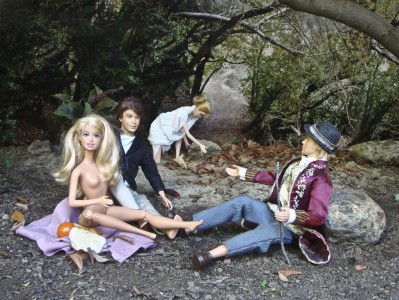
Diane Cassidy After Manet's dejeuner sur L'herbe

Bay Area photographer and artist Diane Cassidy celebrates her 82nd birthday this month with the showing of a new series of photographs at the annual San Francisco Altered Barbie show, and the launch of her first website. Cassidy studied photography at San Jose State University in the late 1980’s, and continues to take classes with respected photographers through various peninsula venues. A monograph of Cassidy’s work is scheduled for publication by Hunger Button Books in 2013.

Whirligig: How did you come to be an artist?

Diane: For me, becoming an artist was an indulgence. Throughout my formative years I was equally interested in making art and natural science. An unfortunate marriage ending in divorce left me, at a very early age, completely responsible for myself and my two children.

My first plan in preparing myself for a well-paying job was to get a degree in Art Education. Being young and impatient, I just couldn’t tolerate the necessary Mickey Mouse curricula; those how to educate courses were so so boring. I had trouble staying awake. One day while conversing with fellow classmates I learned that with a degree in a related science I could qualify for an internship in Medical Technology. I made the switch. How I relished those difficult chemistry and physics classes. A welcome relief.

During my 20 year stint as a Medical Technologist I was always taking art classes and workshops. Art was my hobby. Then one day in the 70’s while on vacation I stopped at the Script’s Institute. I noticed some images of shore life displayed on their walls that I really liked. Upon asking I learned that they were hi-contrast photographs. Thus began my foray into photography.

One day I attended a photo workshop in portraiture with Margo Davis at the Palo Alto Cultural Center. While she went over her bio she mentioned that though she had a BA in French from San Jose State, she returned to get a MA in photography. I had gotten a BA in Biology from San Jose State years ago; maybe I could return to get a MA in photography. Which I did. I retired as early as I could from Valley Medical Center and concentrated on photography in earnest.

Read more

Jody Alexander

Jody Alexander The Artist in Her Studio

Santa Cruz based artist Jody Alexander is known for creating complex characters whose narratives are revealed through an array of artifacts which almost always include handmade books and are often exhibited as interactive art installations.

Her work celebrates collecting, storytelling, and odd characters.

Alexander has just completed two solo exhibitions: Jody Alexander: Sedimentals at Mohr Gallery in Mountain View, California; and The Odd Volumes of Ruby B.: An Installation at Saffron and Genevieve in Santa Cruz, California.

In the first half of 2011 Alexander’s work was included in: The Art of the Book at Donna Seager Gallery in San Rafael, California; The Book: A Contemporary View at Delaware Center for the Contemporary Arts; Reconstructions at Conrad Wilde Gallery in Tucson, Arizona; Encaustic with a Textile Sensibility at Kimball Art Center in Park City, Utah; and Masters: Book Art published by Lark Books.

Alexander has a BA in Art History from UCLA and a MS in Library Science from Simmons College in Boston.

Whirligig: How did you come to be interested in the book as an art object?

Jody: While working on my Master’s degree in Library Science in Boston, Massachusetts. One of my professors took our class to Harvard’s Houghton Library. He began by showing us medieval manuscripts: Book of Hours, Gutenburg Bible, Nuremburg Chronicles amongst others. Obviously, this was very exciting to examine these treasures up close, but then he started taking out artists’ books. I don’t think I had ever seen an artists’ book before, and if I had, I wasn’t really aware of them as a genre of art. I think that I couldn’t breathe for a little while. I had one of those moments when everything suddenly made sense and it was clear that this is what I wanted to do. I proceeded to do every remaining project in Library School on artists’ books: their history, collecting them, storage and preservation of artists’ books, etc. As soon as I graduated I started to make them.

Whirligig: Tell us about the first book you made.

Jody: When I was about eight or nine I know I made some small books. I used to draw a hillbilly family and type out their story on my green portable Sears typewriter. These eventually became little books. I’m not sure how I bound them. They were just little pamphlet books. They no longer exist.

Jody Alexander Eleven Exposed Spines

Read more

Julia Bradshaw

Photographer and video performance artist Julia Bradshaw is exhibiting seven different series of work in her first one person show at Fresno City College this month. Her work often comments on language and the mixed messages of cross-cultural exchanges.

Bradshaw was born in Manchester, England. She spent nine years working and living in Munich, Germany where she studied with Michael Jochum before coming to California in 1995. She received her MFA from San José State University in 2007. Bradshaw is Assistant Professor of Photography at California State University, Fresno.

Whirligig: At Fresno City College you are exhibiting seven different series of photo-based works: Cut Pieces (2010), Case X (2010), Nocturnal (2010), On Photographing Breasts (2009), Tissue Blowing Project (2007), Constraints (2003), and Companions of my Imagination (1994). What is the thread between these bodies of work?

Julia: I am interested in the photographic series as a means to problem solve or comment on everyday life. Apart from the Nocturnal series, all of these projects have something to do with our culture and society. Cut Pieces, On Photographing Breasts and Case X are all linked in that they have to do with my investigations into libraries and books. They consider book content, the public’s misuse of books and a library’s policy on “protecting” books. The Constraints Series has to do with the various societal dictums that potentially have something inherently good and bad associated with them. For example, I have an image and text combination I call “polite conversation.” In this image I am trying to say that “polite conversation” is positive in that it ensures a civil society, however it also has a negative aspect in that polite conversation also can prevent people engaging at a deeper level. Likewise in the Tissue Blowing Project I am also thinking about language. In this project I visually represent miscommunication, disputes, failed advances, diametric viewpoints and avoidance and absence in relationships.

Read more

Pod Post

Pod Post, the mail art duo comprised of artists Carolee Gilligan Wheeler and Jennie Hinchcliff, has become an icon at Bay Area print, book, and zine fairs. Their presence is memorable in part due to their complete-with-merit-badge uniforms, their much sought after collectible mail art ephemera, and their passion and advocacy for all things postal.

In late 2009 their book, Good Mail Day: A Primer for Making Eye-Popping Postal Art, was published. It quickly sold out and has gone into multiple printings. Good Mail Day—a resource rich in visual, historical, conceptual, practical and hands-on information—was created by two inquisitively whimsical pods who know how to correspond.

Whirligig: What is Pod Post?

Carolee: Pod Post—the name—started out as a brainstorm when Jennie and I were on the airplane to Tokyo in 2005. We like alliteration, and we had been playing around with the concept of a pod as a carrier of potential. After that, we discovered that one of the early national mail delivery services was called Post Office Department.

Pod Post originated as an umbrella for our postal and correspondence obsession, and we started making things under that name, rather than our individual “press” names (Jennie’s was Bubble and Squeek at the time, and mine was superdilettante), to denote that it was a partnership separate from our individual work.

Jennie: Carolee summed up the idea of Pod Post nicely—the entity came about organically, based on our mutual love of all things postal and correspondence related. Once we started appearing together at book fairs and expos as “the Pods,” we quickly realized that there were plenty of other folks out there who were just like us: people who agonized over the perfect fountain pen, searched eBay for exotic airmail envelopes, and knew their postal carrier by first name.

Read more