A Conversation with Ever Rodriguez / La Feroz Press
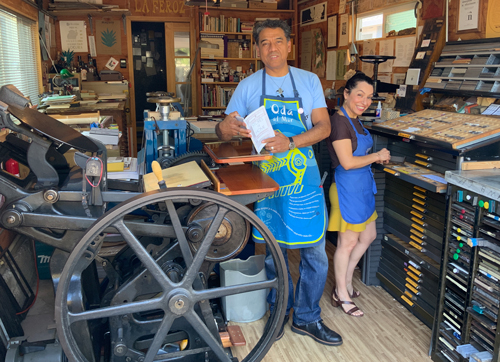
Ever Rodriguez was born and raised in Mexico and has lived in California since the early 1990s. He writes prose and poetry on themes related to his experience, including immigration, biculturalism, music, language and nature. Ever is a pragmatic writer for whom the common becomes the special as a way to contrast the abject against the normal. His education includes a B.A. in Spanish Literature and a M.A. in Library & Information Science from San José State University. He has worked for the Stanford University Libraries for the past 25 years. Ever’s letterpress studio, La Feroz Press, focuses on handmade editions with original texts and translations. His work often has the intention of amplifying the voices and concerns of his marginalized community.
Although we live a short bike ride apart, we conducted this interview via email while sheltering-in-place during the COVID-19 pandemic.
Nanette: What is the history of La Feroz Press?
Ever: La Feroz Press officially started with this name in January of 2019. We had been working under the name of Taller de Tinta y Texto since 2015, which was the time when our printing press project really took shape. It is wise to say here that when one has the intuition or the wish to do something, one has to follow up with at least one decisive action that would move further towards that direction to really get started.
For me, the decisive action that put me on the printing track was taking a letterpress class. This allowed me not only to learn the basics of letterpress printing, but it also laid out the challenges I would need to overcome in terms of space and equipment, and it put me in touch with the printer and bookmaking culture and communities that would inspire me to fully embrace this activity.
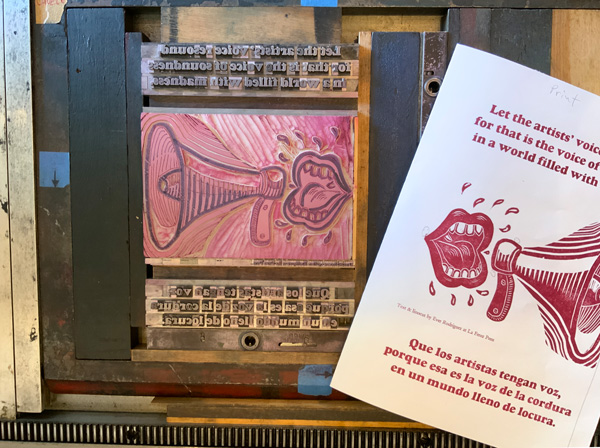
Out of such initial inspiration I was able to create a space for myself at home where I could potentially house a printing press and other essential equipment. For years our one-car garage was filled with unused furniture, souvenirs and unwanted items, so one day I just decided to get rid of all of it and remodel the space to make room for a printing studio.
Once I had the space, I started itching to find me a press. At first, I was looking for a hand press, but those are as rare as they are expensive, and I even started looking at the possibilities of making my own wooden hand press. I figured that if Gutenberg’s contemporaries were able to build those presses without the tools we have today, I should be able to build one press half as good. I found and bought a book entitled The Common Press, by Harris and Sisson, which has drawing plans and notes about the construction of the Franklin hand press, owned by the Smithsonian Institution. But I deviated from that adventure for a different alternative.
In January of 2015, I found a small press for sale online. The press was not ideal, and it was certainly nowhere near the Franklin hand press, but it was an inexpensive alternative that would get me started. So I bought it and the next day I drove to Los Angeles to pick up a midsize (14 x 24) Morgan Line-O-Scribe proofing press. This was the very first piece of equipment that I owned, and it came with a little bit of awful metal and wood type, but that satisfied the itching.
I experimented with that proofing press for about one year, and then Matt Kelsey—printer and owner of Camino Press, in Saratoga, California—told me about a Chandler & Price (C&P) 10×15 platen press that somebody was selling in Gilroy. I decided to buy that press, and a few printer friends helped me pick it up, bring it to my garage and install it. Mark Knudsen and Kim Hamilton made beautiful wooden feed boards and a treadle for it, and other printer friends gave me some tools and made me feel welcome to letterpress printing.
The acquisition of this C&P press gave me added impetus to get more serious about letterpress. I acquired both new and used metal type and other essential tools and items through friends and referrals, and then I started to get more adventurous with printing and designing other things beyond postcards. All along, my wife—who I call Gaby—had been supportive about my new adventure, and I think that when she saw me purchasing that big, old C&P press and hauling it into our garage, she realized that my temporary craziness had turned into long-term seriousness. I think she was happy but surprised and concerned all at once. Once Gaby realized that these old devices and tools were here to stay, and she saw how excited I was about them, she got excited as well and started making lemonade with my lemons.
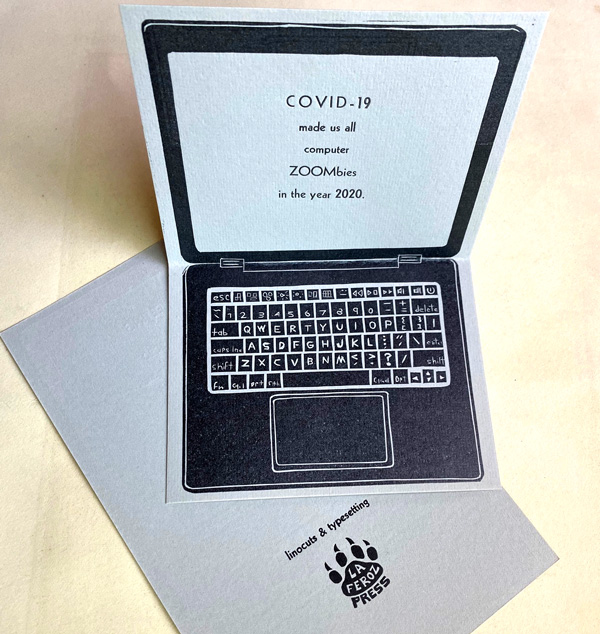
A couple of years passed, and in 2017 our friends Linda Stinchfield and Kim Hamilton gave us a beautiful Griffin etching press, thus helping me to expand my horizons to allow for more and better relief printing, which now includes linocuts and occasional woodcuts. Finally in June of 2019, I was lucky to bid on and win a Vandercook SP15 press at a local auction and that is now part of La Feroz Press.
By then I had taken several letterpress printing classes and I even earned core letterpress diplomas from the San Francisco Center for the Book on both the platen and the cylinder press. So far that is the story of La Feroz Press, which is still in the making.