
Sinjin Jones, transmedia artist

A Conversation with Sinjin Jones, transmedia artist

Sinjin Jones is a transmedia artist, storyteller, and poet interested in the connections between diverse media forms which allow him to combine these in interesting ways. In 2019, shortly before the reality of a global pandemic, Jones became the Executive Artistic Director of The Pear Theatre in Mountain View, California.  
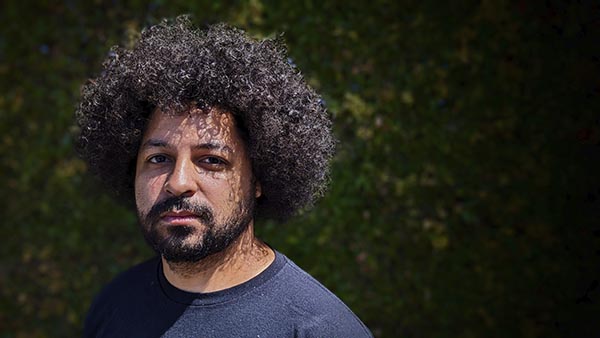
Sinjin Jones in 2024. Photo courtesy of The Pear Theatre.

Jones has a long history of engaging in live performance. From his student days until he moved to the Bay Area, Jones spent his summers working for A Theatre Group in Silverton, Colorado where he wrote, directed, and eventually became their Artistic Director and Vice President of their Board of Directors. He has founded a non-profit, multimedia artists’ collective called Otherworld Collective; and co-founded Perplexity Pictures, a film production company. He has a background in teaching performance arts at all levels, and is currently teaching for The Pear’s outreach programs. Jones has a Bachelor of Arts in Theatre, Film, and Video Production from the University of Colorado, Denver; and an MFA in Creative Writing from Regis University.

At The Pear, Jones is developing dynamic, engaging, and fresh programming that both surprises and challenges.
His leadership consistently demonstrates his rich intellect and deep investment in local communities. We spoke over tea at an outdoor cafe on a lovely spring afternoon.

Nanette: How did you come to theatre?

Sinjin: When I was a kid I would tell stories to myself. We were very poor and didn’t have access to theatre. We would go to the dollar store and I would get to pick out one thing. I would pick out a [cassette] tape because my mom had a radio that also had a tape recorder. I would go into my room at night and tell stories to myself, improvised stories. That turned into getting together with the neighbor kids to tell stories. I would write stories and we would perform them. This was second and third grade, and I didn’t really know what theatre was, only to some small extent. Then my elementary school turned into a school of the arts and I got to take some theatre classes. I think that’s the beginning. I consider myself to be a storytelling artist, but that live act of performing in front of people or seeing story come to life in person has always interested me. That’s really the start of it all.

More formally, I did theatre in high school. I was deciding between archaeology and theatre/film for college. The University of Denver had a program where you could do theatre and film at the same time, so I was sold. The idea of storytelling is really beautiful to me. I’ve practiced a lot of different forms of art, many are less collaborative than theatre is. I like the coalescence of different artists from different backgrounds and different skill sets coming together to create one unified portrait of something.

Nanette: Did you grow up in Colorado?

Sinjin: I did.

Nanette: Denver has a really good art scene.

Sinjin: They do. I am very lucky. Downtown Denver has a ton of public art. In college, one of the assignments for one of my theatre classes was, “Here’s a map of downtown Denver. Go see as many of the public art pieces as you possibly can.” That is very lucky. It’s nice to have a lot of public art to experience and just be around.

Nanette: You demonstrate an immense amount of theatrical knowledge, and it is apparent by your presentations that developing a contemporary and engaging season requires broad and deep research. What is your process from seed to completed season?
Read more

Judith Selby Lang, artist

Judith Selby Lang

Judith Selby Lang’s website states that she “is an artist committed to the creation of positive symbols and life-affirming images to help energize the conversation about social, political and environmental issues.” This is a perfect description of the uplifting and transformative nature of her multi-dimensional art practice as well as a reflection of her demeanor and personality—creative, positive, life-affirming, energetic, and openly communicative about critical concerns that affect us all.

Lang’s work includes artist’s books, mixed media objects, and a wide range of projects using plastic debris collected from 1000 yards of one beach on the Northern California coast. Lang has an extensive exhibition history. She currently has a large scale beach plastic installation in The Secret Life of Earth: Alive! Awake! (And possibly really Angry!) at the American Visionary Art Museum in Baltimore, Maryland; and will be showing in The Great Wave: Contemporary Art about the Ocean at the Bedford Gallery in Walnut Creek, California in early 2020. Her current project is creating a wedding dress made from recovered plastic bags for exhibition in Castaways: Art from the Material World at The Bateman Foundation in Victoria, British Columbia, which opens in Spring of 2020.

Lang has a BA from Pitzer College and an MA in Interdisciplinary Studies in Creative Arts from San Francisco State University. She spent many years teaching art in a variety of North Bay (California) venues before turning her focus to the studio full time. With a barn full of beach plastic—washed, sorted and boxed—collected over the years, Lang has an immense body of work, both independent and collaborative, which reflects our times while engaging viewers from all walks of life in conversations regarding possibilities for improving our environment.

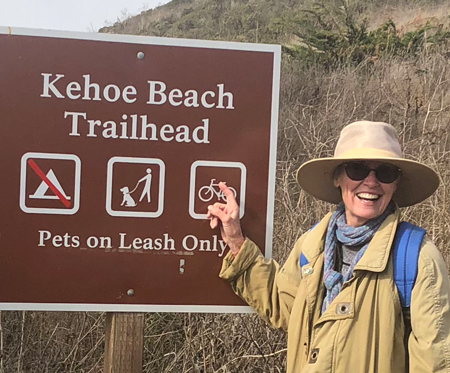
We visited on a bright fall afternoon in her rural Forest Knolls studio, just a short drive to Kehoe Beach.

Nanette: How did you come to art?

Judith: Defining myself as an artist was a long time in coming. I thought I would never have the patience to be an artist. People have this preconception that art is a wild and spontaneous activity but don’t know that after the flash of inspiration sometimes a long and tedious effort is required to realize the vision.

I grew up in a family that was art friendly. My dad and mom both painted. We went regularly to the art museum. In 1962 my parents took me to the Dallas Museum of Art where I saw Andrew Wyeth’s painting That Gentleman.

The painting drew many to the museum—there were long lines with stanchions and velvet ropes to control the crowds. Was it because curious onlookers wanted a glimpse of a painting of a black man? Mind you it was a simple scene of a black man seated, in dusky light, in a moment of repose. It’s of Wyeth’s neighbor Tom Clark. To me it seemed a radical move for the museum to exhibit a painting of a black man especially at a time when segregation still existed in the South. I remember water fountains with signs for whites only, for blacks only. This was 1962, years before the Voting Rights Act of 1965 and the Civil Rights Act of 1968. Perhaps it was the shock to the public that the museum had purchased the painting or maybe, it was, as I would like to think, that there was tremendous interest in seeing a masterwork by a great American artist. Either way there were people, lots of people waiting for their turn to view the painting.

The line moved slowly in a kind of reverential prayer and when it was my turn I stepped up in front of the painting to gaze with wonder not only at the power of the image but also the incredible finesse of the brush work. Something in my young heart was deeply moved. At that moment I made a commitment to art. I made my pledge to become an artist. That an image could have such an incredible impact on me and the people who had come to the museum was something that I too wanted to accomplish. On that day, at age twelve, I knew that I wanted to do something that would make a difference—to make art that would shine a light on injustice in the world.

Read more