
Sinjin Jones, transmedia artist

A Conversation with Sinjin Jones, transmedia artist

Sinjin Jones is a transmedia artist, storyteller, and poet interested in the connections between diverse media forms which allow him to combine these in interesting ways. In 2019, shortly before the reality of a global pandemic, Jones became the Executive Artistic Director of The Pear Theatre in Mountain View, California.  
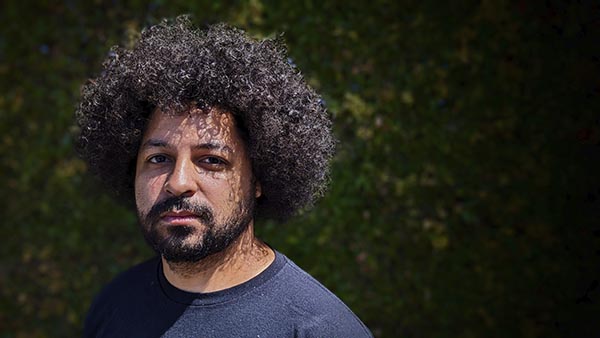
Sinjin Jones in 2024. Photo courtesy of The Pear Theatre.

Jones has a long history of engaging in live performance. From his student days until he moved to the Bay Area, Jones spent his summers working for A Theatre Group in Silverton, Colorado where he wrote, directed, and eventually became their Artistic Director and Vice President of their Board of Directors. He has founded a non-profit, multimedia artists’ collective called Otherworld Collective; and co-founded Perplexity Pictures, a film production company. He has a background in teaching performance arts at all levels, and is currently teaching for The Pear’s outreach programs. Jones has a Bachelor of Arts in Theatre, Film, and Video Production from the University of Colorado, Denver; and an MFA in Creative Writing from Regis University.

At The Pear, Jones is developing dynamic, engaging, and fresh programming that both surprises and challenges.
His leadership consistently demonstrates his rich intellect and deep investment in local communities. We spoke over tea at an outdoor cafe on a lovely spring afternoon.

Nanette: How did you come to theatre?

Sinjin: When I was a kid I would tell stories to myself. We were very poor and didn’t have access to theatre. We would go to the dollar store and I would get to pick out one thing. I would pick out a [cassette] tape because my mom had a radio that also had a tape recorder. I would go into my room at night and tell stories to myself, improvised stories. That turned into getting together with the neighbor kids to tell stories. I would write stories and we would perform them. This was second and third grade, and I didn’t really know what theatre was, only to some small extent. Then my elementary school turned into a school of the arts and I got to take some theatre classes. I think that’s the beginning. I consider myself to be a storytelling artist, but that live act of performing in front of people or seeing story come to life in person has always interested me. That’s really the start of it all.

More formally, I did theatre in high school. I was deciding between archaeology and theatre/film for college. The University of Denver had a program where you could do theatre and film at the same time, so I was sold. The idea of storytelling is really beautiful to me. I’ve practiced a lot of different forms of art, many are less collaborative than theatre is. I like the coalescence of different artists from different backgrounds and different skill sets coming together to create one unified portrait of something.

Nanette: Did you grow up in Colorado?

Sinjin: I did.

Nanette: Denver has a really good art scene.

Sinjin: They do. I am very lucky. Downtown Denver has a ton of public art. In college, one of the assignments for one of my theatre classes was, “Here’s a map of downtown Denver. Go see as many of the public art pieces as you possibly can.” That is very lucky. It’s nice to have a lot of public art to experience and just be around.

Nanette: You demonstrate an immense amount of theatrical knowledge, and it is apparent by your presentations that developing a contemporary and engaging season requires broad and deep research. What is your process from seed to completed season?
Read more

Sharmon Hilfinger, playwright

A Conversation between Bay Area playwright Sharmon Hilfinger and Katherine Bazak

As I sit across the table talking with Sharmon Hilfinger, I see the embodiment of two different women who are elegant, gracious, and intelligent. One is a wife, a mother, a musician; the other is an artist/writer committed to portraying her view of life and the world around her. As a playwright, she has chosen the theater to tell her truths under the guise of entertainment.

Theater is a tough art form to navigate. One must try to get their play off the page and onto the stage. It is impressive to meet someone with Sharmon’s track record. Her produced plays include three dramas and nine ensemble plays with music in collaboration with composer Joan McMillen. These have been produced by San Francisco Bay Area theatre companies, including The Pear Theatre, TheatreFIRST, Inferno Theatre, Menlo Player’s Guild, BootStrap Theater Foundation, as well as Heartland Theatre Company in Illinois. In 1998, she founded BootStrap Theater Foundation which develops and produces original plays by Bay Area playwrights.  

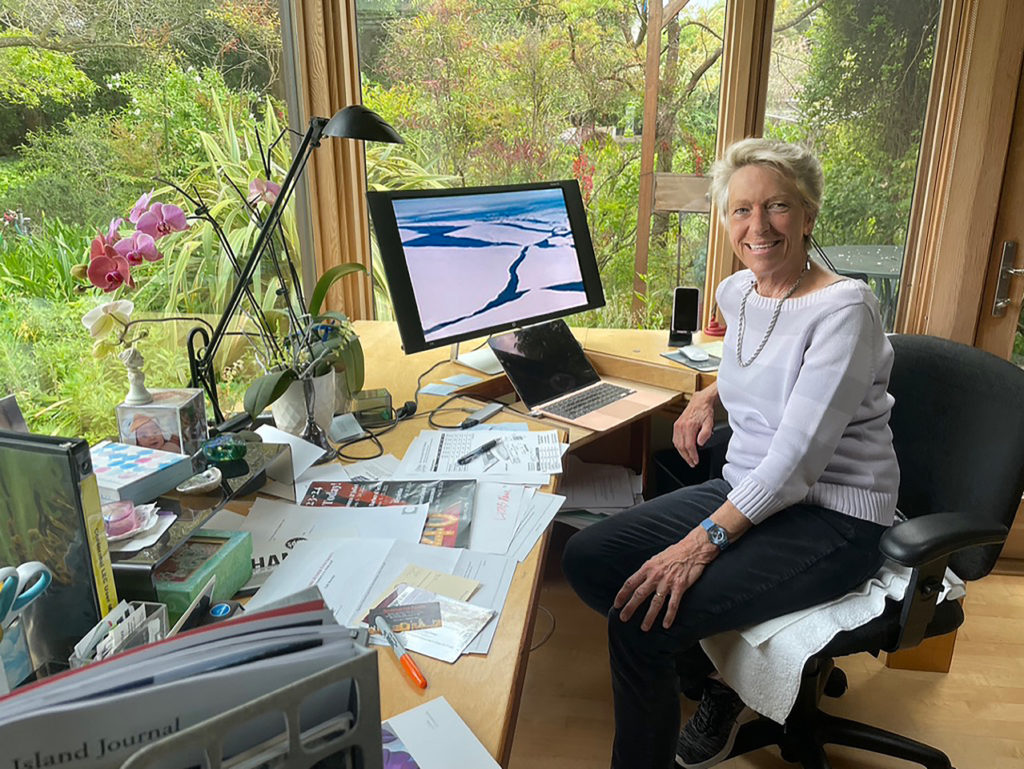
Sharmon Hilfinger in her office. Photo: Katherine Bazak

Katherine: Let’s start at the beginning. I know that I saw An Ideal Mother some time in the early 90s. Was that your first play?

Sharmon: Well it was’t the first play I’d written, but it was the first play of mine that was produced. I read somewhere that The Menlo Players, at Burgess Park Theater in Menlo Park, was asking for scripts, so I sent it in. The director, Dean Burgee, called me immediately and it was produced in 1992. Beginner’s luck!

Katherine: Had you written anything before 1992? 

Sharmon: I had been writing for a long time. I’m not quite sure how to say this—writing was my consolation prize for failure. I was an actor and I was admitted to the Conservatory program at Carnegie Mellon. It was, and still is, a University degree structured as a conservatory program, very unusual at that time. It was heaven! Theater classes all day, crewing shows at night—24/7 theater. It wasn’t easy to get in, and it wasn’t easy to stay in. They had a policy of accepting a certain number of students and cutting 10% of the class after the first year. It was very rigorous and class attendance was mandatory. I was there in 1970 when the Kent State Vietnam War protest killings happened. I cut classes to march on Washington D.C., which did not help my standing in the department. I’m sure there were other reasons (I was not given any kind of performance review) for why I was cut from the program. 

That was traumatic! I was devastated. I came home and finished up my BFA in Drama at Illinois Wesleyan University in Bloomington, Illinois (my hometown). IWU is one of those gems of a good liberal arts college and had a very strong drama department. I grew up getting my theater education there because I went to all the plays they put on—the Head of the Drama Department was surprisingly avant-garde. I finished my BFA in drama, but I had it in my head that I couldn’t expect to pursue a professional career in acting, I was a failure, this profession was not for me. So I gave up theater! My creativity had to go somewhere, and I started writing instead. I wrote a novel, and a number of short stories over the following years. Whatever my day job was, I would get up at six in the morning and write before I went to work. First thing in the morning is still the best time for me to write. 

Read more